Key takeaways
- Four house paint sprayers compared for exterior walls, interior rooms, ceilings and trim: airless power, tip sizes, hose reach, cleanup and thinning.
Painting a house is not one job but several: broad exterior walls that reward speed, ceilings and large rooms that reward reach, and trim, doors and fences that reward control. The sprayer that covers a two-storey exterior in a day will drown a door frame in material, while the fine-finish gun that makes trim look sprayed will take a week to cover siding. Choosing well means matching the machine to the surfaces you actually have, not buying the most powerful tool on the shelf.

This guide is for homeowners repainting a whole house or several rooms, landlords turning over rentals, and first-time buyers who want one sprayer that covers walls, ceilings and trim. Every sprayer below was chosen from the name and specifications on its Amazon product page, with tip sizes, hose reach, tank size and cleanup features checked against the listing.
Quick Picks
As an Amazon Associate we earn from qualifying purchases
| Product | Best for | Key spec from title |
|---|---|---|
| Graco Magnum X5 | Whole-house exteriors and large rooms | Airless, 3,000 PSI, RAC IV 515 tip, 25-foot hose |
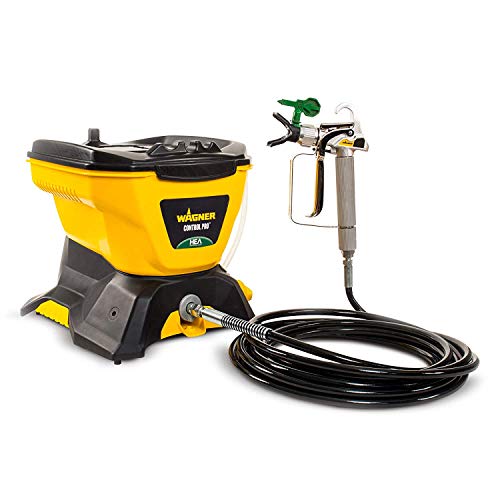
| Wagner Control Pro 130 | First airless sprayer for rooms and siding | HEA airless, 1,600 PSI, 1.5-gallon hopper, 25-foot hose |
| Wagner FLEXiO 5000 | Interior walls, ceilings and cabinets | Stationary HVLP, X-Boost turbine, iSpray and Detail Finish nozzles |
| HomeRight Super Finish Max | Trim, doors, fences and small latex jobs | Handheld HVLP, 450 watts, 3 brass tips, 40-ounce cup |
How to Choose
Airless or HVLP: match the machine to the surface
Airless sprayers use a high-pressure pump to push paint through a small tip, so they lay down unthinned latex fast over walls, ceilings and siding. HVLP sprayers use a turbine and a large volume of air at low pressure, so they lay down a finer coat with far less bounce-back, which suits trim, doors and cabinets. A whole house exterior is an airless job, full stop: a handheld HVLP would take days and hold too little paint. Inside, the split is closer, since HVLP gives a cleaner edge around finished woodwork while airless covers big wall areas faster.
Flow, tip size and pressure decide coverage
The tip orifice controls how much paint leaves the gun, and the listing names it plainly. A 0.015 tip suits most latex wall paint, a 0.011 or 0.013 tip suits stains and sealers, and a 0.017 or 0.019 tip suits primers and heavier coatings. Adjustable pressure matters because thin stain and heavy primer need different output from the same pump, and a fixed-pressure gun forces the buyer to thin everything or live with a rough coat. Check the listing for the included tip size before buying, since a sprayer that ships with a stain tip will struggle on a latex exterior.
Hose reach, tank size and weight decide how you work
A 25-foot hose reaches across most rooms and lets the unit stay on the ground while the buyer works from a ladder, and longer hose support matters on two-storey exteriors where peaks and gables sit far from the pump. A 1.5-gallon hopper means refills every room or two, while a sprayer that draws straight from a 1 or 5 gallon bucket keeps going until the bucket runs dry. Weight matters too: a cart-mounted unit rolls with its paint load, a stationary turbine keeps motor weight on the floor, and a handheld gun puts every ounce in the buyer’s hand for the whole session.
Cleanup and thinning decide whether you use it twice
Every sprayer needs a full clean after use, and the time varies more than buyers expect. An airless unit with a pump and a long hose takes 15 to 30 minutes to flush properly, though a garden-hose adapter speeds the job, while a handheld HVLP gun with a removable cup takes 5 to 10 minutes. Thinning is the other hidden chore: airless sprayers usually take unthinned latex, while many HVLP guns need latex thinned before it atomises well. Budget models cut corners here, with short hoses, small cups, no pressure control and fiddly cleaning, so read the listing for those details.
The 4 Best Options
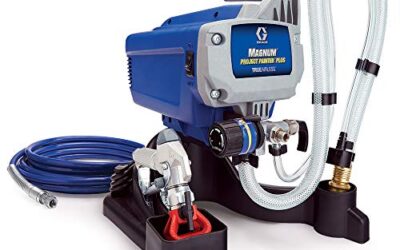
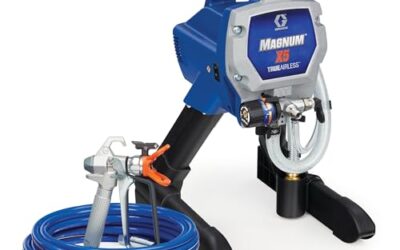
Graco Magnum X5
The X5 is the all-rounder of this group: an airless sprayer with enough pressure and flow to cover a whole house exterior, yet still manageable inside for large rooms and ceilings. Its stainless steel piston pump handles unthinned latex and primers without bogging down, and adjustable pressure lets the buyer dial output down for a thin stain or up for a heavy primer. It draws paint straight from a 1 or 5 gallon bucket, so there is no small hopper to refill mid-wall, and the included RAC IV 515 SwitchTip reverses to clear a clog without taking the gun apart.
Specs
- Airless sprayer with stainless steel piston pump
- 3,000 PSI maximum pressure with adjustable pressure control
- RAC IV 515 SwitchTip, reversible to clear clogs
- Sprays directly from 1 or 5 gallon buckets
- 25-foot hose, extendable to 75 feet
- PowerFlush adapter connects to a garden hose for cleanup
- SG2 metal spray gun
- 120V corded, 17 lbs
Best for: A homeowner repainting a whole house exterior or several large rooms who wants one airless sprayer to do it all.
Watch out for: The 25-foot hose can feel short on a large exterior, so check whether an extension is needed for peaks and gables; masking is essential, since airless spraying throws the most overspray of any type here.
Wagner Control Pro 130
The Control Pro 130 is the easiest way into airless spraying: a compact High Efficiency Airless unit that cuts overspray by up to 55 percent against traditional airless sprayers, which matters indoors where masking every surface is the hidden cost of the job. Its built-in 1.5-gallon gravity-fed hopper removes the suction tube and bucket setup entirely, so the buyer fills it, plugs it in and sprays. At 10 pounds it is far more portable than the Graco units, and the 25-foot hose still reaches from the floor to a ladder without hauling the unit up.
Specs
- High Efficiency Airless (HEA) sprayer with low overspray
- 1,600 PSI maximum pressure
- 1.5-gallon gravity-fed hopper
- 25-foot airless spray hose
- 515 HEA spray tip for latex paints
- Sprays unthinned latex paints and stains, interior and exterior
- 120V corded, 9.5 lbs
Best for: A first-time buyer spraying bedrooms, a deck or a fence who wants airless speed without a large cart-mounted unit.
Watch out for: The lower pressure can struggle with heavier primers or thick elastomeric coatings, and the 1.5-gallon hopper means more refills on a large job; it is not the pick for a whole-house exterior.
Wagner FLEXiO 5000

The FLEXiO 5000 is the stationary HVLP pick for interior house work: the turbine sits in a case on the ground while the buyer holds only the lightweight gun and cup, which cuts arm fatigue on longer sessions. Its X-Boost turbine sprays most unthinned latex paints and stains straight from the can, a real advantage over cheaper HVLP units that demand thinning first. Two nozzles cover broad surfaces with the iSpray nozzle and detail work with the Detail Finish nozzle, and swapping between them takes seconds rather than a rebuild.
Specs
- Stationary HVLP sprayer with X-Boost turbine
- iSpray nozzle for broad surfaces and Detail Finish nozzle for detail work
- 1.5-quart cup, about 120 square feet per fill
- 11.5-foot hose
- Sprays most unthinned latex paints and stains
- 120V corded, 15.1 lbs for the system
Best for: A buyer repainting interior walls, ceilings, doors and cabinets who wants a finer finish with less overspray than airless.
Watch out for: The 11.5-foot hose is shorter than the airless units here, so the turbine case needs moving between rooms, and the cup still needs frequent refills on larger rooms.
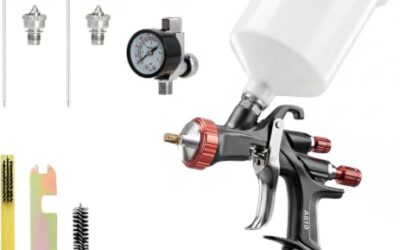
HomeRight Super Finish Max

The Super Finish Max is the handheld HVLP for the detail half of a house job: trim, doors, shutters, fences and small latex projects where a big airless unit would waste paint. Three brass spray tips in 1.5, 2.0 and 4.0 millimetre sizes cover thin stains through thicker latex, and three spray patterns in horizontal, vertical and round shapes fit narrow trim and broad fence boards alike. At about 3.3 pounds it is the lightest sprayer here, and the 40-ounce cup handles most small projects without a refill.
Specs
- Handheld HVLP paint sprayer with 450-watt turbine
- 3 brass spray tips: 1.5 mm, 2.0 mm and 4.0 mm
- 3 spray patterns: horizontal, vertical and round
- 40-ounce container with lid
- Sprays chalk paint, milk paint, latex paints, enamels, primers, sealers, polyurethane, stain and varnish
- 2-year warranty
- 120V corded, 3.3 lbs
Best for: A buyer finishing trim, doors and fences, or touching up small latex jobs around the house, who wants a light gun that is quick to clean.
Watch out for: Thicker latex usually needs thinning for the best result, and heavier coatings can show more texture than from a larger turbine system; it is far too slow for a whole exterior.
Which One Fits Your Situation
Repainting a whole house exterior
Pick the Graco Magnum X5. Its 3,000 PSI pump and 0.015 tip move unthinned latex fast across siding, and drawing from a 5 gallon bucket means long runs without refills. The 25-foot hose reaches most walls from the ground, with extensions available for peaks. Budget a full day for masking, since airless overspray is the real cost of exterior speed.
Repainting several rooms inside
Pick the Wagner FLEXiO 5000. Its stationary turbine keeps the weight off the buyer’s arm through whole rooms, and the HVLP pattern lays down less overspray on floors and finished woodwork than airless. The iSpray nozzle covers walls and ceilings, while the Detail Finish nozzle handles doors and trim without swapping machines mid-room.
Trim, doors and fences only
Pick the HomeRight Super Finish Max. Its three brass tips and three patterns fit narrow trim, louvred doors and broad fence boards, and its light weight suits overhead work on door frames. The 40-ounce cup is plenty for detail runs, and cleanup takes minutes, so it earns its keep on small jobs that would not justify setting up an airless unit.
First sprayer for occasional house jobs
Pick the Wagner Control Pro 130. It brings airless speed to bedrooms, decks and siding without the size and weight of a cart unit, and the HEA design keeps overspray down while the buyer learns technique. The 1.5-gallon hopper is easy to fill and clean, and the 25-foot hose covers a room from one spot on the floor.
Common Mistakes
- Buying a handheld HVLP to paint a whole house exterior: it is too slow, holds too little paint and lacks the pressure for large surfaces, so the job drags on for days.
- Skipping masking because the sprayer looks precise: airless spraying throws overspray well beyond the target, and paint on windows, floors and trim costs more time than masking ever would.
- Using the wrong tip size for the coating: a stain tip starves latex walls, while a primer tip floods trim, so check the listing for the included tip before ordering.
- Skipping cleanup after the last coat: dried paint in the pump, hose or gun ruins a sprayer, and airless units need a full flush every single time.
- Spraying heavy latex unthinned through a small HVLP gun: it spits, leaves texture and clogs, so thin to the listing’s guidance or pick an airless unit instead.
Frequently Asked Questions
Do I need to thin paint before using a sprayer?
Airless sprayers such as the Graco X5 and the Wagner Control Pro 130 usually spray unthinned latex, which is one reason they suit house walls. HVLP sprayers are stricter: the FLEXiO 5000 handles most unthinned latex, while the Super Finish Max often needs thicker latex thinned first. Always test on cardboard before spraying a wall.
Can one sprayer do interior and exterior house painting?
Yes, with the right type. An airless sprayer covers both, since it handles unthinned latex on siding and on large interior walls. An HVLP sprayer also crosses over, but only for interior rooms, trim and cabinets, not for a full exterior. For a buyer who wants a single machine, airless is the safer choice.
What tip size should I use for house walls?
A 0.015 tip works for most latex wall paint, inside and outside. Drop to a 0.011 or 0.013 tip for stains and sealers on fences and decks, and go up to a 0.017 or 0.019 tip for primers and heavier coatings. The Graco RAC IV tip reverses to clear clogs, so keep a spare tip size on hand.
How long does cleanup take after spraying a house?
Between 5 and 30 minutes, depending on the type. A handheld HVLP gun with a removable cup takes 5 to 10 minutes, a stationary HVLP takes 10 to 15, and an airless unit with a pump and a long hose takes 15 to 30. The Graco PowerFlush adapter connects to a garden hose to speed the flush, but never skip it.