Our Short List of 3
- Best for: Mixed plantings where you change pressure often between delicate foliage and taller rows.
- Listed capacity: 4 gallons
- Battery: 18V, 2.6Ah lithium-ion, included
- Runtime: up to 2.5 hours of continuous spraying
- Pressure: 5-position variable control, up to 60 PSI
- Best for: Growers who alternate between mist, fan, and stream patterns across different crops in one session.
- Listed capacity: 4 gallons
- Battery: 18V, 2.0Ah lithium-ion, included
- Charger: 110V fast charger included
- Maximum pressure: 90 PSI

- Best for: Repeat fungicide programs where seal durability and a repeatable pattern matter more than pressure range.
- Listed capacity: 4 gallons
- Battery: 18V, 2.0Ah lithium-ion, included
- Charger: 3.5-hour charger included
- Runtime: up to 4 hours, or 50 gallons per charge
All 4 Picks at a Glance
| Product | Specs | Action |
|---|---|---|
| FlowZone Cyclone 2.5 Battery Powered Backpack Sprayer |
| Check price on Amazon |
| Smith Performance Sprayers Variable Flow Powered Backpack Sprayer |
| Check price on Amazon |
| Smith Multi-Use S2E 18V Lithium-Ion Backpack Sprayer |
| Check price on Amazon |
 SideKing Battery Powered Backpack Sprayer SK4000B |
| Check price on Amazon |
Key takeaways
- Compare five premium battery backpack sprayers for fungicide work, with listed capacity, pressure ranges, nozzle sets, and seal materials from listings.
Fungicide work punishes weak sprayers. Coverage has to reach the underside of leaves and stay even across a whole block, because a patchy pass leaves unprotected foliage where disease can take hold. A basic pump sprayer loses pressure as the tank empties, so droplet size drifts and the final rows get a weaker pattern than the first. The real decision is which premium battery backpack unit holds steady pressure, carries enough solution, and uses seals and nozzles suited to fungicide mixes.
This guide serves orchard keepers, vineyard growers, greenhouse managers, and serious home growers who spray fungicide on a regular schedule. Each pick is a battery powered backpack sprayer chosen from its Amazon listing name and listed details: listed capacity, pressure range, battery size, nozzle count, wand and seal materials, and the applications the listing itself names.
Quick Picks
As an Amazon Associate we earn from qualifying purchases.
| Product | Best for | Key spec |
|---|---|---|
| Field King 190515 Professionals | Fungicide passes in hard to reach planting rows | 24-foot vertical spray height |
| FlowZone Cyclone 2.5 | Growers who change pressure between crops often | 5-position variable pressure, up to 60 PSI |
| Smith Performance Sprayers Variable Flow 190679 | Alternating fine mist and wide fan patterns | 7 nozzles, up to 90 PSI |
| Smith Multi-Use S2E 190576 | Long blocks with chemical mixes that demand tough seals | Viton seals, stainless steel wand |
| SideKing SK4000B | Makita 18V owners who want the largest tank here | Listed capacity of 4.2 gallons, up to 100 PSI |
How to Choose
Pressure Control and Droplet Size
Fungicide labels call for thorough coverage, and droplet size decides whether spray coats leaf surfaces or drifts past them. A variable pressure dial lets you run a gentle fan pattern on tender foliage, then raise output for dense canopies. The FlowZone Cyclone 2.5 offers five pressure positions up to 60 PSI, while the Smith Variable Flow reaches 90 PSI. Fixed output units, such as the Smith Multi-Use at a preset 40 PSI, trade that flexibility for a repeatable pattern. Match the pressure range to your tallest crop and your usual nozzle, not to the biggest number on the box.
Battery Endurance per Charge
A fungicide program often means spraying an entire block in one session, because stopping halfway leaves part of the planting on a different schedule. Compare the gallons per charge figure in each listing, not just the hour figure. The Field King 190515 and the Smith Multi-Use both list up to 50 gallons per charge, which covers many refill cycles of a four gallon tank. Smaller packs, such as the 2.6Ah unit in the SideKing, suit shorter rows or owners who keep spare packs ready. Check whether the battery and charger are included before you plan a full day.
Seals, Wands, and Chemical Resistance
Fungicide mixes, especially those with oil carriers or wettable powders, are hard on soft seals and plastic wands. Listings that name their seal material give you a clearer signal: the Smith Multi-Use lists Viton seals, a stainless steel wand, and a powder coated steel frame, a combination aimed at chemical resistance and long service. Brass nozzle tips resist wear from abrasive mixes better than plain plastic tips. Before buying, confirm the listing names the seal type and wand material, and plan a rinse routine after every session so residue never dries inside the pump or hose.
Listed Capacity and Carry Comfort
Every model here carries a listed capacity near four gallons, and a full tank adds serious weight on your back. Harness design decides whether that load stays manageable across a long row. The FlowZone Cyclone 2.5 uses vest style ComfortStraps with chest, waist, and hip straps to spread the load, while the Field King builds on a no-leak pump design with integrated battery storage. Compare the empty weight in each listing, from 14 pounds for the Cyclone 2.5 to 16 pounds for the Smith Variable Flow, and think about slope, row length, and how often you climb.
The 5 Best Options
Field King 190515 Professionals Battery Powered Backpack Sprayer
This is the clearest fit for growers who want a listing that speaks directly to their work: the Field King page names fungicides among the water based chemicals this sprayer handles in hard to reach areas. Its no-leak pump design, modeled on the proven 190328 layout, keeps solution off your back during long passes. The 18 volt battery delivers up to four hours of spray time and up to 50 gallons per charge, so a full block rarely waits on a charger. Integrated battery storage shields the pack from splashes while filling.
Specs
- Listed capacity: 4 gallons
- Battery: 18V, 2.1Ah lithium-ion, included
- Spray time: up to 4 hours per charge
- Volume per charge: up to 50 gallons
- Maximum pressure: 40 PSI
- Vertical spray height: 24 feet
- Design: no-leak pump with integrated battery storage
- Model number: 190515
Best for: Fungicide passes through orchard rows and tall plantings where reach and a sealed pump matter most.
Watch out for: The 40 PSI ceiling is lower than the other picks here, so confirm it suits your nozzle plan and canopy height before ordering.
ASIN: B07C814RC4 — View on Amazon
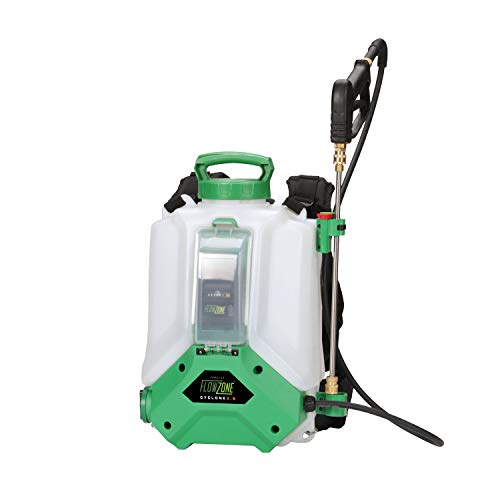
FlowZone Cyclone 2.5 Battery Powered Backpack Sprayer
- Best for: Mixed plantings where you change pressure often between delicate foliage and taller rows.
- Listed capacity: 4 gallons
- Battery: 18V, 2.6Ah lithium-ion, included
- Runtime: up to 2.5 hours of continuous spraying
- Pressure: 5-position variable control, up to 60 PSI
Mixed plantings where you change pressure often between delicate foliage and taller rows.
The 2.6Ah battery is the smaller pack in this group, so check whether one charge covers your longest block or whether a spare pack belongs in the plan.
Growers who move between crops in a single day will value the Cyclone 2.5 and its five position pressure control. Low settings lay down a soft pattern for young foliage, while the top setting pushes spray up to 25 feet for taller plantings. The quick charge lithium-ion battery runs up to two and a half hours of continuous spraying, and the vest style harness spreads a full tank across chest, waist, and hips. At 14 pounds empty, it is the lightest unit in this group, which counts on sloping ground.
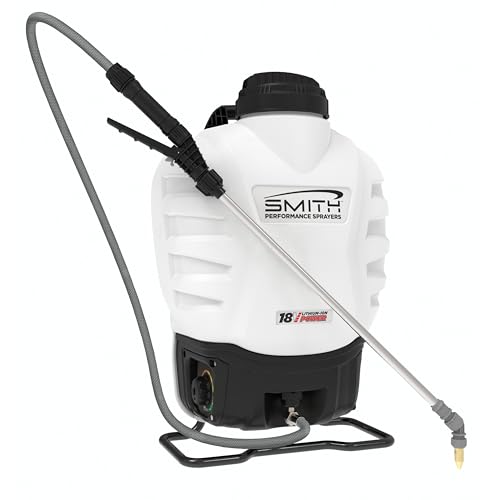
Smith Performance Sprayers Variable Flow Powered Backpack Sprayer
- Best for: Growers who alternate between mist, fan, and stream patterns across different crops in one session.
- Listed capacity: 4 gallons
- Battery: 18V, 2.0Ah lithium-ion, included
- Charger: 110V fast charger included
- Maximum pressure: 90 PSI
Growers who alternate between mist, fan, and stream patterns across different crops in one session.
At 16 pounds before solution, it is the heaviest empty unit here, so check the harness fit against your frame before a long day.
This Smith unit suits applicators who switch patterns constantly during fungicide work. Seven nozzles ride in the box, from an adjustable brass tip and jet stream to high and low volume fan tips, so you can move from a fine foliage pattern to a wide pass without hunting for parts. The variable flow system runs up to 90 PSI, the highest reach oriented figure among the backpack picks with fixed harnesses here, and the fast charger turns the 18V battery around quickly between blocks. A padded harness carries the four gallon tank.
Smith Multi-Use S2E 18V Lithium-Ion Backpack Sprayer
- Best for: Repeat fungicide programs where seal durability and a repeatable pattern matter more than pressure range.
- Listed capacity: 4 gallons
- Battery: 18V, 2.0Ah lithium-ion, included
- Charger: 3.5-hour charger included
- Runtime: up to 4 hours, or 50 gallons per charge
Repeat fungicide programs where seal durability and a repeatable pattern matter more than pressure range.
The pressure is preset rather than adjustable, so confirm the single 40 PSI setting matches the nozzles and droplet size your label calls for.
Chemical resistance leads the case for this Smith model. Viton seals, a stainless steel wand, and a powder coated steel frame are listed materials that stand up to repeated fungicide mixes better than basic plastic internals. Output is preset at 40 PSI and 0.3 GPM with the 8002 nozzle, a repeatable pattern that suits growers who value consistency over constant adjustment. The battery sprays up to four hours or 50 gallons per charge, and six nozzles cover fan, jet stream, foaming, and brass adjustable duties.
SideKing Battery Powered Backpack Sprayer SK4000B
- Best for: Makita 18V owners and growers who want the biggest tank and widest pressure range in one backpack.
- Listed capacity: 4.2 gallons
- Pressure: adjustable, up to 100 PSI maximum
- Battery: 18V, 2.6Ah, included, with charger
- Compatibility: also works with Makita 18V batteries
Makita 18V owners and growers who want the biggest tank and widest pressure range in one backpack.
Confirm which battery you will rely on day to day, because the included pack and Makita packs differ in capacity and change how long a charge lasts.
The SideKing brings the largest listed capacity in this group and the widest pressure span, adjustable from low output up to 100 PSI. That range lets a grower run a soft fan over young plants in the morning and a firmer stream along a treeline later, all from one unit. Five nozzles cover fan, cone, windproof, dual, and stream patterns, and the telescopic wand extends your reach into dense rows. The included 18V battery also works alongside Makita 18V packs, which helps growers who already run that platform.
Which One Fits Your Situation
You Spray Tall Trees and Dense Shrubs
Reach decides this choice. The Field King 190515 lists a 24-foot vertical spray height and a listing that names fungicides for hard to reach areas, while the FlowZone Cyclone 2.5 reaches over 25 feet at its top setting. Pick the Field King for sealed pump confidence on long rows, or the Cyclone when you also need lower settings for shorter plants nearby.
You Alternate Patterns All Day
Frequent nozzle and pressure changes point to the Smith Variable Flow. Its seven included nozzles and 90 PSI range move from fine fan coverage to a jet stream without a trip back to the shed. The FlowZone Cyclone 2.5 is the lighter alternative when five pressure positions cover your crops and harness comfort matters more than the extra nozzle variety.
You Run Long Blocks Between Charges
Endurance per charge separates the Field King 190515 and the Smith Multi-Use S2E, both listed at up to 50 gallons per charge. That figure covers many tank refills before the battery needs attention. Choose the Field King for its no-leak pump layout, or the Smith Multi-Use when Viton seals and a stainless wand matter more for your mixes.
You Already Own Makita 18V Batteries
The SideKing SK4000B fits an existing Makita 18V collection, because the listing names that compatibility alongside its included 18V pack. Spare packs from your other tools can rotate through a long spraying day, and the 4.2 gallon listed capacity is the largest here. Check pack capacities before a big block, since runtime follows the battery you fit.
Common Mistakes
- Mixing fungicide in a sprayer that held herbicide earlier without a full triple rinse, which can carry residue onto the crop you meant to protect.
- Running the highest pressure setting on tender foliage, which pushes droplets past the leaves, wastes solution, and leaves the underside of the canopy uncoated.
- Ignoring seal material when a mix uses an oil carrier, because the wrong seal compound swells or cracks and the pump begins to leak mid-season.
- Leaving mixed solution sitting in the tank overnight, which can settle, clog filters and nozzles, and weaken the next application.
- Skipping the tank strainer when mixing wettable powders, so undissolved granules reach the nozzle and block the pattern partway through a row.
Frequently Asked Questions
Can a battery backpack sprayer apply fungicide evenly?
Yes, provided the unit holds steady pressure across the tank. Battery pumps avoid the pressure fade of a manual pump as solution level drops, so droplet size stays closer to the pattern you set at the beginning. Even coverage still depends on your walking pace, nozzle choice, and overlap between passes, so keep a steady speed and check the pattern on a dry surface first.
What pressure suits fungicide work on foliage?
Most foliage work sits in a moderate band where droplets coat leaves without bouncing off or drifting away. Listings here span preset 40 PSI up to adjustable ranges reaching 60, 90, or 100 PSI. Follow the fungicide label first, then set the sprayer to the lowest output that still gives full coverage with your chosen fan nozzle, and adjust for canopy height.
How should I clean a sprayer after fungicide use?
Empty leftover mix where the label allows, then rinse the tank, hose, wand, and nozzles with clean water and spray the rinse through the system. Repeat the rinse, remove and clean filters and nozzle tips, and let parts dry before storage. Never let mixed solution sit in the tank, and keep a dedicated rinse routine so residue never builds up inside seals.
Can these sprayers handle wettable powder fungicides?
Wettable powders demand good agitation and clean filtration, because settled granules clog small nozzle tips. Pour mix through the tank strainer, keep the solution moving, and rinse the system soon after the session ends. The Smith Multi-Use lists Viton seals and a stainless wand for chemical resistance, while every pick here benefits from a prompt rinse after powder based mixes.