Key takeaways
- Compare hose sprayers for covering a lawn, from dial applicators that feed and treat turf to wide-pattern watering nozzles and a long shower wand.
Covering a lawn with a hose sounds simple until you try it. A narrow jet leaves stripes, a weak shower takes all afternoon, and a liquid feed applied at the wrong rate can scorch the very grass you are trying to help. The tool at the end of the hose decides how wide each pass is, how even the coverage lands, and how much walking the job takes.

This guide splits the job into the two groups of hose sprayer that actually cover turf. The first group is the hose-end applicator: a sprayer with a jar that draws up liquid fertilizer, weed control or insect control and mixes it with hose water at a set rate as you walk. The second group is the watering nozzle or wand, which puts down plain water with wide shower, flat and fan patterns. Pick the group that matches your task first, then pick the model inside it.
As an Amazon Associate, we earn from qualifying purchases.
Quick Picks
| Product | Group | Best for | Key point |
|---|---|---|---|
| Ortho Dial N Spray Hose-End Sprayer | Applicator | Feeding and treating a whole lawn with the least measuring | 14 dial settings mix from 1 teaspoon to 8 ounces per gallon |
| Chapin G362 Professional Hose-End Sprayer | Applicator | Frequent spraying where durability and backflow safety matter | Brass mixing head, 16 ratios and built-in backflow prevention |
| Melnor 65039-AMZ XT Metal Front Trigger Nozzle | Watering nozzle | Hand-watering lawns and new seed with one tool for every pattern | Metal body with 8 patterns including shower and flat |
| Melnor GentleRain 8-Pattern 33-Inch Watering Wand | Watering wand | Covering lawn edges and overseeded patches without bending or blasting soil | 33-inch reach and a gentle rain-style shower head |
How to Choose
Decide what is coming out of the hose. If the job is liquid lawn food, weed killer, fungicide or insect control, you need an applicator with a mixing jar and a metering dial. If the job is water alone, a nozzle or wand is simpler, cheaper to run and has nothing to calibrate. Buying an applicator for plain watering, or a nozzle for liquid feed, makes the task harder than it needs to be.
For applicators, the dial range is the coverage tool. A metering dial sets how much concentrate joins each gallon of water. A wide range, such as the 14 settings on the Ortho or the 16 ratios on the Chapin, lets one sprayer handle both light feeds and stronger treatments without premixing buckets. Check that the setting your product label calls for actually exists on the dial before you buy.
For watering, pattern width beats pattern count. Covering a lawn means wide, soft patterns: shower, flat and fan settings lay water across a broad strip with each pass. A jet setting is for rinsing a driveway, not for turf, and using it on grass digs holes in the soil. Count the wide patterns a nozzle offers, not the total on the box.
Flow and reach decide how long the job takes. A watering wand moves the spray head away from your hand, so you cover ground in longer sweeps and reach under shrubs and along fence lines without dragging the hose across wet grass. For applicators, jar size and total output per fill decide how often you stop to refill in the middle of the lawn.
Backflow prevention is not optional for chemicals. An applicator should include an anti-siphon or backflow feature so lawn chemicals cannot be drawn back toward the house supply if pressure drops. The Chapin builds this in at the mixing head. Whatever you choose, flush the sprayer with clean water after chemical use and store concentrates away from the hose bib.
Best Options
Ortho Dial N Spray Hose-End Sprayer
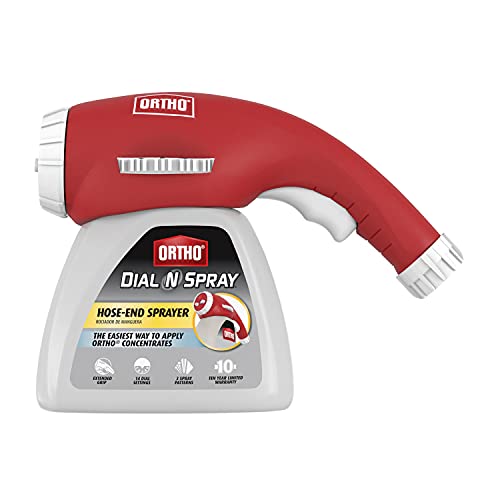
The Dial N Spray is the applicator most lawn owners reach for first, because it removes the measuring cup from the job. You pour concentrate into the jar, set the dial to the rate on the product label, connect the hose and walk the lawn. The sprayer meters the mix as you go, so coverage stays consistent from the first strip to the last instead of getting weaker as a premixed tank runs down.
Three spray patterns cover the shapes a lawn presents: a fan for open turf, a shower for gentler work near beds, and a jet for rinsing off. The extended grip keeps your hand behind the jar and away from the spray, which matters when the jar holds weed control rather than water. For a typical suburban lawn, one jar covers a full treatment pass, and refilling mid-job is a quick unscrew rather than a fresh batch to mix.
Specs
- Hose-end applicator with concentrate jar and suction tube; 14 dial dilution settings mixing from 1 teaspoon to 8 ounces per gallon; 3 spray patterns (fan, shower, jet); extended-reach grip design; model 0841010; connects to a standard garden hose
Best for: Feeding, weed control and insect treatments across a whole lawn without premixing
Watch out for: The dial settings are fixed steps, so a label rate that falls between steps means rounding to the nearest setting; rinse the jar and run clean water through the head after every chemical use
Chapin G362 Professional Hose-End Sprayer
The G362 is the heavier-duty take on the same idea, built around a brass mixing head instead of an all-plastic one. Brass at the metering point holds its calibration better over seasons of use, and the built-in backflow prevention addresses the safety point that cheaper applicators skip. Sixteen mixing ratios give finer steps than most dials, which helps when a concentrate label calls for a rate between the common ones.
The translucent 16-ounce tank sprays up to 100 gallons of mixed solution per fill, so a single fill covers a large lawn in one walk. A removable deflector lets you drop the spray downward for edging and beds or remove it for a longer throw across open turf, with reach that carries well beyond wand distance at normal household pressure. It is the applicator to pick if spraying is a monthly routine rather than a twice-a-year event.
Specs
- Hose-end applicator with 16-ounce translucent chemical-resistant tank; 16 precision mixing ratios; brass mixing head with built-in backflow prevention; sprays up to 100 gallons per fill; removable deflector for downward or distance spraying; fits any standard hose end; made in the USA; model G362
Best for: Regular lawn spraying programs where a metal mixing head and backflow protection are worth having
Watch out for: The 16-ounce tank is smaller than the Ortho jar, so very large lawns may need a refill; the deflector is a small loose part that is easy to misplace between seasons
Melnor 65039-AMZ XT Metal Front Trigger Nozzle
When the job is water rather than chemicals, this is the nozzle pattern set a lawn actually uses. Of its eight patterns, the shower and flat settings do the lawn work: both lay a wide, soft sheet of water that soaks in instead of running off, and the flat pattern suits watering a strip along a path or drive without soaking the concrete. Mist handles new seed gently, and the jet is there for cleanup duty away from the turf.
The metal core is the reason to pick it over plastic turret nozzles that crack after a season on the ground. A front trigger with built-in flow control and a trigger lock lets you set the output once and walk the lawn without holding a squeeze the whole time, and the included QuickConnect product adapter snaps the nozzle on and off the hose end for swaps to other tools. It is a hand-watering tool, so coverage still depends on your walking pace, but the wide patterns make each pass count.
Specs
- Front-trigger watering nozzle with metal core and slip-resistant rubberized grip; 8 spray patterns including shower, flat, mist and jet; built-in flow control and trigger lock; QuickConnect product adapter included; dimensions 2.24 x 5.23 x 6.73 inches; model 65039-AMZ
Best for: Hand-watering established lawns, new seed and dry patches with one durable nozzle
Watch out for: The QuickConnect adapter needs a matching hose-end connector, sold separately, to use the snap-on feature; like any hand nozzle, even coverage depends on a steady walking pace
Melnor GentleRain 8-Pattern 33-Inch Watering Wand
A wand changes the geometry of hand watering. The 33-inch shaft puts the shower head well in front of you, so a single sweep covers a wider arc of lawn, and you can lay water along edges, under low branches and across overseeded patches without stepping on the wet ground you just covered. The GentleRain head is built around a rain-style shower that spreads water softly and evenly, which is exactly what new seed and thin turf need.
Eight patterns are selected at the head, and the front trigger carries both flow control and a built-in lock, so long watering sessions do not turn into a grip endurance exercise. At under three quarters of a pound, the wand stays light through a full front-and-back lawn session. It is the pick for lawns with awkward shapes, slopes you would rather not stand on, or edges that a nozzle at arm’s length keeps missing.
Specs
- Watering wand with 33-inch shaft and GentleRain shower head; 8 spray patterns; front trigger with flow control and built-in trigger lock; item weight 11.6 ounces; dimensions 2.2 x 4.72 x 33.26 inches; model 8637-IN
Best for: Covering lawn edges, slopes and overseeded areas with a soft, wide shower from a standing reach
Watch out for: The long shaft is light-duty compared with the metal nozzle above, so it should be stored indoors rather than left out; the gentle shower trades throw distance for softness, so big open lawns take more passes
Which One Fits
Choose the Ortho Dial N Spray if your lawn work is mostly applying liquid products and you want the simplest dial-and-walk routine. Choose the Chapin G362 if you spray often, want a brass mixing head, finer ratio steps and built-in backflow prevention. Choose the Melnor XT nozzle if the job is plain watering and you want one metal tool whose shower and flat patterns cover turf while the jet handles cleanup. Choose the GentleRain wand if reach matters more than throw: edges, slopes, new seed and patches you do not want to walk on.
Many lawns end up needing one from each group: an applicator for feeding and treatments a few times a year, and a nozzle or wand for the weekly watering in between. What none of these replaces is a sprinkler for very large lawns, where hand coverage stops being practical; these four are for lawns you can walk in a reasonable session.
Common Mistakes
Using a jet pattern on turf. A concentrated jet digs into soil, exposes roots and seed, and leaves the rest of the strip dry. Lawns want shower, flat or fan patterns at moderate flow.
Guessing the dial setting. Applicator dials only work when the setting matches the rate printed on the concentrate label. A stronger mix does not work faster; it burns grass. Set the dial first, then spray.
Spraying chemicals in wind. Even a light breeze pushes fan spray off the lawn and onto beds, paths and neighboring plants. Spray on a calm morning and keep the head low.
Uneven walking pace. Coverage is pace times pattern width. Speeding up on the last strips leaves them underfed or underwatered. Walk the whole lawn at the same steady pace, and overlap each pass slightly.
Leaving concentrate in the jar. Mixed or stored product degrades and gums up metering parts. Empty, rinse and flush the sprayer after use, and store it dry.
FAQ
Can I use a hose-end applicator just to water the lawn?
You can, with plain water in the jar and the dial off, but it adds nothing over a nozzle and the jar makes the tool heavier. Applicators earn their place when something has to be mixed at a set rate. For water alone, a wide-pattern nozzle or wand is the better tool.
How do I know my coverage is even?
Walk at a constant pace, keep the spray head at a consistent height, and overlap each pass by a small margin so no strip gets a double dose or a gap. Placing a few empty cans around the lawn during watering shows how much water each area actually received.
Will these fit my garden hose?
All four products connect to a standard garden hose thread. The Chapin is built to fit any hose end directly, the Ortho connects the same way, and the Melnor nozzle includes a QuickConnect product adapter that works with a matching hose-end connector or a standard threaded connection.
How large a lawn can one applicator fill cover?
It depends on the product rate, but the Chapin sprays up to 100 gallons of mixed solution from one 16-ounce fill, which covers a large residential lawn in a single walk at typical label rates. Smaller jars simply mean one refill stop on bigger properties.
Final Verdict
For covering a lawn, the honest split is chemicals versus water. The Ortho Dial N Spray and Chapin G362 put liquid feed and treatments down at a measured rate, with the Chapin adding brass durability and backflow protection for frequent use. The Melnor XT nozzle and GentleRain wand put plain water down in the wide, soft patterns turf actually absorbs, with the wand winning on reach and the nozzle on toughness. Match the tool to what is in the hose, walk a steady pace, and the stripes and scorched patches that make people give up on hose spraying mostly disappear.