Our Short List of 3

- Panel output: 28 watts (maker rating)
- Ports: 2 USB-C and 1 USB-A
- Output: up to 5V/3A per port, 5V/4.8A combined (maker rating)
- Battery: none, direct charging only

- Panel output: 40 watts (maker rating)
- Ports: USB-C, USB-A and DC output
- Battery: none, direct charging only
- Weather rating: IP67 (maker rating)

- Panel output: 21 watts (maker rating)
- Ports: 2 USB-A
- Output: up to 2.4A per port, 3A total in direct sun (maker rating)
- Battery: none, direct charging only
All 4 Picks at a Glance
| Product | Specs | Action |
|---|---|---|
| 1. BigBlue 28W Solar Charger |
| Check price on Amazon |
| 2. FlexSolar 40W Foldable Solar Panel Charger (E40) |
| Check price on Amazon |
| 3. Anker PowerPort Solar 21W (A2421) |
| Check price on Amazon |
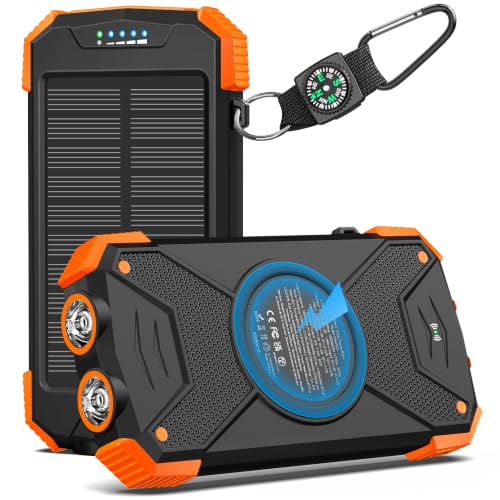 5. BLAVOR Solar Power Bank 10000mAh (PN-W05) |
| Check price on Amazon |
Key takeaways
- Compare the best solar chargers for travel and camping, from folding panels to solar power banks, with maker-rated wattage, ports and pack sizes.
A solar charger turns daylight into a slow but steady refill for the devices a trip depends on: a phone, a headlamp, a camera battery or a power bank saved for the evening. The category splits into two clear families. Folding panels make power only while the sun is on them and send it straight to a device or battery through USB. Solar power banks pair a built-in battery with a small panel, so they store energy like a normal power bank and use sunlight as a top-up between wall charges. Both families publish ratings measured under ideal test conditions, so every wattage and charge-time figure in this guide is the maker’s own rating, not a promise of what a cloudy afternoon will deliver.
Choosing between them comes down to how the trip runs. Travelers who stop in sunny places for lunch, camp chores or a beach hour usually get more from a panel, because a panel produces far more power per ounce than the small cell on a power bank. Travelers who move all day and charge at night usually do better with a solar power bank carried like any other battery, with the panel as a backup rather than the plan. The five picks below cover both approaches, from a 40-watt folding panel for group camps down to a pocketable 10,000 mAh bank.
As an Amazon Associate, we earn from qualifying purchases.
Quick answer
For most travelers, a folding panel such as the BigBlue 28W or the Anker PowerPort Solar 21W is the practical pick: both charge a phone or refill a power bank in direct sun and fold to notebook size. Anyone who would rather carry one device should choose a solar power bank instead: the Hiluckey 27,000 mAh for capacity, or the BLAVOR 10,000 mAh for a lighter pocket carry.
1. BigBlue 28W Solar Charger
- Panel output: 28 watts (maker rating)
- Ports: 2 USB-C and 1 USB-A
- Output: up to 5V/3A per port, 5V/4.8A combined (maker rating)
- Battery: none, direct charging only
The BigBlue 28W is the panel most likely to satisfy a traveler who charges more than one device at a stop. Its three output ports, two USB-C and one USB-A, are unusual in this class, and BigBlue rates each port at up to 5 volts and 3 amps with a combined ceiling of 5 volts and 4.8 amps under strong sun. The maker rates the panel’s sunlight conversion at up to 25.4 percent and folds the four-panel array down to about 11 by 6 by 1.4 inches at roughly 1.5 pounds, with carabiners in the box for hanging it on a pack or a fence line.
There is no battery inside, so charging stops when the light goes, and the maker is clear that the panel must sit in direct sunlight while connected. The panel carries an IP44 rating, while the junction box is not waterproof, so the connection point still needs shelter in rain. Output also rises and falls with sun angle and passing cloud, which is normal for every panel here.
Who it’s for / who should skip
For: campers, festival-goers and group travelers who charge two or three devices during sunny stops. Skip if: you need power stored for the night and do not carry a separate power bank, or your trips run mostly in overcast northern weather.
2. FlexSolar 40W Foldable Solar Panel Charger (E40)
- Panel output: 40 watts (maker rating)
- Ports: USB-C, USB-A and DC output
- Battery: none, direct charging only
- Weather rating: IP67 (maker rating)
The FlexSolar 40W is the high-output option in this group, aimed at travelers charging larger batteries at a basecamp rather than a phone on a ridgeline. FlexSolar rates the panel at 40 watts and gives it three kinds of output: USB-C, USB-A and a DC port, so it can feed phones and power banks directly or connect to a small portable power station that accepts DC input. The maker rates the panel at IP67, the strongest weather rating in this guide, and the unit folds into a flat package of roughly notebook footprint at about 2.9 pounds.
That weight is the trade. At close to double the BigBlue’s mass, the FlexSolar earns its place on car-camping trips, boat days and group hikes where one person carries shared gear, not on weight-counted backpacking lists. The 40-watt figure is a maker rating under ideal sun; real output depends on angle, heat and cloud, and with no internal battery, a power bank or station still has to catch the power for later.
Who it’s for / who should skip
For: car campers, paddlers and groups who want one panel to feed phones, banks and a small power station. Skip if: pack weight matters more than output, or you only ever charge a single phone.
3. Anker PowerPort Solar 21W (A2421)
- Panel output: 21 watts (maker rating)
- Ports: 2 USB-A
- Output: up to 2.4A per port, 3A total in direct sun (maker rating)
- Battery: none, direct charging only
Anker’s PowerPort Solar is the established lightweight panel: 21 watts, two USB-A ports and a fold that slips into a daypack pocket at about 14.7 ounces. Anker rates output at up to 2.4 amps per port and 3 amps total under direct sunlight, and its PowerIQ circuitry is the maker’s system for matching current to the connected device. For a traveler charging one phone and one small accessory, those figures are enough on a clear day, and the two-port layout keeps the design simple and light.
The limits are age and format. Both ports are USB-A, so newer USB-C cables need an adapter or a USB-A end, and there is no battery and no DC output for power stations. Output also depends entirely on keeping the panels square to the sun, so it suits travelers who build charging stops into the day: a long lunch, a hammock hour, a slow morning in camp. Within those terms, it remains a light, credible way to make power off-grid.
Who it’s for / who should skip
For: backpackers and day hikers who count ounces and charge a phone plus one small device. Skip if: your cables are all USB-C, or you want to run a power station from the panel.
4. Hiluckey Solar Charger Power Bank 27000mAh (HI-S225P)
The Hiluckey takes the opposite approach to the panels above: it is a power bank first, with a maker-rated 27,000 mAh battery, and a solar charger second, with four foldable panels that the maker rates at up to 6 watts of solar input. That is far more panel area than a single-cell bank offers, so sunlight becomes a meaningful top-up across a long sunny day, while the battery itself charges from a wall before the trip like any other bank. Outputs include USB-C with power delivery in and out plus three USB outputs, and Hiluckey rates fast charging at up to 22.5 watts.
Size is the cost: this is a brick-class bank, not a pocket one. One planning note for flyers: airlines generally require power banks in carry-on bags and apply capacity limits, and a bank of this size sits close to the 100 watt-hour line many carriers use, so check the airline’s rules before packing it. Treat the solar input as a range extender between wall charges, not a replacement for them, and the Hiluckey makes sense for long road trips, worksites and multi-day camps.
Specs
- Battery capacity: 27,000 mAh (maker rating)
- Solar input: 4 foldable panels, up to 6 watts (maker rating)
- Ports: USB-C input/output plus 3 USB outputs
- Fast charging: up to 22.5 watts (maker rating)
- Extras: built-in flashlight
- Model: HI-S225P
Who it’s for / who should skip
For: road trippers and campers who want one heavy-duty bank that can also sip sunlight for days. Skip if: you fly often with tight carry-on rules, or you want the lightest possible kit.
5. BLAVOR Solar Power Bank 10000mAh (PN-W05)
- Battery capacity: 10,000 mAh (maker rating)
- Solar input: built-in panel for trickle top-ups
- Ports: USB-C input/output, USB output, wireless charging pad
- Fast charging: up to 20 watts wired (maker rating)
The BLAVOR is the carry-everywhere version of the solar power bank idea. Its maker-rated 10,000 mAh battery is half the Hiluckey’s class, which keeps the unit pocketable, and it adds a wireless charging pad on its face alongside USB-C input and output; BLAVOR rates its wired fast charging at 20 watts. The built-in solar panel covers the front of the bank and is best understood as a trickle source: it can keep a stored charge topped up on a dashboard or slowly recover a flat bank across a long day outdoors, which the maker’s own materials frame as backup charging rather than a primary fill.
A flashlight and a small compass round out the outdoor kit. Because the battery is modest, this bank suits phone-first travelers: a commuter who camps on weekends, a festival bag, a glovebox spare. Anyone running a tablet, a camera system and a phone together should step up to the Hiluckey’s capacity or to a folding panel paired with a separate bank instead.
Who it’s for / who should skip
For: light packers who want one pocketable bank with a solar safety net and wireless charging. Skip if: you need multi-day capacity for several devices, or fast solar refills, which no bank-sized panel delivers.
How these solar chargers compare with the alternatives
Wall chargers and plain power banks remain the faster, cheaper way to charge, and for hotel-based travel they win outright; solar gear earns its space only when outlets disappear for days. Vehicle USB ports beat any panel while the engine runs, so road trippers often need solar only for time spent away from the car. Hand-crank chargers work without light but produce very little power for the effort, which makes them emergency tools rather than daily chargers. Larger panels of 60 watts and above, and power stations with separate panels, sit a class above this guide: they charge laptops and run small appliances, but at vehicle weights, not daypack weights. The middle ground covered here, panels of 21 to 40 watts and banks with backup panels, is where solar charging stays genuinely portable.
FAQ
Can a solar charger refill a phone as fast as a wall outlet?
Generally no. Panel wattage is a maker rating under ideal sun, and real output falls with cloud, angle, heat and shade. A 21 to 28 watt panel in strong midday sun can charge a phone at a useful pace, but travelers should plan on solar as a steady top-up across hours, and on a power bank as the buffer that smooths out the slow periods.
Do solar power banks charge fully from sunlight alone?
Only slowly. The panel on a bank is small, and even the Hiluckey’s four-panel array is maker-rated at up to 6 watts, so a full refill from empty takes far longer than a day of sun. The intended pattern is to leave home with the battery full from a wall outlet and let sunlight extend it during the trip.
Can I fly with a solar charger?
Folding panels without batteries are ordinary carry-on or checked items. Power banks, solar or not, generally must travel in carry-on bags, and airlines apply capacity limits, commonly around 100 watt-hours per battery without special approval. A 27,000 mAh bank sits close to that line, so check the specific airline’s policy before a flight.
What should I look at first when choosing between a panel and a solar power bank?
Decide when the charging happens. If the trip includes sunny stops, a panel makes more power per ounce and never runs flat itself. If devices charge overnight or on the move, a bank’s stored energy matters more, and its panel is a bonus. Many multi-day travelers pair a mid-size panel with a plain bank and get both behaviors.
Final verdict
Pick the BigBlue 28W for the most flexible panel charging in a packable fold, the FlexSolar 40W when a camp needs real output and a DC port, and the Anker PowerPort Solar 21W when every ounce counts. Choose the Hiluckey 27,000 mAh for a single heavy bank that can also gather sunlight across a long trip, or the BLAVOR 10,000 mAh for a light everyday carry with a solar backup. Every figure above is a maker rating under ideal conditions, so whichever model fits, the habit is the same: start with full batteries, aim panels at the sun during stops, and treat daylight as a refill, not a guarantee.
Product and ASIN Reference
| Product | ASIN |
|---|---|
| BigBlue 28W Solar Charger | B01EXWCPLC |
| FlexSolar 40W Foldable Solar Panel Charger (E40) | B09H6GGK55 |
| Anker PowerPort Solar 21W (A2421) | B012YUJJM8 |
| Hiluckey Solar Charger Power Bank 27000mAh (HI-S225P) | B0FP2C69MG |
| BLAVOR Solar Power Bank 10000mAh (PN-W05) | B07FDXDB3W |