Key takeaways
- Compare the best kids camping cots and travel cots for camping trips, with raised folding picks sized for toddlers, young kids, and older children.
A child who sleeps on the tent floor feels every root and stone underneath, and many kids wake up damp from ground moisture even inside a good sleeping bag. A raised camping cot lifts the sleeper off the ground, adds airflow underneath on warm nights, and gives a child a bed that feels familiar instead of improvised. The five cots below are child-sized or youth-sized folding designs that pack into a car trunk and set up without loose poles to lose.
As an Amazon Associate, we earn from qualifying purchases.
Quick answer
For most families, the REDCAMP Extra Long Kids Cot is the straightforward pick: a 53-inch steel-frame folding cot for children roughly five to ten. Toddlers who still roll fit the Baby Delight Bungalow, which wraps the sleep surface in mesh walls. The Regalo Extra Long My Cot suits younger children, the Disc-O-Bed Kid-O-Bunk sleeps two siblings as a bunk, and the Alpcour covers older kids and teens.
REDCAMP Extra Long Kids Cot

The REDCAMP Extra Long Kids Cot (model rc18132) is a classic folding camp cot scaled down for children. The sleeping surface measures about 53 inches long by 26 inches wide, which fits most children from around five to ten years old, or up to roughly four feet five inches tall. The steel frame folds open with no assembly, stands on multiple support legs so a child can climb on from any side without tipping it, and the deck is a durable 600D Oxford fabric that wipes clean after muddy trips.
REDCAMP rates the cot to hold up to 220 pounds, far beyond what a child needs, which gives the frame a reassuring margin when a parent sits on the edge at bedtime. The cot weighs about 11.6 pounds and folds into the included carry bag, and a side storage pouch keeps a flashlight or book within reach at night. The trade-off is padding: like most fabric cots, the surface is firm and taut, so pairing it with a thin pad or the child’s sleeping bag matters on cooler nights when air under the cot can chill the sleeper.
Baby Delight Go With Me Bungalow Deluxe Portable Cot

The Baby Delight Go With Me Bungalow Deluxe (model BD06300) answers the biggest worry parents have about cots for toddlers: rolling off. Mesh walls rise on all four sides of the 50 by 26 inch sleep surface, so a restless two or three year old stays contained instead of landing on the tent floor at midnight. The metal frame locks open with a safety lock, folds down into a travel bag, and the listing puts the item weight at just over ten pounds.
Baby Delight rates the Bungalow for children from 15 months old, and says to stop using it when a child passes 75 pounds or 50 inches tall, whichever comes first. The removable canopy is the feature that separates it from every other cot here: it shades the sleep area and is built for outdoor naps at the campsite, the beach, or in a backyard, so the cot doubles as a daytime rest spot. The fabric is polyester and wipes down with a dry cloth. The mesh walls mean this is a toddler product rather than a big-kid bed, and a child who can climb out over the walls has outgrown the design even if the weight limit has not been reached. Inside a family tent it also works well as a defined sleep space that keeps a toddler and their blanket in one place.
Regalo Extra Long My Cot Portable Toddler Bed

The Regalo Extra Long My Cot (model 5008 DS) stretches the well-known My Cot design to a 54 by 28 inch sleeping surface, with a frame that stands about 12 inches tall. Regalo rates it for children from two to eight years old and up to 80 pounds, which covers the preschool and early elementary years in one purchase. The all-steel frame and reinforced canvas liner unfold in seconds with no assembly at all: pull it open, and the bed is ready.
At about nine pounds, this is one of the lightest cots in the roundup, and it folds down to a fraction of its open size for the car or a closet. The canvas surface can be wiped or spot cleaned between trips. Because there are no rails or walls, it suits a child who already stays put on a bed at home; an active roller will end up on the floor. The extra length over the standard toddler cot size is the real value here, since children often outgrow a 48-inch cot by height long before they outgrow it by weight. For camping and nights at a grandparent’s house, the simplicity is the point: no pump, no poles, no parts to misplace in the dark.
Disc-O-Bed Youth Kid-O-Bunk

The Disc-O-Bed Kid-O-Bunk is the space-saving answer for families camping with two children. The set contains two youth cots that can be stacked into a bunk bed, set up side by side as two single cots, or joined into a bench for daytime seating. Each cot has a sleeping area of about 62 by 28 inches and is rated for 200 pounds, and Disc-O-Bed aims the design at children roughly seven to twelve years old. The rounded steel frame has no center bar and no third leg, so the 600D polyester deck flexes slightly instead of pressing a bar into the sleeper’s back.
Each cot packs into its own carry bag, and the bunk configuration needs no tools. Stacked, two kids sleep in roughly the floor footprint of one cot, which matters in a family tent where floor space is the scarcest resource. The set is heavier than the single cots here at around 36 pounds total, so it is a car camping product, not something to carry far. The top bunk sits noticeably higher than a toddler cot, so it belongs to an older child who no longer rolls out of bed; younger children should take the bottom bunk or a separate low cot. Side organizers hang on the frame for books, a headlamp, and small gear, which helps keep the tent floor clear.
Alpcour Folding Camping Cot
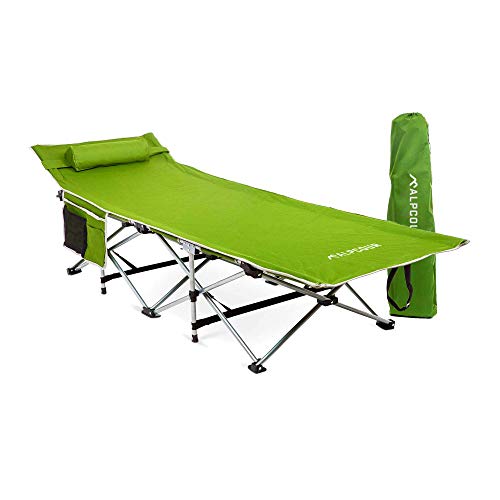
Older kids and teenagers outgrow child-sized cots quickly, and the Alpcour Folding Camping Cot is the step up for them. Alpcour rates the cot for adults and kids up to 300 pounds, and the full-size folding frame gives a tall ten or twelve year old the legroom that a 53-inch cot cannot. The cot folds down into a slim carry bag much like a camp chair, weighs about 13 pounds, and slings over a shoulder for the walk from the car to the tent.
A pillow is included in the bag, along with a side pocket for a phone, book, or flashlight. The steel frame and polyester deck unfold and lock without tools, and the design breaks down in seconds when it is time to pack. Because it is a general camping cot rather than a child-specific model, there are no toddler features here: no mesh walls, no rails, and a higher sleeping surface than the preschool picks. For a teen who camps with a scout group, a sports team, or the family, that is exactly right. It also doubles as a guest bed at home, which makes it easier to justify for families whose camping season is short.
How to choose
Start with length. A cot should be at least a few inches longer than the child is tall, and children outgrow cots by height before weight, so a 48-inch toddler cot often stops fitting around age six while a 53 or 54-inch model lasts to about age ten. Check the maker’s height guidance where it is given, not just the age range, and check the weight rating as a durability margin rather than a target.
Next, match the design to how the child sleeps. A toddler who rolls needs containment, which means mesh walls like the Bungalow or a floor pad instead of a cot. A child who sleeps still can use an open deck. For two siblings in one tent, a convertible bunk like the Kid-O-Bunk saves real floor space. Consider height off the ground as well: lower cots are easier for small children to climb onto and safer to roll off, while a taller frame stores gear underneath.
Then think about the trip itself. Car campers can accept a heavier steel frame; anyone carrying gear to a walk-in site should weigh the cot against everything else. Setup style matters after a long drive, and the fold-open designs here need no assembly, while the bunk set takes a few minutes to stack. Finally, plan for temperature: a cot has no insulation, so in cool weather put an insulated pad on top of the deck. A recall worth knowing about involves Coleman Converta camping cots, recalled in 2025 over a hinge hazard; none of the five cots here is part of it, but it is a reminder to check that folding hinges lock fully before a child climbs on.
Who should skip
Skip a camping cot entirely for a baby. Cots are not a safe sleep surface for infants, who belong in a travel crib or play yard that meets the federal standard for that product. Also skip the open-deck cots for a toddler who rolls heavily and is not ready to stay on a raised surface; either choose the mesh-walled design or keep that child on a pad on the tent floor. Families who backpack to their campsite should skip every cot here, since even the lightest adds more weight and bulk than a sleeping pad. And if your child is already taller than about five feet, skip the child-sized models and go straight to a youth or adult cot like the Alpcour rather than buying a cot that fits for one season.
FAQ
What age can a child start using a camping cot?
Most child-sized cots are rated from about age two, and the mesh-walled Bungalow starts at 15 months because the walls contain the sleeper. Babies should never sleep on a cot. The right starting point is when a child can climb on and off the low frame safely and understands staying on the bed.
Will a kids camping cot fit inside a family tent?
Usually, yes, but measure before the trip. Child cots run from about 48 to 54 inches long, the Kid-O-Bunk sleep area is 62 inches, and a stacked bunk uses the footprint of a single cot. Compare the cot footprint with your tent floor and leave walking room, and protect the tent floor with a mat or foam squares under the cot feet.
Do kids need a sleeping pad on top of a camping cot?
In warm weather, many children sleep fine on the fabric deck with just a sleeping bag. In cool weather, yes: air under the cot carries heat away from the sleeper, so an insulated pad on the deck or a warmer sleeping bag makes a real difference to whether a child stays warm all night.
How do you clean a folding kids cot?
Most decks are polyester, Oxford fabric, or canvas that can be wiped or spot cleaned with mild soap and a damp cloth, then dried completely before the cot is folded and stored. Check the frame hinges for grit after beach or dusty trips, and store the cot dry in its carry bag to keep the fabric fresh.
Final verdict
For a single child in the middle childhood years, the REDCAMP Extra Long Kids Cot is the balanced choice: a real folding cot, honestly sized, with a strong frame and an easy carry. Families with toddlers should look first at the Baby Delight Bungalow for its mesh walls and shade canopy, while the Regalo Extra Long My Cot is the lightest instant-setup option for younger children. Two siblings sharing a tent are best served by the Disc-O-Bed Kid-O-Bunk, and older kids and teens should move to the Alpcour. Match the cot length to the child’s height, add insulation in cool weather, and any of these five will beat the tent floor.
Product and ASIN Reference
| Product | ASIN |
|---|---|
| Disc-O-Bed Youth Kid-O-Bunk | B00U7R4XAE |
| REDCAMP Extra Long Kids Cot | B08M8PFMFW |
| Regalo Extra Long My Cot Portable Toddler Bed | B00BIETAJ4 |
| Baby Delight Go With Me Bungalow Deluxe Portable Cot | B09XZJV9YZ |
| Alpcour Folding Camping Cot | B07DCCKW3H |