Key takeaways
- Compare the best kids hydration packs for hikes and bike rides, with kid-size reservoirs, easy bite valves, safety whistles and room for snacks.
A child who can drink without stopping drinks more often, and that simple fact is why a kids hydration pack earns its place on family hikes and bike rides. Instead of halting every ten minutes to dig a bottle out of an adult pack, your child sips from a bite valve, keeps moving, and starts learning to manage their own water and gear. The catch is sizing. An adult pack shrunk in the marketing copy is not the same as a pack built for a short torso, narrow shoulders and small hands. Straps must cinch down far enough, the reservoir should hold enough water for the outing without turning into a wobbly load, and the valve has to work for a child who will absolutely chew on it. The five packs below are all genuine kid-size designs with included reservoirs, and they cover the main shapes of family use: trail hiking, mountain biking, short neighborhood rides and budget first packs.
As an Amazon Associate, we earn from qualifying purchases.
Quick answer
For most families, the CamelBak Mini M.U.L.E. is the safest first buy: a 1.5 liter Crux reservoir, three pockets and a whistle, all on a frame sized for young riders and hikers. The Osprey Moki 1.5 fits the smallest children best, the Outdoor Products Tadpole is the budget starter, the Ivygreen adds insulated storage, and the Zelvot vest suits kids who dislike backpacks.
CamelBak Mini M.U.L.E. Kids Hydration Backpack

The Mini M.U.L.E. is the reference point in this category, and the current version keeps the formula that made it popular: a 1.5 liter Crux reservoir, a ventilated harness, and cargo space that is small in adult terms but generous for a child. Three exterior pockets, including a stretch overflow pocket and a secure zippered pocket, swallow snacks, a light layer and the rocks and sticks that somehow become essential cargo. The reservoir uses a self-sealing Big Bite valve with an on-off lever, so a parent can shut the flow off in the car and a child can still manage a real drink on the trail. CamelBak rates the fit for torsos roughly 12 to 16 inches, which covers most children from preschool through the early tween years, and the sternum strap carries a built-in safety whistle. Reflective accents help on dusk rides home. One brand note: CamelBak recalled caps sold with its Podium and Peak Fitness bottles in 2021 over a choking hazard. That recall covered bottle caps, not this pack or its Crux reservoir, but it is a reminder to inspect any small detachable parts on gear a young child will mouth. Families who mostly ride bikes will find this the most dialed option here.
Osprey Moki 1.5 Kids Hydration Pack

The Moki is the pick for the smallest riders and hikers, the children who are still swallowed by every other pack on this list. Osprey built it as a true scaled-down version of its adult bike packs: a 1.5 liter Hydraulics LT reservoir in its own sleeve, a front shove-it pocket for a shed layer, a small zippered pocket for snacks, and a blinker light attachment for rides that end near dark. The sternum strap slides through a wide adjustment range and cinches down tighter than most rivals, which is exactly what a narrow three-to-six-year-old torso needs, and it carries both an integrated whistle and a magnetic holder that parks the drink tube against the strap instead of letting it dangle in the dirt. The ventilated back pad keeps the reservoir from pressing directly against the child’s back. One caution from Osprey itself: the magnetic tube holder means this pack is not for children under four, because small magnets are a swallowing hazard if they ever come loose. For a petite child past that age who is starting on trails or a balance bike, nothing else here fits as precisely.
Outdoor Products Tadpole Hydration Pack

The Tadpole is the honest budget starter pack, the one to buy when you are not yet sure a hydration pack will get used every weekend. It pairs a 1.5 liter reservoir with about 3.5 liters of total carrying capacity in a compact 13.5 by 7.5 by 2.1 inch frame made of high-density polyester, and Outdoor Products backs it with a lifetime guarantee, which is unusual at this end of the market. Several pockets divide up snacks, a phone and small essentials, and the reservoir sleeve can physically accept a larger bladder later, though a full 1.5 liters is the sensible load for a child. The bite valve is the main compromise: it is a push-pull style valve that reviewers consistently describe as better suited to children five and up, since younger kids can find it stiff, and it lacks the self-sealing polish of the CamelBak and Osprey valves. The straps and back panel are also simpler, with less ventilation. None of that matters much on a one-hour ride or a short nature walk, which is precisely the Tadpole’s job. Buy it to start the habit; upgrade only if the habit sticks.
Ivygreen Kids Hydration Backpack

The Ivygreen is the organizer’s pick, a small hiking backpack first and a hydration pack second. Its 1.5 liter bladder rides in an insulated pocket, which slows how fast water warms up on a sunny trail, and the bladder itself is BPA-free and PVC-free with a taste-free lining meant to avoid the plastic flavor that makes some children refuse to drink. Around it sits 8 liters of storage, the most in this roundup, split between a main compartment, a front pocket and two side mesh pockets for sunglasses and grab-now items. Padded shoulder straps and a padded back panel suit longer walks, and the safety set is complete: a whistle built into the chest strap buckle and reflective strips across the front pocket and both straps. Ivygreen positions the pack for a wide band of children, roughly ages three to twelve, but treat the top of that range carefully, since the frame and straps are tuned for younger, smaller bodies and a tall older child will run out of adjustment. For a young hiker who insists on carrying binoculars, a field guide and a full snack operation, this is the pack that keeps it all sorted.
Zelvot Kids Hydration Backpack Vest
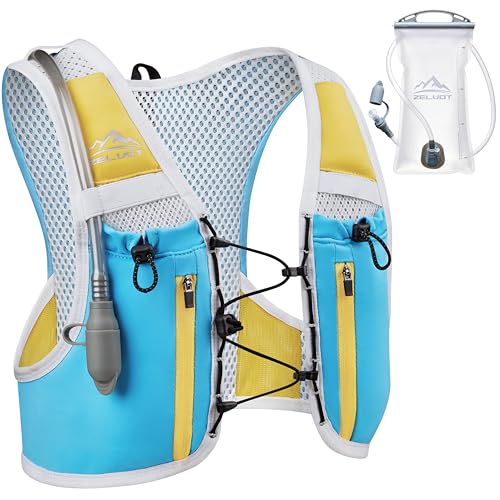
The Zelvot takes a different shape entirely: a running-vest style pack that hugs the torso instead of hanging off the shoulders. For children who complain that backpacks bounce, slide or feel hot, the close fit and dual adjustable chest straps can be the difference between a pack that gets worn and one that gets carried by a parent. The 1.5 liter BPA-free and PVC-free bladder sits in the back panel, while eight pockets, most of them up front where a child can reach them without taking the pack off, handle snacks, a small phone and trail finds. Reflective trim and a reflective logo address visibility, and at well under half a pound empty it is the lightest option in this roundup by a wide margin. The vest format has real trade-offs: cargo space is snack-scale only, there is no room for a jacket or lunch, and the close fit that runners love can feel warm on a slow, hot hike. Sizes change the included bladder capacity on some listings, so confirm the size’s reservoir before ordering. For young runners, riders and theme-park walkers who travel light, it is the most comfortable carry here.
How to choose
Start with fit, because a pack a child will not wear is worthless. Measure the torso from the bony bump at the base of the neck to the top of the hip bones, and match it to the maker’s stated range; most of these packs suit torsos under about 16 inches, and a child taller than that is ready for a small adult pack. Next, size the reservoir to the outing. A 1.5 liter reservoir is the sweet spot for children: enough for a couple of hours of hiking or riding, and when full it adds a manageable load. Keep the total packed weight near a tenth of the child’s body weight, and fill the reservoir only partway for small children or short outings. Then look at the valve. Self-sealing bite valves with an on-off lever, like the CamelBak Crux, forgive chewing and prevent car-seat leaks; push-pull valves are simpler but harder for the youngest kids. Storage is the last decision. Pure hydration designs like the Zelvot and Tadpole keep weight down, while the Ivygreen and Mini M.U.L.E. add real cargo for kids who carry their own snacks and layers. Finally, check the safety extras that matter for your routes: a sternum-strap whistle, reflective trim and a light attachment all cost nothing in weight and pay off at dusk.
Who should skip
Skip the hydration pack entirely if your outings are short park loops with easy water access, where a simple bottle in a bike cage or side pocket does the same job with zero cleaning. Skip the Moki for any child under four, because of its magnetic tube holder, and skip vest-style packs like the Zelvot if your child needs to carry a jacket, lunch or school items, since the storage is snack-scale. Families of heavy valve-chewers may also want to skip the budget push-pull design of the Tadpole and go straight to a replaceable self-sealing valve. And if your child is already in early teens with a torso beyond the stated ranges, skip this whole category and size up to a small adult pack instead of squeezing into a kids model.
FAQ
What size reservoir does a child actually need?
For most children, 1.5 liters is the right ceiling. It covers roughly two hours of active hiking or riding, and a full reservoir plus pack stays light enough for a small back. Younger children often do better with the reservoir filled halfway, and longer or hotter outings are handled better by planning a refill stop than by strapping on a bigger bladder.
At what age can a child start carrying a hydration pack?
Most children can start around age three or four with a small, light pack and a partially filled reservoir, provided the straps cinch snugly and an adult checks the fit. Always respect maker age guidance: the Osprey Moki, for example, is not for children under four because of its magnetic tube holder. Start with short outings and build up.
How do you clean a kids hydration pack reservoir?
Rinse the reservoir and tube with warm water after every outing, use a mild soap or a reservoir cleaning tablet weekly during heavy use, and scrub the bite valve, where residue collects. The critical step is drying: prop the reservoir open, hang the tube so it drains fully, and store everything uncapped. A reservoir put away wet is where off flavors and growth start.
Hydration pack or water bottle: which is better for kids?
For walks and rides longer than about an hour, a pack wins because children sip steadily without stopping, and the water cannot be dropped or left behind. For short trips, playgrounds and school use, a bottle is simpler, cheaper and far easier to clean. Many families end up with both and choose based on the length of the outing.
Final verdict
Buy the CamelBak Mini M.U.L.E. if you want one proven pack for mixed hiking and biking. Choose the Osprey Moki 1.5 for a petite child over four who needs the snuggest fit, the Outdoor Products Tadpole as a low-risk first pack, the Ivygreen when storage and insulation matter, and the Zelvot vest for a child who runs or rides and hates backpack bounce. All five include their reservoirs, all five are sized for children rather than shrunk in name only, and any of them will get more water into a kid than a bottle riding in your own pack.
Product and ASIN Reference
| Product | ASIN |
|---|---|
| CamelBak Mini M.U.L.E. Kids Hydration Backpack | B0G6G25M6M |
| Osprey Moki 1.5 Kids Hydration Pack | B07Z9ZBPH6 |
| Outdoor Products Tadpole Hydration Pack | B07HJW2K61 |
| Ivygreen Kids Hydration Backpack | B0DSDBSFPC |
| Zelvot Kids Hydration Backpack Vest | B0G4MCF9XH |