Key takeaways
- Compare five kids sunscreens for sensitive skin, from Blue Lizard Kids lotion to Thinkbaby, Pipette, Aveeno Kids and Coppertone Kids, plus reapply tips.
The short answer: for most families, the Blue Lizard Kids Mineral SPF 50 Sunscreen Lotion in the 5 fl oz bottle is the kids sunscreen to buy first, because it answers the kids sunscreen question outright, with a fully mineral zinc oxide formula made for children, broad spectrum UVA and UVB protection at SPF 50, water resistance rated for 80 minutes, and a fragrance-free and paraben-free lotion that spreads over arms, legs, face and neck. The Thinkbaby SPF 50 Plus Baby Sunscreen in the 3 oz tube is the premium mineral pick, with a zinc oxide formula that carries EWG verification, a thick lotion texture that stays where it is put, and a small tube that fits a pocket or a small bag. The Pipette Mineral Sunscreen SPF 50 in the 4 fl oz tube is the sheer-finish pick, with non-nano zinc oxide, sugarcane-derived squalane that helps the lotion glide, and a lightweight feel that rubs in with little white cast. The Aveeno Kids Continuous Protection Zinc Oxide Mineral Sunscreen Lotion SPF 50 in the 3 fl oz tube is the tear-free pick, with a zinc oxide formula made for sensitive skin, a non-greasy feel, and a tube shaped for faces and ears. And the Coppertone Kids Tear Free Sunscreen Lotion SPF 50 in the 8 fl oz bottle is the budget pick, with a chemical-filter formula rather than a mineral one, a tear-free claim, water resistance rated for 80 minutes, and the largest bottle in this guide for families that go through lotion fast.
Two framing facts apply to the whole guide, and the first one is the difference between a mineral sunscreen and a chemical sunscreen, because the two are easy to confuse and they are different purchases entirely. A mineral sunscreen uses zinc oxide, or zinc oxide with titanium dioxide, as the active ingredient, and it works by sitting on the skin and blocking and scattering ultraviolet light, while a chemical sunscreen uses chemical UV filters that absorb ultraviolet light and turn it into heat, and the two behave differently on the skin. Four of the five picks here are mineral sunscreens, and the fifth is a chemical sunscreen, because some families prefer a lotion that rubs in clear and spreads fast over a large area. This guide covers kids sunscreen only, for children old enough to wear sunscreen, because sunscreen is not the right sun protection for a baby under six months of age, and a household with a baby that young should ask a doctor about sun protection and keep the baby in shade and covered clothing instead. Every pick here is a lotion or a cream, and none of them is an aerosol spray, because a lotion lets a parent see exactly where the protection went and how much went on, and a spray cloud is harder to control near a small face.
The second framing fact is the one every kids sunscreen decision turns on, and it applies to all five picks without exception: this guide is general information about products sold on the market, and it is not medical advice, and it does not replace a conversation with a pediatrician or another clinician who knows the child. A sunscreen for a child is judged by the active ingredient, the SPF, the broad spectrum claim, the water resistance, and the skin the child has, not by the character on the bottle, and a child with eczema, a rash, broken skin, or a known reaction to a sunscreen ingredient needs a clinician to say what is going on before a household settles on a new formula. No pick in this guide is a recalled product, and the checks section sets out the recall record for this category with its scope exact.
As an Amazon Associate, we earn from qualifying purchases.
Table of Contents
- How to Choose
- Quick Comparison
- 1. Blue Lizard Kids Mineral SPF 50 Sunscreen Lotion, 5 fl oz
- 2. Thinkbaby SPF 50 Plus Baby Sunscreen, 3 oz
- 3. Pipette Mineral Sunscreen SPF 50, 4 fl oz
- 4. Aveeno Kids Continuous Protection Sunscreen Lotion SPF 50, 3 fl oz
- 5. Coppertone Kids Tear Free Sunscreen Lotion SPF 50, 8 fl oz
- Safety and Recall Checks
- Frequently Asked Questions
- Conclusion
- Product and ASIN Reference
How to Choose
Match the active ingredient to the skin first, because the active ingredient is the whole of what makes one kids sunscreen different from another. Four picks here use zinc oxide as the active ingredient, and the fifth uses chemical UV filters, and the difference between them is how the protection sits on the skin. The Blue Lizard Kids lotion, the Thinkbaby tube, the Pipette tube and the Aveeno Kids tube are all mineral sunscreens, with zinc oxide that forms a barrier on the skin surface, which is the reason they are the picks for the child whose skin reacts to scented or chemical products, because a mineral barrier does not need to be absorbed to work. The Coppertone Kids lotion is the chemical pick, with UV filters that absorb into the top layer of skin, which is the reason it is the pick for the family that wants a lotion that rubs in clear and spreads fast, because a chemical lotion leaves less visible residue than a mineral one. A household buying for a child with eczema should weigh the mineral picks first, and a household buying for a child who refuses anything white on the skin should weigh the Coppertone Kids lotion or the Pipette tube.
Judge the SPF and the broad spectrum claim together, because an SPF number alone says nothing about the full range of ultraviolet light. Every pick in this guide is SPF 50, except the Thinkbaby tube, which is SPF 50 Plus, and every pick states broad spectrum protection, which is the claim that the lotion guards against UVA rays as well as UVB rays. The SPF number describes protection against UVB rays, the rays that burn, while the broad spectrum claim is what covers UVA rays, the rays that age skin and pass through cloud and glass, which is the reason a lotion with a high SPF and no broad spectrum claim would be a poor buy, because a burn-free afternoon is not the same as a fully protected afternoon. The five picks here all carry both, so the choice between them is not about the number on the front.
Weigh water resistance and the reapply rule before the bottle size, because a sunscreen that washes off in the pool is a sunscreen that stops working when the child needs it most. Every pick in this guide states water resistance rated for 80 minutes, which is the longest water resistance rating a sunscreen label can carry, and the number means the SPF held up in water testing for that long, not that the lotion lasts all afternoon. The rule for all five picks is the same: apply generously fifteen minutes before sun exposure, reapply at least every two hours, reapply after 80 minutes of swimming or sweating, and reapply immediately after towel drying, because a towel takes the lotion off with the water.
Pick the format by who applies it and where, because a lotion a parent can see is a lotion a parent can trust, and a format a child will sit still for is a format that gets used. All five picks here are lotions or creams in a tube or a bottle, and the difference between them is the size of the container and the thickness of the lotion. The Blue Lizard Kids lotion and the Coppertone Kids lotion come in the largest containers here, a 5 fl oz bottle and an 8 fl oz bottle, which is the reason they are the picks for full-body application on a beach day, because a small tube runs out halfway down a small body. The Thinkbaby tube, the Pipette tube and the Aveeno Kids tube are 3 fl oz or 4 fl oz tubes, which is the reason they are the picks for faces, ears, necks and hands, and for a bag, because a tube fits where a bottle does not. No pick here is a spray, and that is a deliberate line, because a spray near a small face is a spray a child can breathe in, and a lotion is a lotion a parent can see.
Read the scent, the feel and the age line before the character on the bottle, because a sunscreen a child hates is a sunscreen that stays in the bag. Three picks here state fragrance-free on the listing, and that matters, because a scented lotion is a lotion a sensitive nose notices, and a child who dislikes the smell is a child who runs from the bottle. The Blue Lizard Kids lotion, the Thinkbaby tube and the Pipette tube are all fragrance-free, which is the reason they are the picks for the child who complains about smell, while the Aveeno Kids tube is made for sensitive skin and the Coppertone Kids lotion carries a light classic sunscreen scent, which suits the family that does not mind it. And the age line matters most of all, because every pick here is labelled for babies six months and older or for children, with a direction to ask a doctor for anything younger, and a household with a baby under six months should not use any pick here without a doctor saying so.
Quick Comparison
| Product | Active ingredient | SPF | Water resistance | Size | Best for | Tier |
|---|---|---|---|---|---|---|
| Blue Lizard Kids Mineral Lotion | Zinc oxide, mineral | 50 | 80 minutes | 5 fl oz | First kids sunscreen | Mid-range |
| Thinkbaby SPF 50 Plus | Zinc oxide, mineral | 50 Plus | 80 minutes | 3 oz | Premium mineral | Premium |
| Pipette Mineral Sunscreen | Non-nano zinc oxide, mineral | 50 | 80 minutes | 4 fl oz | Sheer finish | Premium |
| Aveeno Kids Continuous Protection | Zinc oxide, mineral | 50 | 80 minutes | 3 fl oz | Tear-free faces | Mid-range |
| Coppertone Kids Tear Free | Chemical UV filters | 50 | 80 minutes | 8 fl oz | Budget family bottle | Budget |
1. Blue Lizard Kids Mineral SPF 50 Sunscreen Lotion, 5 fl oz

The Blue Lizard Kids Mineral SPF 50 Sunscreen Lotion in the 5 fl oz bottle is the pick to buy first for most families, because it is the sunscreen in this guide that brings a fully mineral formula and a family-sized bottle together in one lotion made for children. Blue Lizard built the lotion around one idea: a kids sunscreen should be simple enough for a parent to trust and gentle enough for a child to wear every day, because sun protection is a routine and a routine holds only when the lotion does not sting, smell or fight back, and the lotion carries the whole idea in one bottle, with zinc oxide as the active ingredient, broad spectrum UVA and UVB protection at SPF 50, water resistance rated for 80 minutes, and a fragrance-free and paraben-free formula that a parent can spread over a whole small body. For a household buying a first kids sunscreen, that combination of a mineral formula, a clear SPF and a useful size is the reason to start here.
The mineral formula is the feature that decides the pick. The lotion uses zinc oxide as its active ingredient, with no chemical UV filters in the formula, which is the reason the pick suits the child whose skin reacts to other sunscreens, because a mineral barrier sits on the skin surface rather than being absorbed into it, and a barrier that sits on the surface is a barrier a sensitive child tolerates better. The formula is also vegan and free of parabens and fragrance, which is the reason the pick suits the household that reads ingredient lists before buying, because a short list of things left out is a list a parent can check in seconds. The broad spectrum claim is the second feature that decides the pick, because a lotion that guards against UVA rays as well as UVB rays is a lotion that protects the whole afternoon, not only the burning part of it.
The 5 fl oz bottle is the third feature that decides the pick. The bottle is the middle size in this guide, larger than the 3 oz and 4 fl oz tubes and smaller than the 8 fl oz Coppertone bottle, which is the reason the pick suits a family that wants one bottle for arms, legs, face and neck without carrying a large bottle everywhere, because a middle bottle covers a full-body application and still fits a beach bag. The water resistance is the fourth feature that decides the pick, because a rating of 80 minutes is the longest a sunscreen label can carry, and a pool afternoon needs a lotion that holds up in water rather than one that rinses away at the first splash. The rule still applies: reapply after 80 minutes of swimming or sweating, and reapply immediately after towel drying, because water resistance is a rating, not a promise that lasts all day.
The lotion texture is the fifth feature that decides the pick. The lotion spreads as a white cream and rubs in with a visible cast at first, which is the honest trade of a mineral formula, because a zinc oxide lotion shows where it went, and a parent who can see the lotion can see the gaps. A household that wants a lotion that disappears entirely should buy the Pipette tube instead, because its sheer finish rubs in with less visible cast.
The limits are honest ones. The Blue Lizard Kids lotion is a mineral lotion, so it is not the pick for a household that wants the fastest rub-in over a large area, and a household in that position should buy the Coppertone Kids lotion instead, because its chemical formula spreads faster and leaves less visible residue. The pick is a lotion in a bottle, so it is not the pick for a household that wants the smallest tube for a pocket, and a household in that position should buy the Thinkbaby tube instead, because its 3 oz tube packs smaller.
Specs
- Brand — Blue Lizard
- Style — Kids Mineral SPF 50 Sunscreen Lotion, 5 fl oz
- Form — Lotion, 1 bottle
- Active ingredient — Zinc oxide, fully mineral
- SPF — 50, broad spectrum UVA and UVB
- Water resistance — 80 minutes
- Scent — Fragrance-free
- Free of — Parabens
- Best for — First kids sunscreen
2. Thinkbaby SPF 50 Plus Baby Sunscreen, 3 oz

The Thinkbaby SPF 50 Plus Baby Sunscreen in the 3 oz tube is the premium mineral pick, because it is the sunscreen in this guide that brings a zinc oxide formula and an independent verification together in one small tube made for babies and young children. Thinkbaby built the sunscreen around one idea: a sunscreen for a small child should be verifiable from the outside, because a parent cannot test a formula at home and needs a label that says what is in it and what is not, and the tube carries the whole idea in one small package, with zinc oxide as the active ingredient, broad spectrum protection at SPF 50 Plus, water resistance rated for 80 minutes, EWG verification on the label, and a vegan formula with no fragrance. For a household buying a kids sunscreen for a baby or a toddler, that combination of a zinc oxide formula and a verified label is the reason to start here.
The zinc oxide formula is the feature that decides the pick. The tube lists zinc oxide as the active ingredient, with no chemical UV filters, which is the reason the pick suits the child with sensitive or reactive skin, because a mineral formula sits on the skin surface and does the work there, and a formula that does the work on the surface is a formula a small child tolerates well. The EWG verification is the second feature that decides the pick, because a verification from an independent group means the formula was checked against a published list of ingredients to avoid, and a checked formula is a formula a parent can buy without reading every line of the Drug Facts box. The tube is also vegan and fragrance-free, which is the reason the pick suits the household that wants a short and simple ingredient story.
The thick lotion texture is the third feature that decides the pick. The lotion comes out as a thick cream that stays where it is put, which is the reason the pick suits faces, ears and necks, because a thick lotion does not run into eyes the way a thin lotion can, and a face lotion that stays put is a lotion that protects the face. The 3 oz tube is the fourth feature that decides the pick, because a small tube fits a pocket, a small bag and a nappy bag, and a tube that fits is a tube that goes where the child goes. The water resistance is the fifth feature that decides the pick, because a rating of 80 minutes means the SPF held up in water testing for that long, and a toddler in a paddling pool needs a lotion that holds up rather than one that rinses away.
The limits are honest ones. The Thinkbaby tube is the premium pick in this guide, so it is not the pick for a household that wants the largest bottle for the least outlay, and a household in that position should buy the Coppertone Kids lotion instead, because its 8 fl oz bottle is the largest here. The pick is a 3 oz tube, so it is not the pick for a household that wants one bottle for a whole beach day on two children, and a household in that position should buy the Blue Lizard Kids lotion instead, because its 5 fl oz bottle covers more skin.
Specs
- Brand — Thinkbaby
- Style — SPF 50 Plus Baby Sunscreen, 3 oz
- Form — Lotion, 1 tube
- Active ingredient — Zinc oxide, fully mineral
- SPF — 50 Plus, broad spectrum UVA and UVB
- Water resistance — 80 minutes
- Scent — Fragrance-free
- Verification — EWG Verified
- Best for — Premium mineral
3. Pipette Mineral Sunscreen SPF 50, 4 fl oz
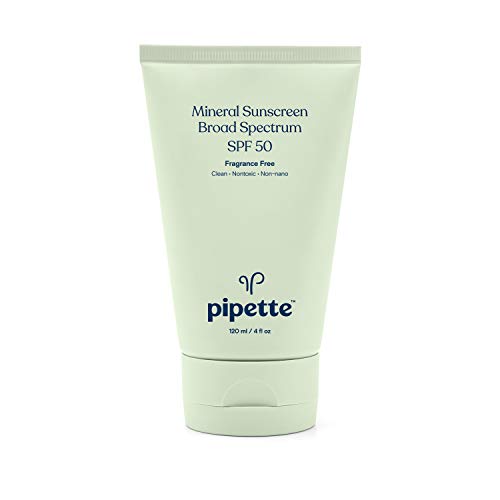
The Pipette Mineral Sunscreen SPF 50 in the 4 fl oz tube is the sheer-finish pick, because it is the sunscreen in this guide that brings a non-nano zinc oxide formula and a lightweight feel together in one tube made for kids and sensitive skin. Pipette built the sunscreen around one idea: a mineral sunscreen should not feel like a chore to wear, because a child who hates the feel of a lotion is a child who runs from the bottle, and the tube carries the whole idea in one squeeze tube, with non-nano zinc oxide as the active ingredient, broad spectrum protection at SPF 50, water resistance rated for 80 minutes, sugarcane-derived squalane that helps the lotion glide, and a fragrance-free formula that rubs in sheer. For a household buying a kids sunscreen for a child who refuses thick white lotions, a household with a child who has sensitive skin, or a household that wants a mineral lotion that behaves like a light daily cream, that combination of a sheer finish and a mineral formula is the reason to start here.
The non-nano zinc oxide is the feature that decides the pick. The tube lists non-nano zinc oxide as the active ingredient, which means the mineral particles are not made in the smallest size, and the lotion forms a barrier on the skin surface rather than being absorbed, which is the reason the pick suits the child with sensitive skin, because a barrier that sits on the surface is a barrier a reactive child tolerates well. The squalane is the second feature that decides the pick, because sugarcane-derived squalane is a moisturiser that helps the lotion glide across the skin, and a lotion that glides is a lotion that spreads evenly, and an even spread is what turns a squeeze of lotion into real coverage. The sheer finish is the third feature that decides the pick, because the lotion rubs in with little white cast, which is the reason the pick suits deeper skin tones and older children who notice a white face, because a lotion that disappears is a lotion a child will wear without complaint.
The lightweight feel is the fourth feature that decides the pick. The lotion is lighter than the thick creams in this guide, with a texture closer to a daily moisturiser than to a beach cream, which is the reason the pick suits everyday use, school days and playground mornings, because a light lotion is a lotion a parent can apply fast before the school run. The 4 fl oz tube is the fifth feature that decides the pick, because a middle tube covers faces and arms without the bulk of a large bottle, and a tube that squeezes is a tube a parent can control one-handed while the other hand holds a wriggling child. The formula is also hypoallergenic, vegan and cruelty-free, which is the reason the pick suits the household that wants those claims on the label.
The limits are honest ones. The Pipette tube is a premium pick in this guide, so it is not the pick for a household that wants the largest bottle for a beach week, and a household in that position should buy the Coppertone Kids lotion instead, because its 8 fl oz bottle is the largest here. The pick is a light lotion, so it is not the pick for a household that wants the thickest lotion for a face that needs a lotion that stays put, and a household in that position should buy the Thinkbaby tube or the Aveeno Kids tube instead, because both are thicker creams.
Specs
- Brand — Pipette
- Style — Mineral Sunscreen SPF 50, 4 fl oz
- Form — Lotion, 1 tube
- Active ingredient — Non-nano zinc oxide, fully mineral
- SPF — 50, broad spectrum UVA and UVB
- Water resistance — 80 minutes
- Scent — Fragrance-free
- Texture — Lightweight, sheer finish with squalane
- Best for — Sheer finish
4. Aveeno Kids Continuous Protection Sunscreen Lotion SPF 50, 3 fl oz

The Aveeno Kids Continuous Protection Sunscreen Lotion SPF 50 in the 3 fl oz tube is the tear-free pick, because it is the sunscreen in this guide that brings a zinc oxide formula and a face-first design together in one tube made for children’s sensitive skin. Aveeno built the lotion around one idea: a kids sunscreen fails at the face first, because a lotion that runs into eyes is a lotion a child remembers, and the tube carries the whole idea in one small package, with zinc oxide as the active ingredient, broad spectrum protection at SPF 50, water resistance rated for 80 minutes, a tear-free claim, a non-greasy feel, and a tube shaped for faces, ears and necks. For a household buying a kids sunscreen for a child who cries when lotion reaches the eyes, a household with a child who has sensitive skin, or a household that wants a dedicated face tube alongside a body bottle, that combination of a tear-free claim and a mineral formula is the reason to start here.
The tear-free claim is the feature that decides the pick. The tube states tear-free on the label, which means the formula is made to be gentle near the eyes, and a lotion that does not sting the eyes is a lotion a child will sit still for, which is the reason the pick suits faces, because the face is the skin that gets the lotion closest to the eyes and the skin that a child rubs first. The zinc oxide formula is the second feature that decides the pick, because a mineral active ingredient sits on the skin surface rather than being absorbed, and a surface barrier is a barrier a sensitive child tolerates well. The non-greasy feel is the third feature that decides the pick, because a lotion that does not leave hands sticky is a lotion a child will not wipe off on a shirt, and a lotion that stays on the skin is a lotion that keeps working.
The 3 fl oz tube is the fourth feature that decides the pick. The tube is small enough for a pocket or a small bag, which is the reason the pick suits a face tube that travels with the child, because a face needs reapplying more often than arms and legs, and a tube that is always there is a tube that gets used. The sweat and water resistance is the fifth feature that decides the pick, because a rating of 80 minutes means the SPF held up in water testing for that long, and a child who sweats through a sports practice needs a lotion that holds up rather than one that runs away with the sweat. The tube is also made for sensitive skin, which is the reason the pick suits the child whose skin reacts to scented or chemical products.
The limits are honest ones. The Aveeno Kids tube is a 3 fl oz tube, so it is not the pick for a household that wants one bottle for a whole beach day on two children, and a household in that position should buy the Blue Lizard Kids lotion or the Coppertone Kids lotion instead, because both come in larger bottles. The pick is a mineral lotion, so it is not the pick for a household that wants the fastest rub-in over a large area, and a household in that position should buy the Coppertone Kids lotion instead, because its chemical formula spreads faster and leaves less visible residue.
Specs
- Brand — Aveeno
- Style — Kids Continuous Protection Sunscreen Lotion SPF 50, 3 fl oz
- Form — Lotion, 1 tube
- Active ingredient — Zinc oxide, fully mineral
- SPF — 50, broad spectrum UVA and UVB
- Water resistance — 80 minutes
- Claim — Tear-free, non-greasy
- Skin — Sensitive skin
- Best for — Tear-free faces
5. Coppertone Kids Tear Free Sunscreen Lotion SPF 50, 8 fl oz

The Coppertone Kids Tear Free Sunscreen Lotion SPF 50 in the 8 fl oz bottle is the budget pick, because it is the sunscreen in this guide that brings a chemical-filter formula and the largest bottle together in one lotion made for active kids. Coppertone built the lotion around one idea: a family sunscreen should cover a whole summer of play without running out, because a bottle that empties mid-week is a bottle that leaves a child unprotected, and the bottle carries the whole idea in one large package, with chemical UV filters rather than zinc oxide, broad spectrum protection at SPF 50, water resistance rated for 80 minutes, a tear-free claim, and an 8 fl oz bottle that covers more skin than any other pick here. For a household buying a kids sunscreen for a family that goes through lotion fast, a household with a child who refuses white mineral lotions, or a household that wants the simplest bottle to spread over arms and legs, that combination of a large bottle and a fast-spreading formula is the reason to start here.
The chemical-filter formula is the feature that decides the pick. The lotion uses chemical UV filters that absorb ultraviolet light, rather than a mineral barrier that sits on the skin, which is the reason the pick rubs in clear and spreads fast over a large area, because a chemical lotion has no white mineral to rub away, and a lotion that disappears is a lotion a child will wear without complaint. The large bottle is the second feature that decides the pick, because an 8 fl oz bottle covers more full-body applications than any other pick here, and a bottle that lasts is a bottle a family does not have to replace every week. The tear-free claim is the third feature that decides the pick, because a lotion made to be gentle near the eyes is a lotion a child will sit still for, and a child who sits still is a child who gets full coverage.
The water resistance is the fourth feature that decides the pick, because a rating of 80 minutes means the SPF held up in water testing for that long, and a child in a pool needs a lotion that holds up rather than one that rinses away. The lotion is also free of oxybenzone, octinoxate, dyes and PABA, which is the reason the pick suits the household that reads the free-of list before buying, because a lotion that states what it leaves out is a lotion a parent can check fast. The brand claim is the fifth feature that decides the pick, because the lotion carries a pediatrician-recommended brand claim, and a claim like that is a claim a parent can weigh alongside the formula.
The limits are honest ones. The Coppertone Kids lotion is a chemical sunscreen, so it is not the pick for a household that wants a mineral formula for a child with very reactive skin, and a household in that position should buy the Blue Lizard Kids lotion or the Thinkbaby tube instead, because both use zinc oxide alone. The pick is a lotion in a large bottle, so it is not the pick for a household that wants the smallest tube for a pocket, and a household in that position should buy the Thinkbaby tube instead, because its 3 oz tube packs smaller.
Specs
- Brand — Coppertone
- Style — Kids Tear Free Sunscreen Lotion SPF 50, 8 fl oz
- Form — Lotion, 1 bottle
- Active ingredient — Chemical UV filters
- SPF — 50, broad spectrum UVA and UVB
- Water resistance — 80 minutes
- Claim — Tear-free
- Free of — Oxybenzone, octinoxate, dyes, PABA
- Best for — Budget family bottle
Safety and Recall Checks
No pick in this guide is a recalled product, and the recall record for kids sunscreen is a narrow one that deserves exact scoping, because the recalls that touch sunscreen at all are about aerosol sprays, and no pick here is a spray. The search found no recall notice naming the Blue Lizard Kids lotion, the Thinkbaby tube, the Pipette tube, the Aveeno Kids tube, or the Coppertone Kids lotion, and no pick in this guide is named in any recall notice, so the five products here stand clear of the recall record as it stands. The recalls that matter for this category are the benzene recalls of 2021 and 2022, and the line between those and the five picks here is the spray line, so it is worth setting out in full.
In July 2021, Johnson and Johnson voluntarily recalled five aerosol sunscreen product lines after its own testing found benzene, a contaminant that has no place in a sunscreen: Neutrogena Beach Defense aerosol, Neutrogena Cool Dry Sport aerosol, Neutrogena Invisible Daily Defense aerosol, Neutrogena Ultra Sheer aerosol, and Aveeno Protect and Refresh aerosol. The recall covered aerosol sprays only, and it did not cover lotions, so the Aveeno Kids lotion in this guide was not part of it, and no Aveeno Kids lotion was recalled. In September 2021, Coppertone recalled five aerosol spray products after benzene was found in some lots: Coppertone Pure and Simple SPF 50 spray in the 5.0 oz can, Coppertone Pure and Simple Kids SPF 50 spray in the 5.0 oz can, Coppertone Pure and Simple Baby SPF 50 spray in the 5.0 oz can, Coppertone Sport Mineral SPF 50 spray in the 5.0 oz can, and Coppertone Sport Spray SPF 50 in the 1.6 oz can. The recall covered sprays only, and it did not cover lotions, so the Coppertone Kids lotion in this guide was not part of it, and no Coppertone Kids lotion was recalled. In 2022, Edgewell recalled Banana Boat Hair and Scalp Sunscreen Spray SPF 30 after benzene was found, and in January 2023 a fresh lot of the same spray was recalled for the same reason. No Banana Boat product is a pick in this guide, so that recall does not touch the five products here.
A testing snapshot sits behind those recalls and should not be confused with them. In May 2021, the independent lab Valisure petitioned the Food and Drug Administration after finding benzene in 78 of 294 sunscreen batches it tested, across sprays, gels and lotions from many brands, and the petition asked for recalls of the products with any level of benzene. The official recalls that followed were the spray recalls set out above, so a household should check the recall list by product name and form rather than by brand alone. Benzene is a contaminant, not an ingredient, and it reached some products through propellants and thickeners used in sprays, which is the reason the recalls cluster on aerosols and the reason a lotion-first guide like this one sits outside them.
Beyond recalls, the safety checks for kids sunscreen are age checks, patch checks, and storage checks, and they apply to every pick here. Check the age line before the first use, because sunscreen is not recommended for a baby under six months of age, and a household with a baby that young should ask a doctor about sun protection and keep the baby in shade and covered clothing instead. Check the skin with a patch test, because a small patch on the inside of the arm will show a reaction a day before a full-body application does, and a child with eczema, a rash, or broken skin should not have sunscreen applied over the broken skin. Check the expiry date and the storage, because a sunscreen left in a hot car loses strength, and a tube past its expiry date is a tube that should be replaced rather than used up. And check the Drug Facts box on the bottle being bought, because formulas change, and the active ingredient and the warnings on the box in hand are the facts that govern, not the box in a photograph.
One scope note belongs here with its boundary exact. Sunscreens are regulated as drugs by the Food and Drug Administration, not as general children’s products by the Consumer Product Safety Commission, so the Commission recalls that touch children’s products, such as the Fisher-Price Rock and Play and Snuga swings, the Papablic bedside sleepers, the AirClub bassinets, the nursing pillows under the 16 CFR 1242 rule, the Pillowfort weighted blankets, the Baby Brezza SuperFast Sterilizer Dryer, the KidKraft Farm to Table play kitchen, the Raychy light-up sneakers, and the Tiny Land play tents, do not touch this category at all, and no pick here is any of those products.
Frequently Asked Questions
What SPF should a kids sunscreen have?
A kids sunscreen should have SPF 50 with a broad spectrum claim, because SPF 50 is the level every pick in this guide carries, and the broad spectrum claim is what covers UVA rays as well as UVB rays. The SPF number describes protection against UVB rays, the rays that burn, while the broad spectrum claim covers UVA rays, the rays that pass through cloud and glass. A higher SPF is not a substitute for reapplying, because no SPF number survives swimming, sweating and towelling without a fresh coat, and a household that buys SPF 50 and reapplies on schedule protects a child better than a household that buys a higher number and applies it once.
Is mineral or chemical sunscreen better for kids?
A mineral sunscreen is the better first choice for most kids, because its zinc oxide sits on the skin surface rather than being absorbed, and a surface barrier is a barrier a sensitive child tolerates well. Four picks here are mineral: the Blue Lizard Kids lotion, the Thinkbaby tube, the Pipette tube and the Aveeno Kids tube, and all four use zinc oxide as the active ingredient. A chemical sunscreen is the better choice for the child who refuses anything white on the skin, because its UV filters rub in clear and spread fast, and the Coppertone Kids lotion is the chemical pick here. Both types work when they are applied generously and reapplied on schedule, and the choice is about the skin and the child, not about one type being unsafe and the other safe.
How often should I reapply kids sunscreen?
Kids sunscreen should be applied generously fifteen minutes before sun exposure, reapplied at least every two hours, reapplied after 80 minutes of swimming or sweating, and reapplied immediately after towel drying, because a towel takes the lotion off with the water. The face should be reapplied first, because the face is the skin that sweats and rubs first, and the ears, the neck, the hands and the feet should be reapplied too, because those are the spots a parent misses. Water resistance rated for 80 minutes means the SPF held up in water testing for that long, not that the lotion lasts all afternoon, so a household should set the reapply clock by the swim, not by the clock on the wall.
Can a baby under six months wear sunscreen?
A baby under six months of age should not wear sunscreen unless a doctor says so, because sunscreen is not recommended for babies that young, and the guidance on every pick here says to ask a doctor for anything younger than six months. A household with a baby that young should keep the baby in shade, dress the baby in covered clothing and a wide hat, and plan outings outside the strongest sun, rather than reaching for any pick in this guide. Once a child is old enough for sunscreen, a patch test on a small area of skin before the first full application is the sensible step, because a reaction found on a small patch is a reaction found early.
Conclusion
The best kids sunscreen for most families is led by the Blue Lizard Kids Mineral SPF 50 Sunscreen Lotion in the 5 fl oz bottle, because it is the sunscreen in this guide that brings a fully mineral zinc oxide formula and a family-sized bottle together in one lotion, with broad spectrum protection at SPF 50, water resistance rated for 80 minutes, and a fragrance-free and paraben-free formula made for sensitive skin. A household that wants the most checked and labelled mineral pick should buy the Thinkbaby SPF 50 Plus Baby Sunscreen in the 3 oz tube instead, because its zinc oxide formula and EWG verification make it the premium pick for babies and toddlers. A household with a child who refuses thick white lotions should buy the Pipette Mineral Sunscreen SPF 50 in the 4 fl oz tube, because its non-nano zinc oxide and squalane glide rub in sheer with little white cast. A household that wants a dedicated face tube should buy the Aveeno Kids Continuous Protection Sunscreen Lotion SPF 50 in the 3 fl oz tube, because its tear-free claim and non-greasy feel are made for faces and ears. And a household that goes through lotion fast should buy the Coppertone Kids Tear Free Sunscreen Lotion SPF 50 in the 8 fl oz bottle, because its chemical formula spreads fast and its large bottle is the budget pick for a whole summer of play. Whichever product a household buys, the rules stay the same: apply generously, reapply on schedule, and keep babies under six months out of the sun.
Product and ASIN Reference
| Product | ASIN |
|---|---|
| Blue Lizard Kids Mineral SPF 50 Sunscreen Lotion, 5 fl oz | B08Y8KT28V |
| Thinkbaby SPF 50 Plus Baby Sunscreen, 3 oz | B004CDQ73K |
| Pipette Mineral Sunscreen SPF 50, 4 fl oz | B085Z49QW6 |
| Aveeno Kids Continuous Protection Sunscreen Lotion SPF 50, 3 fl oz | B07LCW7CZD |
| Coppertone Kids Tear Free Sunscreen Lotion SPF 50, 8 fl oz | B09PFCS47P |