Key takeaways
- Compare the best eye masks for camping and travel, with contoured cups, silk panels, adjustable straps, and packable designs for dark sleep anywhere.
The best eye mask for most campers and travelers is the Manta Sleep Mask, because its two eye cups are separate pieces that slide along the strap and adjust to the shape of your own face, so the mask seals out light without pressing on your eyelids or your lashes. If you want soft molded foam at a mid-range tier, the Alaska Bear memory foam contoured mask shapes deep cups into a single panel. The Zimasilk silk mask covers the flat, feather-light option for warm nights, the Tempur-Pedic mask covers molded comfort foam in a simple one-size shape, and the LKY Digital three-pack covers families and long trips where a spare mask in the bag is worth more than any single luxury feature.
As an Amazon Associate, we earn from qualifying purchases.
Table of Contents
- Why an Eye Mask Earns Its Place in a Camp Kit
- What Makes One Eye Mask Better Than Another
- Quick Comparison
- 1. Manta Sleep Mask
- 2. Alaska Bear Memory Foam Contoured Sleep Mask
- 3. Zimasilk Mulberry Silk Sleep Mask
- 4. Tempur-Pedic Sleep Mask
- 5. LKY Digital Sleep Mask 3-Pack
- How to Choose for Your Kind of Trip
- Who Should Skip Which Mask
- Care, Packing, and Everyday Use
- Frequently Asked Questions
- Conclusion
- Product and ASIN Reference
Why an Eye Mask Earns Its Place in a Camp Kit
A tent keeps out wind and rain, but it does almost nothing about light. Dawn arrives early on a summer trip, the lantern at the next site glows through thin tent fabric, and a bright morning turns into an alarm clock you cannot switch off. At home the same problem shows up as streetlights through curtains, a hallway light left on, or a partner who reads late. An eye mask is the lightest fix for all of it. It weighs almost nothing, folds flat, costs less than most camp accessories, and turns a bright room or a bright tent dark on demand.
The mask also travels better than almost any other sleep aid. It needs no batteries, no charging, and no setup. You pull it from a side pocket, slip it on, and adjust the strap once. On a plane it blocks cabin light during a nap. In a car it helps a passenger rest while someone else drives. In a hostel dorm it gives you darkness even when the room stays lit. For kids on a family camping trip, a mask can turn a strange, bright tent into a familiar dark bedroom, which makes the first night outdoors far easier.
What separates a good mask from a forgettable one is not a single feature. It is the combination of a seal that keeps light out, cups or fabric that leave your eyes alone, a strap that stays comfortable for hours, and a build that survives being stuffed into a pack. The five masks below cover the main shapes on the market: modular cups, molded foam, flat silk, molded comfort foam, and a multi-pack of contoured masks. Each one suits a different sleeper, and the guide below explains which sleeper that is.
What Makes One Eye Mask Better Than Another
The light seal matters more than the fabric
A mask can use the softest fabric in the world and still fail if light leaks in around the nose or the edges. The seal depends on shape. A flat panel relies on the fabric lying close to the skin, which works well for back sleepers with even features and less well for people with a high nose bridge or deep-set eyes. A contoured mask with raised cups seals around each eye separately, which handles varied face shapes better. A modular mask with cups that move independently seals best of all, because you position each cup over its own eye instead of accepting a mold made for an average face.
When you try a mask, check the seal in a lit room. Close your eyes, look toward a lamp, and notice whether any glow reaches the edges. Then press your cheek into a pillow the way you would as a side sleeper and check again. A mask that seals while you sit upright can leak badly once your face meets a pillow, and that is exactly the position that matters at camp.
Eye pressure decides whether you keep it on
The second test is pressure. A mask that presses on your eyelids feels fine for a minute and becomes annoying after an hour. It can also smudge makeup, press on lash extensions, and make blinking feel strange when you wake. Contoured masks solve this by holding the fabric away from the eyes, leaving a pocket of air over each eye. Flat masks avoid pressure a different way: they use almost no structure at all, so there is nothing to press, but they sit directly on the lids.
Side sleepers should pay special attention here. When your head rests on a pillow, the pillow pushes the mask toward your face. A deep cup keeps the fabric off your eyes even under that pressure. A thin flat mask can work too, because there is little bulk for the pillow to push, but a shallow molded mask is the worst of both worlds: enough structure to press, not enough depth to clear the lashes.
Fabric decides heat and skin comfort
Fabric is where personal preference takes over. Silk feels cool and smooth, slides easily against skin, and stays comfortable on warm nights, but it can slip if the strap is loose. Cotton breathes well and feels familiar, though it absorbs moisture and can feel damp by morning in a humid tent. Memory foam and molded foam hold their shape and seal well, but they trap more heat than a thin fabric panel. Synthetic performance fabrics split the difference, wicking moisture while holding a molded shape.
Skin sensitivity matters too. If you wake with marks on your face, the culprit is usually the strap or the edge binding, not the main panel. A wide, soft strap spreads pressure. A narrow elastic cord digs in. Masks with adjustable hook-and-loop or buckle straps let you set tension precisely, while fixed elastic straps either fit or they do not. For children, a gentle strap matters even more, because a tight band can leave a mark and turn a child against the mask entirely.
Strap design and adjustability
A good strap does three things: it holds the mask in place, it stays comfortable for hours, and it does not catch hair. Wide straps distribute pressure across the back of the head. Thin straps can work if they are soft and flat, but round cords tend to slide and dig. Adjustable straps matter because head sizes vary widely, and a mask that fits an adult loosely may slide off a child or a smaller adult entirely.
Hook-and-loop closures adjust in tiny steps and are easy to change in the dark, but they can catch long hair. Buckle sliders avoid that problem and stay put once set, though they take a moment longer to adjust. Elastic-only straps are the simplest and the lightest, and they suit travel, but they stretch over time and cannot be tightened once they loosen. For camping, where the mask may be shared among family members, an adjustable strap is the practical choice.
Packability and care on the road
A mask that lives in a toiletry bag needs to survive that life. Flat silk and cotton masks fold to almost nothing and slip into any pocket. Molded masks hold their shape, which protects the cups, but they take up more room. Modular masks can be taken apart for packing, though the separate pieces are easier to lose at a dark campsite. A travel pouch or a mesh wash bag helps here, keeping the mask clean and keeping small parts together.
Washing matters more on a long trip than most people expect. A mask touches your face for hours every night, so it collects skin oils and sweat. Masks that can be hand washed and air dried are the easiest to keep fresh at camp. Machine-washable masks are convenient at home, though the cups on a molded mask should be protected in a mesh bag. Silk needs gentler care than cotton or foam, so read the care label before the trip, not after the mask has been through a hot wash.
Quick Comparison
| Mask | Design | Best for | Strap |
|---|---|---|---|
| Manta Sleep Mask | Modular adjustable eye cups | Side sleepers and hard-to-fit faces | Wide adjustable strap |
| Alaska Bear Memory Foam Contoured Sleep Mask | Molded memory foam cups | Lash extensions and zero eye pressure | Adjustable strap |
| Zimasilk Mulberry Silk Sleep Mask | Flat silk panel | Warm nights and light packers | Adjustable strap |
| Tempur-Pedic Sleep Mask | Molded comfort foam | Simple one-size comfort | Adjustable strap |
| LKY Digital Sleep Mask 3-Pack | Contoured 3-pack | Families and long trips | Adjustable strap |
1. Manta Sleep Mask

The Manta is the most adjustable mask in this roundup and the premium pick. Instead of a fixed panel, it uses two separate foam eye cups that slide along the strap and detach completely, so you place each cup exactly over your own eye socket and set the spacing to your face rather than accepting a mold made for an average head. That matters more than it sounds. Faces differ in eye spacing, nose height, and cheek shape, and a fixed mask always compromises somewhere. The Manta lets you remove the compromise cup by cup.
The cups are tapered, deeper at the outer edge, which makes the design work for side sleepers. When your cheek meets the pillow, the cup holds its shape instead of collapsing against your eye. The seal comes from the cups pressing gently around each eye, with a padded bridge that fills the gap at the nose. Because the cups are separate, you can angle one slightly differently from the other, which helps if your face is not perfectly symmetrical. Few people have perfectly symmetrical faces, and most fixed masks ignore that fact.
The strap is wide and soft, and it adjusts to fit a range of head sizes. A wide strap spreads pressure across the back of the head, which matters on a long night when a narrow band would dig in. The strap also keeps the cups in place when you turn over, which is the moment most masks fail. If you sleep on your side and shift positions through the night, the Manta stays sealed where a flat mask would ride up and a shallow molded mask would leak at the nose.
Care is straightforward. The cups detach, and the mask can be machine washed in a mesh bag, then laid flat to air dry. That is a real advantage on a family trip, where the mask may be used every night for a week and needs to stay fresh. The modular design does add small pieces, so keep the cups and strap together in a pouch when the mask is not in use. Losing one cup at a dark campsite would end the trip for that mask, and a small bag prevents that.
The trade-offs are bulk and setup time. The Manta is heavier and bulkier than a flat silk mask, and the first fitting takes a few minutes of adjusting cup position and strap tension. That is time well spent, because once the fit is set, the mask holds it, but travelers who want a mask they can pull on without thinking may prefer a simpler shape. The Manta is also the most expensive style in this roundup, though the modular build means a worn cup can be replaced without replacing the whole mask.
For camping, the Manta earns its place when sleep is hard to come by. If you wake at first light in a tent, if the site next door keeps a lantern burning, or if you sleep on your side on a thin camp pad, the adjustable seal is the feature that pays off. It is the mask to choose when other masks have leaked, slipped, or pressed on your eyes, and you want the fit tuned to your face rather than to an average.
Specs
- Design: modular mask with two detachable, independently adjustable eye cups
- Seal: cupped seal around each eye with padded nose bridge
- Strap: wide, adjustable strap that fits a range of head sizes
- Care: cups detach for washing; machine wash in a mesh bag and air dry
- Best for: side sleepers, lash extensions, and faces that fixed masks never fit
- ASIN: B07PRG2CQY
2. Alaska Bear Memory Foam Contoured Sleep Mask

The Alaska Bear memory foam contoured mask takes the zero-pressure idea and builds it into a single molded panel. Deep cups sit over each eye, leaving space for blinking and for lash extensions, while the foam around the cups seals against the face. It is the simplest way to get a contoured fit: there is nothing to assemble, nothing to adjust cup by cup, and nothing to lose. You put it on, tighten the strap once, and the shape does the work.
Memory foam is the right material for this shape. It is soft enough to feel gentle against skin, firm enough to hold the cup shape under the light pressure of a pillow, and slow to rebound, so it settles around the contours of your face instead of springing back. The cups are deep enough that the fabric never touches the eyelids, which is the detail that matters for anyone who wears lash extensions or who finds flat masks irritating. The mask also includes a set of earplugs, which pairs naturally with the blackout design: at a busy campground, blocking light and muffling sound together makes for a deeper night.
The strap adjusts to fit different head sizes, and the foam panel is light enough that the mask does not feel heavy on the face. That lightness matters for side sleepers, because a heavy mask shifts when the head turns, while a light one stays where it was placed. The contoured shape also helps here. The cups clear the eyes, and the panel rests on the forehead, nose bridge, and cheekbones, which are the stable points of the face. A flat mask rests on the eyelids themselves, which move, so it shifts more.
Washing is easy. The mask is machine washable, which makes it practical for nightly use at home and on longer trips. Wash it in a mesh bag to protect the cups, and air dry it so the foam keeps its shape. Heat can deform molded foam, so skip the dryer and let it dry flat. The black color hides travel wear, and the simple shape packs flat enough to slip into a toiletry bag or a pack lid pocket.
The trade-offs are heat and bulk. Memory foam holds warmth more than a thin silk panel, so on a hot summer night in a tent, this mask can feel warmer than the Zimasilk below. It also takes up more room than a flat mask, though far less than a modular mask with separate cups. The single-piece design means the fit cannot be tuned cup by cup, so if your eye spacing is far from average, the Manta above will fit better. For most faces, though, the molded shape fits well out of the box.
For camping, this is the mask to pack when you want contoured comfort without fiddling. It suits side sleepers, lash wearers, and anyone who has tried flat masks and found the pressure on their eyes annoying. It is also a good choice for a partner or a child who needs a mask that simply works the first time, with no learning curve and no small parts.
Specs
- Design: single-panel molded memory foam mask with deep contoured eye cups
- Seal: foam cups seal around each eye with no contact on eyelids or lashes
- Strap: adjustable strap for different head sizes
- Care: machine washable; air dry to protect the molded foam shape
- Included: earplug set for blocking sound as well as light
- Best for: lash extensions, side sleepers, and anyone who dislikes pressure on the eyes
- ASIN: B07CPWZSZN
3. Zimasilk Mulberry Silk Sleep Mask

The Zimasilk mask is the flat silk option in this roundup, and it is the lightest and most packable mask here. It uses pure mulberry silk on both sides of a flat panel, with an adjustable strap and a choice of colors. There are no cups, no foam, and no structure to learn. The silk lies directly on the skin, smooth and cool, and the panel is so light that you can forget you are wearing it. For warm nights, that simplicity is the point.
Silk earns its reputation on hot nights. It feels cool when you first put it on, it breathes, and it slides against the skin instead of gripping it. That matters in a tent on a humid evening, when a foam mask can feel warm and a cotton mask can feel damp by morning. Silk also suits sensitive skin, because the smooth surface creates very little friction. If you wake with creases or irritation from other masks, a silk panel is often the fix.
The flat design seals differently from a contoured mask. Instead of cups around each eye, the panel rests on the face and blocks light by lying close to the skin. A shaped lower edge helps the panel sit near the nose, cutting the light that slips underneath. The adjustable strap sets the tension, and because the mask is so light, it stays in place without much pressure. Back sleepers get the best seal from this shape. Side sleepers can use it too, because there is almost no bulk for a pillow to push, though the seal at the nose can open slightly when the cheek presses into a pillow.
Packing is where this mask wins outright. It folds to the size of a handkerchief and weighs almost nothing, so it fits in a shirt pocket, a hip belt pocket, or the corner of a toiletry bag. It is the mask to carry as a spare, the mask to slip into a daypack for a nap at a rest stop, and the mask to give a child who will not tolerate anything heavier on the face. The range of colors also helps on a family trip, since each person can tell their mask apart at a glance.
Care needs a gentler hand than foam or cotton. Hand wash the mask in cool water and air dry it to keep the silk soft and smooth. Hot water and rough handling can dull silk and weaken the fibers, so treat it like the delicate fabric it is. That is a fair trade for the comfort, and the mask dries quickly when hung at camp.
The trade-off is eye pressure. A flat mask sits directly on the eyelids, so it cannot offer the air pocket that a contoured mask provides. If you wear lash extensions, or if pressure on your eyes bothers you, choose the Alaska Bear or the Manta instead. The flat panel also seals less completely than cups for people with a high nose bridge. For everyone else, especially back sleepers and warm-weather campers, the Zimasilk is the comfortable, packable choice.
Specs
- Design: flat panel mask in pure mulberry silk on both sides
- Seal: shaped lower edge sits close to the nose to cut light leaks
- Strap: adjustable strap for a comfortable, low-tension fit
- Care: hand wash in cool water and air dry
- Colors: multiple color options for telling masks apart on family trips
- Best for: warm nights, back sleepers, sensitive skin, and ultralight packing
- ASIN: B0761QNQYW
4. Tempur-Pedic Sleep Mask

The Tempur-Pedic sleep mask brings the comfort foam the brand is known for into a simple one-size eye mask. It is a molded mask in a single piece, sized to fit most adults, with a soft foam body that settles against the face and a navy finish that hides wear. There is nothing to assemble and nothing to tune cup by cup. You put it on, adjust the strap, and the foam does the rest.
The appeal here is the foam itself. Tempur material responds to warmth and pressure, softening slightly against the skin and holding the shape of the face. That gives the mask a custom feel without any adjustment beyond the strap. The molded shape keeps the fabric off the eyes more than a flat panel does, while the foam around the edges seals light at the forehead, nose, and cheeks. It is a middle ground between the flat silk mask and the deeply contoured foam mask: more structure than silk, less depth than a dedicated contoured cup.
One size is both the strength and the limit of this mask. For most adults, the single size fits well, and the lack of choices keeps the buying decision simple. For very small or very large heads, the fit may be loose or tight, and the strap can only compensate so much. If you have struggled with one-size masks before, the adjustable Manta or the three-pack below, with its spare sizes to try, may serve you better. For the average adult head, though, this mask fits out of the box.
The mask is light for a molded design and packs reasonably well, though it holds its shape and takes more room than a flat silk panel. Slip it into a packing cube or a toiletry bag where the shape is protected rather than crushed. The foam should be kept dry and cleaned by hand according to the care label, since molded foam keeps its shape best when it is not soaked or heated. A quick hand wash and air dry keeps it fresh between trips.
For camping, this mask suits the traveler who wants a familiar, comfortable, no-fuss option. It is a good pick for a car camping trip where pack space is generous, for a cabin stay, or for home use between trips. It also suits gift giving, because the brand is widely known and the one-size design removes the guesswork about sizing. Pair it with earplugs from your own kit if the campground is noisy, since this mask focuses on light, not sound.
The trade-off is the same as any single-size molded mask: the fit is good for most people and imperfect for the rest. It is also warmer than a silk panel on a hot night. But for a straightforward, comfortable, well-made mask from a maker known for sleep comfort, it is an easy recommendation.
Specs
- Design: one-size molded comfort foam mask with a soft, face-hugging shape
- Seal: molded foam seals at the forehead, nose bridge, and cheeks
- Strap: adjustable strap for setting tension to your head size
- Care: hand wash and air dry to protect the molded foam shape
- Color: navy finish that hides travel wear
- Best for: adults who want a simple, comfortable, one-size molded mask
- ASIN: B0027OUUFW
5. LKY Digital Sleep Mask 3-Pack
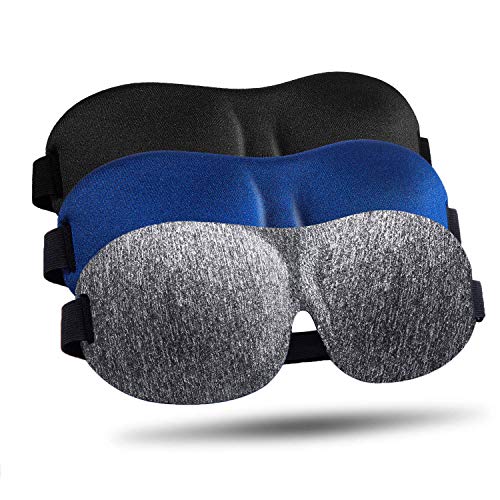
The LKY Digital three-pack takes a different approach from every other mask here: instead of one premium mask, you get three contoured masks in a single purchase. Each mask uses a molded three-dimensional shape with raised cups over the eyes, an adjustable strap, and a blackout design that blocks light without pressing on the eyelids. The value is in the spares. One mask lives in the toiletry bag, one stays in the tent, and one is ready for the laundry rotation or for a family member who forgot theirs.
The contoured shape is the key feature. Raised cups hold the fabric away from the eyes, so you can blink freely and the mask never presses on your lashes. That makes this pack a good choice for side sleepers, because the cups keep their shape when the cheek meets the pillow, and for anyone who found flat masks irritating. The strap adjusts to fit different head sizes, and because there are three masks, each person in a family can set their own strap tension and leave it set. No one has to readjust a shared mask every night.
Having three masks changes how you use them. A single mask on a long trip gets dirty, and washing it every day is a chore. With three, you rotate: one in use, one clean and ready, one in the wash. On a family camping trip, three masks cover three sleepers without a separate purchase for each. On a trip with kids, a spare matters even more, because masks get dropped in the dirt, left at a picnic table, or claimed by a sibling. A lost mask stops being a problem when two more are in the bag.
The masks are light and packable for a molded design. They stack together, cups nesting loosely, and slip into a packing cube without much bulk. The build is simpler than a modular mask and lighter than a memory foam panel, which makes the pack a good fit for car camping and for trips where the mask may be treated roughly. Hand wash them and air dry to keep the shape, and they hold up well through a season of use.
The trade-offs are finish and longevity. A three-pack at this tier does not match the refined materials of a silk mask or the adjustable precision of a modular mask. The foam and fabric are practical rather than luxurious, and the masks may show wear sooner than a single premium mask would. The fit is also a standard molded shape, not a tunable one, so faces far from average will fit the Manta better. For most sleepers, though, the contoured shape fits well, and the convenience of spares outweighs the simpler finish.
For camping, this is the practical pack. It covers a family, it covers a long trip, and it covers the inevitable lost or dirty mask. It is the mask to buy when you need more than one, when you want contoured comfort without a premium outlay, and when a spare in the bag matters more than luxury fabric.
Specs
- Design: three contoured masks with raised eye cups in one pack
- Seal: molded cups seal around each eye with no pressure on eyelids or lashes
- Strap: adjustable strap on each mask for individual fitting
- Care: hand wash and air dry to protect the contoured shape
- Quantity: three masks for rotation, spares, and family use
- Best for: families, long trips, and anyone who wants a spare mask in the bag
- ASIN: B0832GKW4Q
How to Choose for Your Kind of Trip
The right mask depends on how you sleep and where you sleep. Start with your sleep position. Side sleepers need cups that hold their shape against a pillow, which points to the Manta or the Alaska Bear, with the LKY Digital pack as the practical alternative. Back sleepers can use any shape, including the flat Zimasilk, because nothing presses the mask into the face. Stomach sleepers should choose the lightest, lowest-profile mask they can, since any bulk gets pushed into the face, which makes the flat silk mask the natural pick.
Next, consider the temperature. Warm-weather camping favors silk and thin cotton, which breathe and feel cool. Cold-weather camping is kinder to foam masks, because the extra warmth is welcome and the tent is dark for longer anyway. If you camp across seasons, a contoured foam mask is the safer all-rounder, while a silk mask is the better second mask for summer.
Think about who is using the mask. For a solo traveler, one well-fitted mask is enough, and the Manta is worth the fitting time. For a couple, two masks with different shapes often work better than two identical ones, since partners rarely share a face shape. For a family, the three-pack covers the most ground for the least fuss, and the color options on the Zimasilk help tell masks apart. For kids, the lightest mask wins. A child who finds a mask heavy or tight will simply take it off, so start with silk or a light contoured mask and a loose strap.
Light conditions matter too. A tent at dawn, a hostel dorm, and a bright hotel room all leak light differently. In a tent, the main leak is the low sun through thin fabric, which a cupped seal handles well. In a dorm, the leak is often a hallway light or a phone screen, which any decent mask blocks. If you are a very light sleeper, the modular Manta gives the most complete seal, because you can tune each cup. If you sleep deeply, any of these five will do, and comfort becomes the deciding factor.
Finally, think about lashes and glasses. Lash extensions need a cup with real depth, which rules out flat masks entirely. Glasses do not matter while you sleep, but if you wear a mask while reading or resting before sleep, a contoured mask leaves room for the frames to sit naturally. Contact lens wearers should remove lenses before sleep regardless of the mask, since a mask can make a dry lens feel worse by morning.
Who Should Skip Which Mask
No mask suits everyone, and knowing which to skip is as useful as knowing which to buy. Skip the Manta if you want the lightest possible kit or if you will not spend a few minutes fitting the cups. Its bulk and setup time are real, and a traveler who wants a mask to pull on without thinking will be happier with the Alaska Bear or the LKY Digital pack. Skip the Alaska Bear if you sleep hot. Memory foam holds warmth, and on a humid summer night the mask can feel warmer than you would like. Skip the Zimasilk if you wear lash extensions or if pressure on your eyes bothers you, because a flat panel cannot offer the air pocket a contoured mask provides.
Skip the Tempur-Pedic mask if your head is much smaller or larger than average, since the one-size design cannot be tuned the way an adjustable modular mask can. It is also worth skipping if you need several masks for a family, because buying one at a time costs more in effort than a three-pack. Skip the LKY Digital three-pack if you want luxury materials or a precisely tunable fit. Its strength is practicality and spares, not refinement, and a sleeper who has struggled with fit will do better with the Manta.
Children deserve a special note. A mask that is too tight can leave a mark and put a child off masks entirely, so fit a child with a loose strap and a light mask, and let the child choose the color when there is a choice. A mask is a sleep aid, not a piece of safety gear, and a child who does not want to wear one should not be forced. The mask should make the tent feel cozy, not restrictive.
People with certain eye conditions should also take care. If you have an eye infection, a recent eye procedure, or a condition that makes your eyes sensitive to pressure, talk to your eye doctor before using a mask that presses on the face. A flat silk mask with a loose strap is usually the gentlest option, but a doctor can advise for your specific situation. The same goes for anyone who uses a breathing device at night: check that the mask strap does not interfere with the device headgear, and choose a mask with a thin, flat strap if it does.
Care, Packing, and Everyday Use
A mask lasts longer when it is cleaned and stored well. Wash a mask after several nights of use, or sooner if it feels oily or smells of campfire smoke. Hand washing in cool water with a mild soap is the safest method for every mask in this roundup. Machine washing is fine for the Manta and the Alaska Bear when the mask is inside a mesh bag, but the cups should be protected and the mask should always air dry. Heat from a dryer can deform molded foam and dull silk, so lay the mask flat or hang it in the shade.
Packing is simple. Flat masks fold into any pocket. Molded masks should be packed where their shape is protected, such as inside a packing cube or a toiletry bag, rather than crushed at the bottom of a pack. Modular masks should be kept together in a pouch so the cups do not separate. A small stuff sack or a zip bag keeps the mask clean in a dusty pack and keeps it easy to find in the dark.
At home, the same mask that serves at camp can help with daytime naps, shift work, and bright bedrooms. Keep one mask by the bed and one in the travel bag, so you are never without one when a trip comes up. A mask that lives in the bag is a mask that gets used, and a mask that lives in a drawer at home does not help on the road. Rotate masks if you own more than one, so each one gets washed and aired between uses.
One last habit makes a real difference: fit the mask before the trip. Spend an evening wearing it at home, adjust the strap, and check the seal with the lights on. A mask fitted at home is a mask that works on the first night at camp. A mask tried for the first time in a dark tent is a mask that may leak, slip, or press, and you will spend the night adjusting it instead of sleeping. The fitting takes a few minutes at home and saves a night of poor sleep outdoors.
Frequently Asked Questions
Which eye mask is best for side sleepers?
A contoured mask with deep cups works best for side sleepers, because the cups hold their shape when the cheek presses into a pillow. The Manta Sleep Mask is the strongest choice here, since each cup adjusts independently, and the Alaska Bear memory foam mask is the simpler alternative. A flat mask can also work because it has almost no bulk for the pillow to push, but its seal at the nose can open when the face turns into the pillow.
Can children use an eye mask for camping?
Children can use an eye mask for camping, and a light mask can help a child fall asleep in a bright tent. Choose the lightest mask available, fit the strap loosely so it never leaves a mark, and let the child pick the color when there is a choice. A flat silk mask is usually the easiest for a child to accept. If a child does not want to wear a mask, do not force it; the mask should make the tent feel cozy, not restrictive.
How do I keep an eye mask clean on a camping trip?
Hand wash the mask in cool water with a mild soap and air dry it, which works for every mask in this roundup. Bring a spare mask on longer trips so one can dry while the other is in use, which is exactly what the three-pack is for. Store the mask in a small bag or pouch to keep it clean in a dusty pack, and keep it out of direct sun while it dries.
Do eye masks help with sleeping in a tent at dawn?
An eye mask helps a great deal with dawn light in a tent, because tent fabric blocks very little sunlight. A mask with a good seal around the eyes and the nose keeps the tent dark even after sunrise, which lets you sleep past first light. Pair the mask with earplugs if the campground is noisy, since the mask blocks light but not sound, and the combination covers both kinds of disturbance.
Conclusion
An eye mask is one of the smallest and most useful items in a camp kit. It weighs almost nothing, needs no batteries, and turns a bright tent, a lit dorm, or a sunny bedroom dark on demand. The five masks in this roundup cover the shapes that matter: the Manta Sleep Mask for the most adjustable, most complete seal; the Alaska Bear memory foam mask for simple contoured comfort with no pressure on the eyes; the Zimasilk silk mask for warm nights and ultralight packing; the Tempur-Pedic mask for straightforward molded comfort in a single size; and the LKY Digital three-pack for families and long trips where a spare mask is worth more than luxury fabric.
Choose by your sleep position first, then by temperature, then by how many masks you need. Side sleepers and lash wearers should pick a contoured cup. Warm-weather campers should pick silk. Families should pick the three-pack. Fit the mask at home before the trip, wash it gently, and keep a spare in the bag. With the right mask, dawn stops being an alarm clock, and the tent stays as dark as you need it to be.
Product and ASIN Reference
| Product | ASIN |
|---|---|
| Manta Sleep Mask | B07PRG2CQY |
| Alaska Bear Memory Foam Contoured Sleep Mask | B07CPWZSZN |
| Zimasilk Mulberry Silk Sleep Mask | B0761QNQYW |
| Tempur-Pedic Sleep Mask | B0027OUUFW |
| LKY Digital Sleep Mask 3-Pack | B0832GKW4Q |