Key takeaways
- Compare five travel routers for hotel and public Wi-Fi, from Wi-Fi 6 VPN models to tiny nano routers, with bands, ports, VPN support and power details.
Hotel and airport Wi-Fi usually means signing every phone, laptop and tablet in separately through a login page, on a network shared with every other guest. A travel router shrinks that to one connection: the router joins the venue network or plugs into the room’s Ethernet port, then rebroadcasts it as your own private network with your own name and password, so all of your devices sign in once, to a network you control.
This guide compares five pocket routers from two established makers, each checked against two independent sources for brand, model and headline specs. Three are GL.iNet models built around OpenWrt firmware with built-in VPN clients, from Wi-Fi 6 flagships down to a budget Wi-Fi 5 pick. Two are TP-Link nano routers that skip VPN extras for tiny size and simple multi-mode operation. Bands, ports, VPN ceilings and power are the details that separate them.
As an Amazon Associate, we earn from qualifying purchases.
Quick answer
For most travelers, the GL.iNet GL-MT3000 (Beryl AX) is the strongest all-round pick: Wi-Fi 6 speeds, a 2.5-gigabit WAN port and maker-rated WireGuard throughput up to 300 Mbps. The GL-AXT1800 (Slate AX) suits anyone who wants faster VPN figures and more LAN ports. On a budget, the GL-SFT1200 (Opal) covers the basics, while the two TP-Link nano routers are the smallest, simplest options.
GL.iNet GL-MT3000 (Beryl AX)

The Beryl AX is GL.iNet’s current pocket flagship, built on a MediaTek MT7981B dual-core processor at 1.3 GHz with 512 MB of DDR4 memory. It is a Wi-Fi 6 router rated at 574 Mbps on 2.4 GHz and 2,402 Mbps on 5 GHz, with two external antennas that fold flat against a body of about 120 by 83 by 34 millimeters.
Wired connections are a step above the rest of this list: one 2.5-gigabit WAN port, one gigabit LAN port, and a USB 3.0 port the maker supports for storage, tethering and cellular modems. Power comes in over USB-C. The OpenWrt-based firmware includes repeater mode for joining existing Wi-Fi, an AdGuard Home option, and VPN client and server support for OpenVPN and WireGuard. GL.iNet rates the ceilings at up to 150 Mbps for OpenVPN and 300 Mbps for WireGuard, from its own local-network tests in client mode, so the venue line will usually be the slower link.
Specs
- Brand and model: GL.iNet GL-MT3000 (Beryl AX)
- Wi-Fi: Wi-Fi 6 (802.11ax), dual band, 574 Mbps (2.4 GHz) plus 2,402 Mbps (5 GHz)
- Ports: 1 x 2.5 Gbps WAN, 1 x 1 Gbps LAN, 1 x USB 3.0, USB-C power input
- VPN: OpenVPN client and server (maker-rated up to 150 Mbps), WireGuard client and server (up to 300 Mbps)
- Processor and memory: MediaTek MT7981B dual-core 1.3 GHz, 512 MB DDR4, 256 MB flash
- Firmware: OpenWrt-based, with repeater mode and AdGuard Home
GL.iNet GL-AXT1800 (Slate AX)
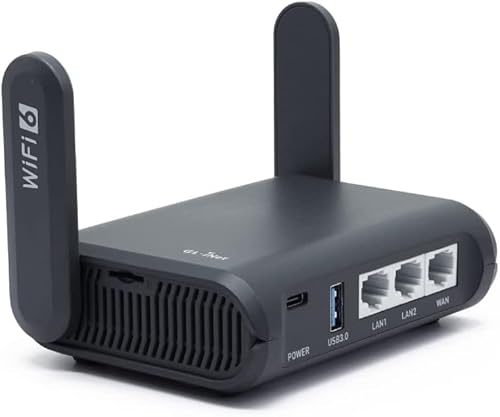
The Slate AX is the larger, more powerful GL.iNet option, built around a quad-core IPQ6000 processor at 1.2 GHz. It is also Wi-Fi 6, rated at 600 Mbps on 2.4 GHz and 1,200 Mbps on 5 GHz, and GL.iNet rates it for up to 120 connected devices. Retractable antennas fold into a body measuring 125 by 82 by 36 millimeters, at 245 grams.
Its port layout is the most complete here: one gigabit WAN, two gigabit LAN ports, a USB 3.0 port for storage sharing, and a microSD slot accepting cards up to 512 GB. Power is USB-C at 5V/4A per the maker, with consumption under 8.75 watts. VPN support covers OpenVPN and WireGuard as client and server, with higher rated ceilings than the Beryl AX: up to 560 Mbps for OpenVPN with DCO support and 550 Mbps for WireGuard, again from the maker’s local-network tests in client mode. WPA3, DNS over HTTPS and DNS over TLS, and AdGuard Home round out the stated features.
Specs
- Brand and model: GL.iNet GL-AXT1800 (Slate AX)
- Wi-Fi: Wi-Fi 6 (802.11ax), dual band, 600 Mbps (2.4 GHz) plus 1,200 Mbps (5 GHz)
- Ports: 1 x gigabit WAN, 2 x gigabit LAN, 1 x USB 3.0, 1 x microSD slot (up to 512 GB), USB-C power input
- VPN: OpenVPN client and server (maker-rated up to 560 Mbps with DCO), WireGuard client and server (up to 550 Mbps)
- Device capacity: Up to 120 devices, per the maker
- Power: USB-C, 5V/4A input; consumption under 8.75 W per the maker
GL.iNet GL-SFT1200 (Opal)
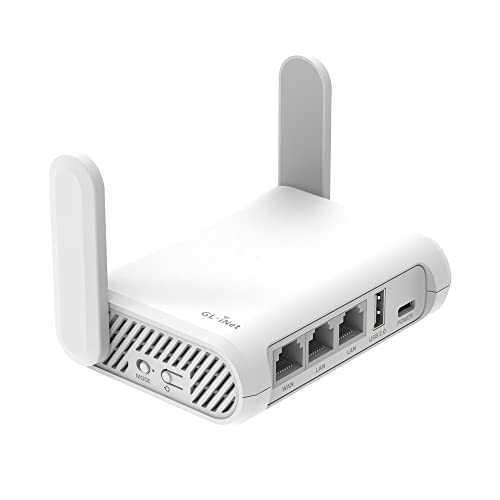
The Opal is GL.iNet’s budget travel router, trading wireless generation and VPN speed for a simpler spec sheet. It is a Wi-Fi 5 unit rated at 300 Mbps on 2.4 GHz and 867 Mbps on 5 GHz, with gigabit Ethernet ports and a USB 2.0 port, in the same pocketable format as the rest of the line.
It runs the same style of OpenWrt-based firmware with repeater mode and both VPN protocols, but the maker’s own comparison figures put its ceilings far lower: up to 21 Mbps for OpenVPN and up to 65 Mbps for WireGuard, measured via Ethernet. That covers email, browsing and messaging over a VPN, but it will bottleneck a fast hotel line or a video call with the VPN on. One caution: recent Amazon listing crawls for this model showed no featured offers, so check the listing’s current availability before counting on it.
Specs
- Brand and model: GL.iNet GL-SFT1200 (Opal)
- Wi-Fi: Wi-Fi 5 (802.11ac), dual band, 300 Mbps (2.4 GHz) plus 867 Mbps (5 GHz)
- Ports: Gigabit Ethernet (1 x WAN, 2 x LAN), 1 x USB 2.0, USB-C power input
- VPN: OpenVPN client and server (maker-rated up to 21 Mbps), WireGuard client and server (up to 65 Mbps)
- Firmware: OpenWrt-based, with repeater mode
TP-Link TL-WR902AC

TP-Link’s AC750 travel router takes a different approach: no VPN client and no open firmware, just a small dual-band router with a mode for nearly every travel situation. It is rated at 300 Mbps on 2.4 GHz and 433 Mbps on 5 GHz under 802.11ac, and TP-Link describes it as pocket-sized, made to be carried in a pocket, purse or bag.
The five modes cover the common cases: Router mode turns a hotel Ethernet port into private Wi-Fi, Hotspot mode joins a public WISP access point, and Range Extender, Client and Access Point modes handle home use. A single 10/100 Ethernet port serves as WAN or LAN depending on mode, and the USB 2.0 port shares files from a storage drive or charges one phone at 5V/1A, per TP-Link. The router runs from a micro USB power input, so a laptop port or power bank can keep it going. It suits travelers who want a simple private network and no router-level VPN.
Specs
- Brand and model: TP-Link TL-WR902AC
- Wi-Fi: Wi-Fi 5 (802.11ac), dual band, 300 Mbps (2.4 GHz) plus 433 Mbps (5 GHz)
- Ports: 1 x 10/100 WAN/LAN, 1 x USB 2.0 (file sharing, 5V/1A charging output), micro USB power
- Modes: Router, Hotspot, Range Extender, Client and Access Point, per TP-Link
- VPN: No VPN client stated by the maker
TP-Link TL-WR802N

The TL-WR802N is the smallest and oldest design in this guide, a single-band nano router measuring 2.2 by 2.2 by 0.7 inches at about 1.06 ounces. It tops out at 300 Mbps on 2.4 GHz under 802.11n, which makes it a browsing-and-email tool rather than a streaming hub, and its one Ethernet port runs at 10/100 speeds.
What it still does well is flexibility per gram. TP-Link lists Router, Repeater, Client, Access Point and Hotspot (WISP) modes, so it can create a network from a wired port, repeat an existing one, or bridge a wired-only device such as a game console or older smart TV onto Wi-Fi. Power is 5V/1A through micro USB, so almost any USB source runs it. The trade-offs are dated: wireless security stops at WPA2-era encryption per the maker’s datasheet, with no 5 GHz band and no VPN support. Pick it as a tiny backup or single-device bridge, not as a main travel network.
Specs
- Brand and model: TP-Link TL-WR802N
- Wi-Fi: Wi-Fi 4 (802.11n), single band 2.4 GHz, up to 300 Mbps
- Ports: 1 x 10/100 WAN/LAN, 1 x micro USB power input
- Modes: Router, Repeater, Client, Access Point and Hotspot, per TP-Link
- Security: WEP, WPA and WPA2 encryption, per the maker’s datasheet
- Power: 5V/1A via micro USB
Who it’s for / who should skip
These five suit travelers who regularly work or stream from hotels, rentals, RVs and cruise cabins: people who want every device on one remembered network, who hit per-device sign-in limits, or who want a VPN running at the router so phones, tablets and streaming sticks share one configuration. The GL.iNet trio fits the VPN-minded, the Slate AX fits groups with many devices, and the TP-Link pair fits minimalists who only need a private sign-in of their own.
Skip the category entirely if you only carry a phone and a laptop, since a phone hotspot or each device’s own VPN app may be simpler. Skip the TL-WR802N if you need 5 GHz or modern encryption, and skip the Opal if you expect to push a VPN at video-call speeds. Also skip all of these where venue terms prohibit attaching routers or Wi-Fi is billed per device, since a router does not change what the venue allows or charges.
How they compare with alternatives
Against a phone hotspot, a travel router wins on battery life, device count and wired sources, since it can turn a room’s Ethernet port into Wi-Fi without draining your phone; a hotspot wins when there is no venue network worth joining. Against a full-size home router, every model here gives up range, antenna size and ports to fit in a carry-on. Against running a VPN app on each device, a router-level VPN client covers gadgets that cannot run VPN apps, such as many streaming sticks and e-readers, but adds a box to configure. A basic Wi-Fi extender is cheaper for fixing one dead zone at home, but lacks the modes and VPN options that make the GL.iNet models useful on the road.
Frequently asked questions
How does a travel router handle a hotel login page?
In repeater or hotspot mode, the router joins the hotel network first, then you open the login page once, usually from a phone or laptop connected to the router’s own network, and the venue registers the router’s connection. Every device behind the router then shares that single sign-in. Steps vary by brand and venue, and device or time limits still apply, so follow both the maker’s guide and the venue’s terms.
Does a travel router make public Wi-Fi safe?
No, not by itself, and it is worth being plain about that. A travel router gives you your own network name, password and firewall between your devices and other guests, a real improvement over joining an open network directly. But the link between the router and the venue is still the venue’s network. A VPN client on the router, as the three GL.iNet models support, encrypts traffic between the router and your VPN provider when configured and connected; without it, treat hotel Wi-Fi with the same caution as any public network.
Can I use a travel router on a cruise ship or plane?
Only where the operator allows it. Some cruise lines and airlines prohibit routers or network sharing in their Wi-Fi terms, and many sell access per device, so a router may not connect or may breach the terms you accepted. Check the operator’s current policy before you travel, and expect satellite connections to be slow regardless of router. Where routers are permitted, the repeater-style modes on these models are the ones designed for joining an existing wireless network.
Which power supply do these routers need?
All five run on 5-volt USB power, but details differ. The GL.iNet models take USB-C inputs, with the Slate AX specified at 5V/4A by its maker, so use the supplied adapter or one matching the stated rating. The TP-Link models use micro USB, at 5V/1A for the TL-WR802N. A power bank can run the smaller models, handy in cabins and older rooms with few outlets.
Final verdict
Pick the GL.iNet GL-MT3000 (Beryl AX) for the best balance of size, Wi-Fi 6 speed and VPN headroom, or the GL-AXT1800 (Slate AX) for the fastest maker-rated VPN figures and extra LAN ports. Choose the GL-SFT1200 (Opal) to spend less and still get the GL.iNet software, subject to checking its current availability. Choose the TP-Link TL-WR902AC for the simplest dual-band private network without VPN, and the TL-WR802N as an ultra-small backup or wired-device bridge. Whichever you pick, confirm the venue allows routers before relying on one, and set expectations by the venue’s connection, not the numbers on the box.
Product and ASIN Reference
| Product | ASIN |
|---|---|
| GL.iNet GL-MT3000 (Beryl AX) | B0BPSGJN7T |
| GL.iNet GL-AXT1800 (Slate AX) | B0B2J7WSDK |
| GL.iNet GL-SFT1200 (Opal) | B09N72FMH5 |
| TP-Link TL-WR902AC | B01N5RCZQH |
| TP-Link TL-WR802N | B00TQEX8BO |