Key takeaways
- Compare four home auto touch up paint sprayers for chips, scratches and spot repairs, with nozzle, cup and air supply specs taken from each Amazon listing.
The real decision with a touch up sprayer is not how fast it lays paint down, but how little paint it wastes on a repair the size of a coin. A stone chip, a key scratch or a scuffed bumper corner needs a small fan pattern, a fine fluid tip and a cup that holds just enough mixed paint for one panel, because leftover two-stage paint cannot go back in the can. Buy a gun built for whole panels and you will spend more time cleaning it than spraying.


This guide is for home users repairing their own cars in a driveway or garage, working from a small air compressor. Every pick below is a mini or detail gun, or a set built around one, whose Amazon listing states automotive touch-up or detail painting in its own wording. Specs come from the title and product details on each listing, not from roundups.
Quick Picks
As an Amazon Associate we earn from qualifying purchases.
| Product | Best for | Key spec from title |
|---|---|---|
| SRQLNTT HVLP Air Paint Spray Gun Set (SR802GT touch-up gun) | Spot clear coat and bumper corner repairs | 1.0mm nozzle and 125ml cup on the touch-up gun |
| TCP Global Automotive HVLP Spray Gun | Door jambs and small panel repairs at home | 1.0mm stainless steel tip, 150cc aluminum cup |
| Dynastus Touch Up 5 oz HVLP Air Spray Gun | First-time users who want a regulator in the box | 1.0mm nozzle with regulator, 5 oz cup |
| PNTGREEN HVLP Mini Spray Gun H2001 | Fine chips and tight detail work | 0.8mm nozzle, 125cc cup |
How to Choose
Match the fluid tip to the size of the repair
Tip size decides how tight a pattern the gun can hold. A 0.8mm tip suits rock chips, thin scratches and small blend edges where you want paint to land in a narrow band. A 1.0mm tip is the safer all-round choice for home touch up work: it handles base coat and spot clear coat on areas like a door handle surround or a mirror cap without forcing you to thin the paint excessively. Larger tips around 1.3mm and up belong to full panel guns. They flood a small repair, build edges too fast and make blending into the surrounding finish much harder to control.
Pick a cup size you can clean without resentment
Touch up work uses very little paint, so cup size is really about waste and cleaning effort. A 125cc cup is enough for several chip repairs or one small panel, and it rinses out quickly with a small amount of solvent. A 150cc cup gives a little more working time on a bigger spot repair, such as a scuffed bumper corner, before you stop to refill. Avoid guns with large 600ml cups for this job: mixed paint left sitting in a big cup is paint you throw away, and a heavy cup changes how a small gun balances in your hand.
Check your compressor against the gun’s air figures
Every gun in this guide is air powered, so the listing’s pressure and air consumption figures decide whether your compressor can keep up. Working pressures here run from about 20 to 51 PSI depending on the model, and air consumption figures run up to about 9 CFM on the hungriest pick. A small garage compressor that copes with short bursts is usually fine for chip work, because you spray in seconds, not minutes. Problems start on longer spot repairs, where a weak compressor lets pressure sag mid-pass and the pattern turns coarse. Match the gun to the compressor you own, not the one you plan to buy.
Look for three controls and a cleaning plan
A usable touch up gun needs separate adjustment for spray pattern, fluid flow and air flow, because each repair asks for a different combination: narrow pattern and low fluid for a chip, wider pattern for a blended clear spot. All four picks below list three controls in some form. Also think about what happens after spraying. Two-stage automotive paint hardens inside a gun quickly, so a model that includes a filter, a cleaning brush or a regulator you can dial down for a test spray saves real frustration. Guns sold with only a manual mean you supply the rest of the cleaning kit yourself.
The 4 Best Options
SRQLNTT HVLP Air Paint Spray Gun Set (SR802GT and SR801GT)
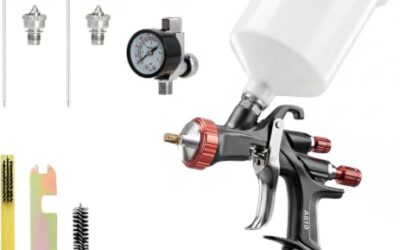
This is a two-gun set, and the reason it belongs here is the smaller SR802GT gun. Its listing specification table assigns that gun a 1.0mm nozzle and a 125ml cup, and names its suitable coatings as touch-up paint, spot clear coat application and detail coatings, with an application scope of corners, bumper corners, door handles and undercarriage edges. The product description also names automotive touch-ups directly. The larger SR801GT gun covers primer and full panels when a repair grows, so the set suits a home user whose jobs range from chips to one repainted door.
Specs
- Touch-up gun (SR802GT): 1.0mm nozzle, 125ml cup, 240mm maximum spray width
- Second gun (SR801GT): 1.4mm and 1.7mm nozzles, 600ml cup
- Working pressure: 2.0 to 3.5 bar (29 to 51 PSI)
- Air inlet: G1/4, Japanese Standard and NPT options listed
- Material: aluminum
- Model number: SR801GT+SR802GT
Best for: Home users who want one purchase covering spot clear coat work and the occasional larger panel.
Watch out for: Half of this set is a full-size panel gun, so buyers who only ever fix chips are paying for capacity they will not use.
ASIN: B0GCB4656H
TCP Global Automotive HVLP Spray Gun (G5500)
TCP Global sells this as an automotive gun first and foremost: the listing copy calls it a high-quality automotive paint gun and an ideal touch up paint gun for spot repairs, and describes it reaching tight spaces such as door jambs and small panels where larger automotive guns cannot work. The single 1.0mm stainless steel tip and 150cc aluminum gravity feed cup sit right in the home touch up range, giving slightly longer spray time between refills than the 125cc guns here. Pattern, fluid flow and air pressure are each adjustable from the gun’s own knobs.
Specs
- Fluid tip: 1.0mm stainless steel
- Cup: 150cc aluminum gravity feed cup
- Controls: pattern width, fluid flow and air pressure adjustment knobs
- Model name: G5500
- Brand: TCP Global
Best for: Owners repairing door jambs, small panels and spot repairs who want a metal cup instead of plastic.
Watch out for: The listing offers one tip size only, so heavier primer work on a larger repair is outside what this gun is set up for.
ASIN: B001NJLQHI
Dynastus Touch Up 5 oz HVLP Air Spray Gun

Dynastus names this gun for exactly the job in the keyword: the title calls it an auto car detail paint sprayer for spot repair, and the listing bullets describe a 125cc gravity feed cup and 1.0mm nozzle as perfect for detailed spot repairs and tight spaces. It runs at low pressure, between 20 and 43 PSI, and the listing states a minimum compressor size of 3/4 HP, which makes matching it to a small home compressor unusually straightforward. Three built-in knobs cover fluid, pattern and air adjustment, and the regulator version adds a gauge at the gun.
Specs
- Nozzle: 1.0mm stainless steel
- Cup: 125cc gravity feed (listed as 5 oz)
- Operating pressure: 20 to 43 PSI, maximum pressure 43 PSI
- Material: aluminum
- Model number: 232022
- Manufacturer: Dynasty Tools
Best for: Beginners who want the compressor requirement and pressure range stated plainly before they buy.
Watch out for: The small cup means frequent refills if a repair grows from chips into a whole bumper corner, and the gun still needs that minimum 3/4 HP compressor.
ASIN: B0921VJB8F
PNTGREEN HVLP Mini Spray Gun H2001

The PNTGREEN H2001 is the finest-tipped gun in this guide. Its Amazon listing title for the H2001 variant reads Mini HVLP Gravity Feed Touch Up Air Spray Gun, and the bullet points state a 0.8mm stainless steel nozzle with a brass airflow cap, used for automotive painting among other surfaces. That smaller tip is the one to reach for when the repair is a row of stone chips on a hood edge rather than a panel section. The 125cc cup detaches for cleaning, the nozzle direction adjusts through a full circle, and at 0.73 pounds it is the lightest gun here.
Specs
- Fluid nozzle: 0.8mm stainless steel, brass airflow cap
- Cup: 125cc detachable gravity feed cup
- Air pressure: 3 bar (43 PSI)
- Air consumption: 9 CFM
- Air inlet: 1/4 inch
- Item weight: 0.73 pounds
- Model number: H2001
Best for: Fine chip work and narrow scratches where a 1.0mm pattern would lay paint too wide.
Watch out for: The listing states that cleaning accessories and extra nozzles are not included, so budget a brush kit separately, and its 9 CFM air consumption is the highest figure in this guide.
ASIN: B07CPMHZFS
Which One Fits Your Situation
You are fixing stone chips and parking scratches
Start with the PNTGREEN H2001. Its 0.8mm tip lays the narrowest pattern here, which keeps base coat inside the damaged area instead of fogging the good paint around it. The small detachable cup also fits this work, because a chip session uses very little paint and ends with a quick rinse rather than a full strip-down clean.
You are blending a scuffed bumper corner
Choose the SRQLNTT set and use the SR802GT gun. The listing names bumper corners in that gun’s application scope and lists spot clear coat among its suitable coatings, which is exactly the two-stage sequence a bumper repair needs. The 125ml cup holds enough for the corner without mixing a panel-sized batch.
Your compressor is small and old
Look at the Dynastus first. It is the only pick whose listing states a minimum compressor size, 3/4 HP, and its 20 to 43 PSI working range is gentle on tired equipment. Short touch up bursts stay inside what a modest garage compressor can deliver, so pressure is less likely to sag halfway across a repair.
You want one gun for jambs, mirrors and small panels
The TCP Global G5500 fits that brief. Its 150cc aluminum cup runs a little longer between refills than the 125cc guns, the metal cup shrugs off solvent cleaning, and the listing describes it reaching door jambs and small panels directly. It is the most single-purpose automotive tool in this guide.
Common Mistakes
- Buying a full-size panel gun for chip work, then fighting a wide pattern and a heavy cup on repairs the size of a coin.
- Mixing a full cup of two-stage paint for three stone chips and throwing most of it away after it passes its usable life.
- Ignoring the listing’s air consumption figure and pairing a 9 CFM gun with a compressor that cannot sustain it.
- Spraying clear coat over a repair that was never cleaned or degreased, so the new paint lifts at the edges within weeks.
- Skipping a test spray on cardboard, then discovering the pattern is set wrong on the car itself instead of on scrap.
Frequently Asked Questions
Can a touch up gun spray both base coat and clear coat?
Yes, and the listings here say so in their own terms: the SRQLNTT touch-up gun lists touch-up paint and spot clear coat among its suitable coatings, while the other guns are described for automotive paint generally. In practice, clean the gun thoroughly between stages, because dried clear residue in the fluid path will spoil the next base coat pass.
What size compressor do I need for home touch up work?
Match the gun, not a rule of thumb. The Dynastus listing states a minimum of 3/4 HP and a 20 to 43 PSI working range, while the PNTGREEN lists 9 CFM air consumption at 43 PSI. Touch up spraying happens in short bursts, so a modest garage compressor usually keeps up as long as its delivery covers the figure on the listing you choose.
Is a 0.8mm or 1.0mm tip better for touch ups?
It depends on repair size. A 0.8mm tip, like the PNTGREEN H2001, keeps paint in a narrower band for chips and thin scratches. A 1.0mm tip, fitted to the other three picks, covers small panels and spot clear work more comfortably. If your repairs vary, the 1.0mm size is the more forgiving single choice.
Do I still need to sand and mask for a small sprayed repair?
Yes. A spray gun does not remove the prep work: the damaged area still needs cleaning, light sanding for adhesion and masking to protect surrounding paint from overspray. The gun only changes how the paint arrives, laying a thinner and more even film than a brush, which is why the finish blends better afterward.