Our Short List of 3
All 4 Picks at a Glance
| Product | Specs | Action |
|---|---|---|
 1. Wagner Control Pro 130 Power Tank Paint Sprayer | Check price on Amazon | |
 2. HomeRight Super Finish Max HVLP Paint Sprayer | Check price on Amazon | |
 3. Wagner FLEXiO 590 Handheld HVLP Paint Sprayer | Check price on Amazon | |
 4. Graco Magnum X5 Stand Airless Paint Sprayer | Check price on Amazon |
Key takeaways
- Looking for the best inexpensive exterior paint sprayers? Compare budget-friendly airless and HVLP models for siding, fences, decks, sheds, and more.
Introduction
Painting the outside of a house with a brush and roller takes days. A fence that would swallow a whole weekend with a brush can be coated in a single afternoon with a sprayer. The trouble is that professional rigs carry professional price tags. Yet a growing group of budget-tier sprayers is built for exactly this kind of work: siding, fences, decks, and sheds, handled by a homeowner rather than a crew.
The best inexpensive exterior paint sprayers spray unthinned latex paint, cover a wide area quickly, and clean up in a few minutes with water. This guide looks at four models that fit that description, explains how to choose between them, and covers the preparation and technique that make the difference between a smooth coat and a mess.
How to Choose an Inexpensive Exterior Paint Sprayer
Airless or HVLP
Airless sprayers push paint through a small tip at high pressure and lay down a lot of material fast, which suits broad surfaces such as siding and fences. HVLP sprayers, short for high volume low pressure, use a turbine to move a large volume of air at low pressure. They give a finer finish and more control, which suits trim, doors, and smaller sections, though they work more slowly on a whole wall. For a full house exterior, an airless model usually wins on speed; for trim work, an HVLP model is the more flexible choice.
Unthinned latex capability
Exterior paint is usually a thick latex coating, and many low-cost sprayers can only handle it after thinning. Thinning adds measuring and guesswork, and a coat thinned too far may need an extra pass. A sprayer rated for unthinned latex saves time and keeps the coating at the thickness the manufacturer intended. Treat this capability as a requirement for exterior work rather than a bonus.
Flow rate and coverage
Flow rate tells you how much paint a sprayer can move. Handheld HVLP units move a modest amount per hour, which is fine for a fence panel or a shed door. Cart and stand airless units move far more, which is what you want for a whole side of a house. Match the flow rate to the size of the job: a small sprayer on a large house means constant refills, while a large sprayer on a small gate wastes setup and cleanup time. The tip also matters: a wider tip covers siding fast, a narrower tip suits trim, and some tips reverse to clear a clog without taking the gun apart.
Paint supply: cup or bucket feed
Handheld sprayers carry paint in a cup attached to the gun, usually holding around a quart. That is plenty for trim and small sections, but on a long fence you will stop to refill often. Stand and cart airless sprayers draw paint directly from a one or five gallon bucket through a suction tube, so you can keep spraying until the bucket runs dry. For a whole exterior, bucket feed is a real advantage. For a single fence or a shed, a cup is lighter and simpler. A hose of 25 feet lets you work along a wall while the unit stays put, which also matters on a ladder.
Weight and cleanup
Exterior jobs are physical work, and a heavy sprayer adds fatigue. Handheld units weigh only a few pounds, while stand units sit on the ground, so you carry only the gun and hose. Latex paint cleans up with water, and models with a flush adapter that connects to a garden hose make the job far quicker.
Top Picks
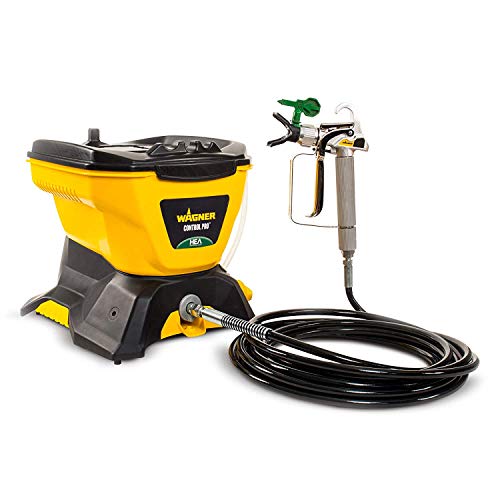
1. Wagner Control Pro 130 Power Tank Paint Sprayer
The Wagner Control Pro 130 is a stationary airless sprayer built around a 1.5 gallon tank. Instead of refilling a small cup, you pour paint into the tank and spray from a gun connected by a 25 foot hose. That combination suits long runs of siding and fence, where stopping to refill breaks your rhythm and leaves visible edges in the coat.
It uses High Efficiency Airless technology, described as producing less overspray than traditional airless spraying. Maximum pressure is rated at 1600 psi, and the unit sprays unthinned latex paint, so there is no thinning step. The included 515 HEA spray tip is sized for latex paints on broad surfaces, and the gun and hose fit inside the tank for storage.
At 11 pounds, the tank unit is light enough to carry to the work area, and the long hose means you can leave it on the ground and work up a ladder with only the gun in hand. The listing describes it as suited to houses, sheds, garages, decks, and fences. Cleanup is a flush and rinse, and the tank design means fewer separate parts to wash than a cup fed gun. This is the pick for a homeowner facing a whole exterior or a long fence, where tank capacity and hose length remove the two most common frustrations of budget spraying: constant refills and limited reach.
2. HomeRight Super Finish Max HVLP Paint Sprayer
The HomeRight Super Finish Max is a handheld HVLP sprayer built around a 450 watt turbine. It is the lightest and simplest machine in this group, and it suits smaller exterior jobs such as a fence section, a shed door, garden furniture, trim, and railings.
It ships with three brass spray tips, in 1.5, 2.0, and 2.6 millimeter sizes, and three spray patterns. The smaller tips suit fine work and thinner materials such as stains and sealers, while the larger tip handles latex paint. The pattern can be set horizontal or vertical, and the nozzle twists to change the fan direction without tools. The cup holds 27 ounces, enough for a section of fence or a door before a refill, and the whole unit weighs under three pounds, so arm fatigue stays low even on a long session.
The Super Finish Max is designed for furniture, cabinets, and trim, and those same qualities transfer to exterior trim, shutters, and small structures. It handles stains, sealers, and latex paints. Cleanup is straightforward: the cup and nozzle come apart and rinse with water after a latex job. This is the pick for a homeowner whose exterior work is measured in panels and pieces rather than whole walls, and it also works as a second sprayer for detail work alongside a larger airless unit.
3. Wagner FLEXiO 590 Handheld HVLP Paint Sprayer
The Wagner FLEXiO 590 is a handheld HVLP sprayer with a broader range than most handhelds. Its X-Boost turbine is rated to spray unthinned interior and exterior paints and stains, which removes the thinning step that slows many handheld units on exterior latex. That single capability makes it a genuine option for siding and fences, not just for furniture and cabinets.
It includes two nozzles. The iSpray nozzle is made for larger jobs such as walls, fences, and decks, while the Detail Finish nozzle suits small projects and fine finishing. The X-Boost power dial has ten speed settings, so you can turn the flow down for trim and up for a broad wall. The pattern adjusts between horizontal and vertical, wide or narrow, to match the fan to the surface.
Wagner states that the FLEXiO 590 can cover an eight by ten foot surface in one minute for stains and five minutes for latex paints, and that it can spray up to 8.0 gallons per hour. Cleanup is listed at about five minutes. This is the pick for a homeowner who wants one handheld sprayer that can move between exterior walls and interior rooms: the two nozzles and ten speed settings give it a range that a single nozzle handheld cannot match, and the unthinned latex capability keeps exterior work simple.
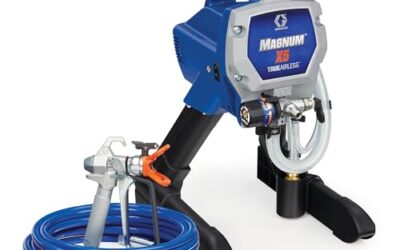
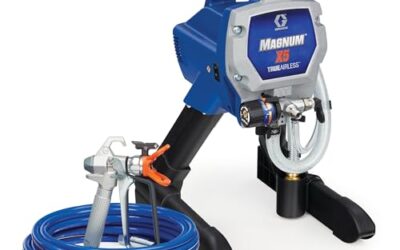
4. Graco Magnum X5 Stand Airless Paint Sprayer
The Graco Magnum X5 is a stand airless sprayer and the most capable machine in this group. It draws paint directly from a one or five gallon bucket through a flexible suction tube, so there is no cup to refill and no tank to pour. For a whole house exterior, that is the most efficient way to work. The annual use recommendation is up to 125 gallons per year, which covers a house exterior plus fences and decks.
Maximum pressure is rated at 3000 psi, with a flow rate of 0.27 gallons per minute. The stainless steel piston pump sprays paint unthinned at high pressure, and the supported tip size goes up to 0.015 inch. It includes the SG2 metal spray gun, a RAC IV 515 SwitchTip that reverses to clear a clog without stopping work, a 25 foot Duraflex paint hose, Pump Armor storage fluid, and a PowerFlush adapter that connects to a garden hose for fast cleaning. The unit can support up to 75 feet of paint hose, which gives extra reach on a tall house.
The manufacturer describes the Magnum X5 as suited to decks, siding, fences, and small homes, and lists it in a project series aimed at homeowners who take on midsize jobs. At 13 pounds in the manufacturer comparison table, the stand unit stays on the ground while you work with the gun and hose. This is the pick for the largest job in this guide: a full house exterior, a long fence line, or several structures in one season.
Comparison Table
| Product | Key Feature | Best For |
|---|---|---|
| Wagner Control Pro 130 | 1.5 gallon tank, 25 ft hose, 1600 psi, HEA technology | Whole house exteriors and long fences |
| HomeRight Super Finish Max | 450 watt turbine, 3 brass tips, 3 patterns, under 3 lb | Trim, shutters, shed doors, and small sections |
| Wagner FLEXiO 590 | X-Boost turbine, 2 nozzles, 10 speed settings, unthinned latex | Mixed interior and exterior work with one handheld |
| Graco Magnum X5 | 3000 psi, 0.27 GPM, bucket feed, 25 ft hose, RAC IV tip | Large exteriors, decks, and siding |
Buying Guide
Match the sprayer to the size of the job
The most common mistake is buying a sprayer that is too small for the project, or too large for it. A handheld HVLP unit is a pleasure on a shed door and a chore on a whole house, because the cup needs refilling every few minutes and the flow rate cannot keep up with a broad wall. A stand airless unit is fast on a house and clumsy on a single gate, because setup and cleanup take longer than the spraying itself. Measure the area first: a fence of a few panels, a shed, or a set of shutters calls for a handheld, while a house side, a long fence run, or several structures calls for a tank or bucket fed airless model.
Prepare the surface before you spray
A sprayer lays paint evenly, but it cannot fix a dirty or loose surface. Wash the siding or fence with water and let it dry fully. Scrape away peeling paint and sand the rough edges smooth. Caulk gaps around trim and windows, and let the caulk cure before painting. Mask windows, lights, and door hardware, and lay drop cloths over plants, paths, and cars. Preparation takes longer than spraying, and it is the step that decides how long the coat lasts.
Mind the weather and the wind
Exterior paint needs a dry surface and a mild day. Avoid spraying in direct sun on a hot wall, because the paint can dry before it levels and leave a rough finish. Avoid cold mornings when dew is still on the surface. Wind is the other factor: even a light breeze carries overspray onto cars, windows, and a neighbor’s fence. Pick a calm day, work in the shade as the sun moves, and stop if the wind picks up.
Learn the technique on a test board
Before pointing the gun at the house, practice on a scrap board or a hidden section of fence. Hold the gun about 10 to 12 inches from the surface and move it in steady, parallel passes, overlapping each pass by about half. Keep the gun moving before you pull the trigger and after you release it, so paint does not pool at the start and end of each pass. Keep the gun square to the surface rather than arcing your arm, which lays paint thick in the middle and thin at the edges.
Plan for cleanup while you work
Latex paint cleans up with water, but only while it is wet. Keep a bucket of water and a hose nearby, and flush the sprayer as soon as the job is done. Models with a PowerFlush style adapter connect straight to a garden hose, which makes the job quick. Run water through until it comes out clear, then take the tip and nozzle apart and rinse them. Pump Armor or a similar storage fluid protects the pump between jobs, so the sprayer is ready next season. A sprayer cleaned the same day lasts for years. Wear a respirator rated for paint spray, plus goggles and gloves, since spraying puts fine paint mist in the air, and keep children and pets away until the paint is dry.
Frequently Asked Questions
Can an inexpensive paint sprayer handle unthinned exterior latex paint?
Some can, and some cannot, so check the listing for each model. The Wagner Control Pro 130, the Wagner FLEXiO 590, and the Graco Magnum X5 are all described as spraying unthinned latex paint. The HomeRight Super Finish Max handles latex paints with its larger brass tip. If a sprayer is not rated for unthinned latex, you would need to thin the paint, which adds a step and changes the coating.
Is an airless or an HVLP sprayer better for a house exterior?
An airless sprayer is usually faster on a house exterior because it moves more paint and covers broad siding quickly. The Control Pro 130 and the Magnum X5 are airless models suited to that work. An HVLP sprayer gives a finer finish and more control, which suits trim, doors, and smaller areas. Many homeowners use an airless unit for the walls and an HVLP handheld for the trim.
How much paint will I need for a fence or a house exterior?
That depends on the surface, the color change, and how rough the wood is. Rough sawn fence boards absorb more paint than smooth siding, and a dark to light color change usually needs a second coat. A sprayer lays paint faster than a brush, but it also uses more paint, because some material becomes overspray. Buy a little more than the paint can label suggests for the area.
How do I keep overspray off windows, cars, and plants?
Mask windows and trim with painter tape and plastic sheeting, and move cars, garden furniture, and potted plants away from the work area. Cover fixed plants with drop cloths. Spray on a calm day, since wind carries mist further than you expect, and work with the wind at your back so overspray drifts away from clean surfaces. Hold the gun close to the surface and keep the pressure at the lowest setting that gives an even fan.
Conclusion
An inexpensive exterior paint sprayer can turn a multi-day painting job into a weekend project, provided the sprayer matches the size of the work. For a whole house or a long fence, a bucket or tank fed airless model such as the Graco Magnum X5 or the Wagner Control Pro 130 gives the speed and capacity the job needs. For trim, shutters, and smaller structures, a handheld HVLP model such as the HomeRight Super Finish Max or the Wagner FLEXiO 590 gives control and a fine finish without the setup of a larger machine. Whichever model you choose, prepare the surface, pick a calm day, practice on a test board, and clean the sprayer the same day.
Disclosure: As an Amazon Associate, we earn from qualifying purchases.