Key takeaways
- Compare five lawn weed killer sprayers for spot work and full-yard coverage, from a 1-gallon handheld pump model to 4-gallon backpack sprayers.
A lawn weed killer only works as well as the sprayer that delivers it. The real decision is not which brand looks sturdiest on a shelf. It is matching the sprayer to the size of your lawn and the way weeds appear in it. A small lawn with scattered dandelions needs a light handheld tank you can carry to each weed. A large lawn with weeds spread across the whole yard needs a bigger tank or a hose-end sprayer, because constant refilling turns a short job into an afternoon of walking back to the tap.


This guide is for homeowners treating a suburban lawn, owners of larger properties who spray whole sections at once, and anyone who applies weed killer several times a season. Every sprayer below was picked from its Amazon listing title and listed specifications, and every one of them is a sprayer only. None of them ships with herbicide in the tank, so you still choose the weed killer separately and mix it as its label directs.
Quick Picks
As an Amazon Associate we earn from qualifying purchases.
| Product | Best for | Key spec from title |
|---|---|---|
| Chapin 20000 1-Gallon Pump Sprayer | Spot-treating weeds on a small lawn | 1-gallon translucent tank |
| Smith Performance Sprayers R200 2-Gallon Compression Sprayer | Frequent treatments with harsh mixes | 2-gallon compression sprayer |
| Ortho Dial N Spray Hose-End Sprayer | Covering a large lawn without pumping | 14 dilution settings |
| Chapin 61900 4-Gallon Backpack Sprayer | Long sessions across a large property | 4-gallon backpack sprayer |
| Field King 190328 4-Gallon Backpack Sprayer | High-pressure spraying with a no-leak pump | Internal no-leak pump, up to 150 PSI |
How to Choose
Tank Size Against Lawn Size
Tank size decides how often you stop to refill, and refilling is where most spraying sessions fall apart. A 1-gallon tank suits a small lawn where you walk to each weed and spray it, because the tank stays light and you finish before it runs dry. A 2-gallon tank covers a medium lawn or a long session of spot work without a second fill. A 4-gallon backpack tank fits a large property where you spray whole beds and borders in one pass. The trade-off is weight: a 4-gallon tank is heavy on your back, so match the tank to the area you spray rather than buying the largest tank and dreading the lift.
Pump Style and Pressure Control
Hand pump sprayers build pressure with a handle on top of the tank, and you pump again when the spray weakens. Backpack sprayers move the pump to a lever at your side, so you keep pressure up while you walk and spray. Hose-end sprayers skip pumping entirely and use water pressure from the garden hose to draw concentrate from a jar. Pressure control matters because weed killer needs an even coat: too little pressure gives a weak dribble, while too much pressure turns the spray into fine mist that drifts onto grass and flower beds you never meant to treat.
Nozzles and Spray Pattern Control
The nozzle decides whether the weed killer lands on the weed or on everything around it. An adjustable cone nozzle moves from a narrow stream for one dandelion to a wide cone for a patch of clover, which makes it the most flexible choice for mixed lawns. Flat fan nozzles lay down an even band across a strip of turf, so they suit blanket applications where weeds are spread evenly. A foaming nozzle leaves a visible mark on each treated weed, which helps you see where you have already sprayed. Look for a sprayer that includes the nozzle styles your lawn needs rather than one fixed pattern.
Seals, Wand Materials, and Chemical Resistance
Weed killers are hard on sprayer parts, and the parts that fail first are the seals and the wand. Viton seals resist chemical attack far longer than standard rubber seals, which is why sprayers built for regular herbicide work list them as a feature. A stainless steel wand with a protective lining stands up to repeated chemical exposure better than a plain plastic wand, and it also reaches under shrubs and along fences without bending. An in-line filter keeps grit and undissolved particles out of the nozzle, so the spray stays steady instead of clogging halfway through a tank. Check these parts before you buy.
The 5 Best Options
Chapin 20000 1-Gallon Pump Sprayer
The Chapin 20000 is the sprayer for a small lawn where weeds show up one at a time. Its 1-gallon tank is light enough to carry by the handle or over a shoulder, and the translucent tank shows the liquid level at a glance, so you never guess how much mix is left. The funnel-top opening makes filling clean, and the 34-inch hose with a 12-inch extension wand reaches under shrubs and along fence lines without bending over. It is a simple manual pump sprayer, so there is nothing to charge and no hose to drag behind you.
Specs
- 1-gallon translucent tank with funnel-top opening
- 34-inch hose with 12-inch poly extension wand
- Adjustable cone nozzle
- Anti-clog filter
- Maximum pressure of 60 PSI
- Made in USA
Best for: Spot-treating scattered weeds on a small lawn.
Watch out for: The 1-gallon tank needs refilling on anything larger than a small lawn, so measure your area before choosing this size.
Smith Performance Sprayers R200 2-Gallon Compression Sprayer
The Smith R200 is built for people who spray weed killer often and want the sprayer to survive it. Viton seals run through the pump and shut-off, giving it the chemical resistance that standard seals lose over a season of herbicide use. The 21-inch stainless steel wand has a poly lining for extra protection, and four nozzles come in the box: an adjustable brass nozzle, a wide flat fan, a narrow flat fan, and a foaming nozzle. A pressure relief valve lets pressure out safely before you open the tank, and the lock-on shut-off keeps the spray going without holding the trigger down.
Specs
- 2-gallon tank
- 21-inch stainless steel wand with poly lining
- Viton seals throughout the pump and shut-off
- Four included nozzles: adjustable brass, wide flat fan, narrow flat fan, foaming
- Pressure relief valve and lock-on shut-off
- In-line filtration system
- Nylon shoulder strap
- Item weight of 4.7 pounds
Best for: Frequent weed killer treatments where chemical resistance matters most.
Watch out for: The 2-gallon tank still needs a refill on a large lawn, so it suits medium lawns and repeated spot work better than whole-yard blanket spraying.
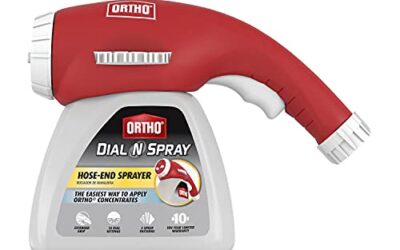
Ortho Dial N Spray Hose-End Sprayer
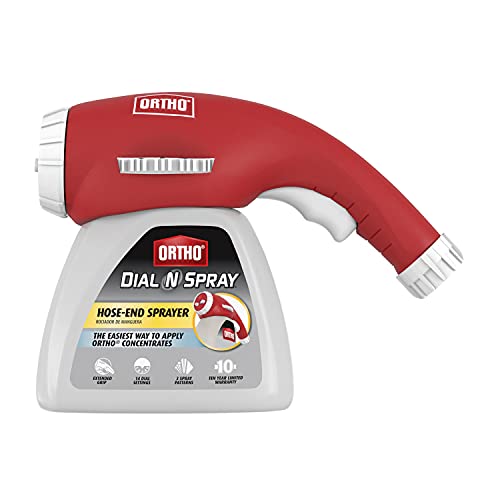
The Ortho Dial N Spray takes a different approach: it connects to a garden hose and uses water pressure to mix and spray, so there is no pumping at all. You pour liquid concentrate into the jar, turn the dial to one of 14 dilution settings, and pull the trigger. The dial mixes from 1 teaspoon to 8 ounces per gallon of water, which covers most liquid weed killers, insect killers, fungicides, and fertilizers. Three spray patterns let you switch between a broad fan and a focused jet, and the extended grip keeps your hands away from the spray.
Specs
- 14 dilution settings, from 1 teaspoon to 8 ounces per gallon
- Three spray patterns
- Extended grip design
- Jar with suction tube
- Connects to a standard garden hose
- 10-year limited warranty
Best for: Covering a large lawn quickly without pumping a tank.
Watch out for: It only works with liquid concentrates and a garden hose, so it cannot spray plain water mixes you prepare in a tank, and the dilution dial needs checking against the weed killer label.
Chapin 61900 4-Gallon Backpack Sprayer

The Chapin 61900 is the sprayer for a large property where a handheld tank would need constant refilling. Its 4-gallon translucent tank carries enough mix for long sessions, and the backpack design spreads the weight across your shoulders while a side pump lever keeps pressure up as you walk. A stainless steel wand and three included nozzles give you pattern choices for different weeds, while a 3-stage filtration system keeps the nozzles clear. The translucent tank lets you watch the liquid level without opening the cap, which is useful when you are far from the tap.
Specs
- 4-gallon translucent tank
- Stainless steel wand
- Three included nozzles
- 3-stage filtration system
- Backpack design with side pump lever
- Made in USA
Best for: Long spraying sessions across a large property.
Watch out for: A full 4-gallon tank is heavy, so try the straps and fit before a long session, and plan your route so you finish near your refill point.
Field King 190328 4-Gallon Backpack Sprayer
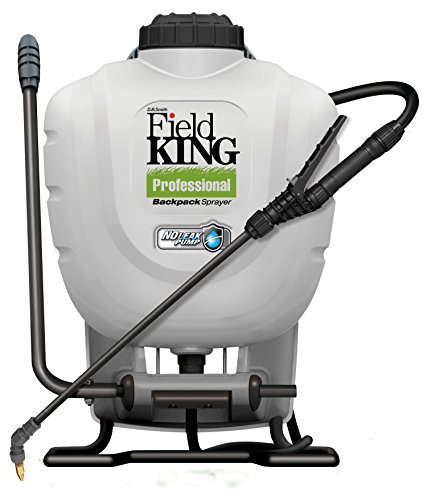
The Field King 190328 stands out for its internal no-leak pump, which keeps the pump sealed away from the chemical tank so liquid cannot drip onto your back while you work. The pump delivers up to 150 PSI, giving a strong, even spray across a wide area, and the tank carries graduated markings at 1, 2, and 3 gallons so you can mix the right amount for the area you plan to cover. The 4-gallon capacity suits large lawns and long sessions, and the backpack frame keeps the weight balanced while you move between beds and borders.
Specs
- 4-gallon tank with graduated markings at 1, 2, and 3 gallons
- Internal no-leak pump design
- Delivers up to 150 PSI
- Backpack design
Best for: High-pressure spraying on a large lawn where a leak-free pump matters.
Watch out for: The strong output needs care near flower beds and vegetable gardens, so keep the nozzle low and check the wind before each pass.
Which One Fits Your Situation
Small Lawn With Scattered Weeds
Choose the Chapin 20000. A small lawn rarely needs more than a gallon of mix, and this sprayer is light enough to carry from weed to weed without tiring your arm. The adjustable cone nozzle lets you hit one dandelion with a narrow stream, then widen the pattern for a clump of clover. Refilling is quick through the funnel top, and the translucent tank shows exactly how much mix remains.
Large Lawn Needing Whole-Yard Coverage
Choose the Ortho Dial N Spray. When weeds cover the whole yard, pumping a tank and refilling it every few minutes wastes the afternoon. This hose-end sprayer uses water pressure to do the work, and the 14 dilution settings let you match the mix to the weed killer label. Walk the lawn in steady strips and the spray keeps flowing as long as the hose reaches.
Frequent Treatments Through the Season
Choose the Smith R200. If you spray every few weeks, the sprayer lives with herbicide in its seals and wand all season. Viton seals and a lined stainless steel wand resist that exposure better than standard parts, and the four included nozzles cover spot work and blanket work alike. The pressure relief valve and lock-on shut-off make repeated sessions easier on your hands.
Big Property With Long Spraying Sessions
Choose the Chapin 61900. A big property needs a big tank, and 4 gallons of mix covers far more ground than a handheld sprayer before a refill. The backpack design and side pump lever let you keep spraying while you walk, and the 3-stage filtration keeps nozzles clear through a long session. If high output matters more than filtration, the Field King 190328 is the alternative, with its no-leak pump and strong spray.
Safety Notes
Weed killers are chemicals, and the sprayer is only as safe as the way you use it. Wear gloves, long sleeves, and eye protection every time you mix and spray, and wash your hands and face when you finish. Spray on calm days only, because wind carries fine droplets onto flower beds, vegetable gardens, and neighboring lawns. Keep children and pets off the treated area until it has dried, and follow the waiting time on the herbicide label. Read the weed killer label before every use, mix only the amount you need, and rinse the sprayer with clean water after each session. Store weed killer and the sprayer out of reach of children, in a locked shed or high shelf.
Common Mistakes
- Spraying on a windy day, so the weed killer drifts onto grass and plants you wanted to keep.
- Mixing more weed killer than the label directs, which can damage the lawn instead of saving it.
- Using the same sprayer for weed killer and for watering or feeding plants, which risks carrying herbicide residue into beds.
- Skipping gloves and eye protection because the job looks quick.
- Leaving mix in the tank for days, which can clog the nozzle and wear out the seals.
Frequently Asked Questions
Can I use a lawn weed killer sprayer for fertilizer too?
Yes, most of these sprayers handle liquid fertilizer as well as weed killer, because they move liquid mixes through a pump and nozzle. Avoid mixing the two jobs in one session. Rinse the tank, hose, and nozzle with water between liquids, and never leave herbicide residue in a sprayer you later use on plants you want to keep.
What size sprayer do I need for my lawn?
A 1-gallon sprayer suits a small lawn with scattered weeds, since you carry it to each weed and finish before it runs dry. A 2-gallon sprayer fits a medium lawn or a long round of spot work. A 4-gallon backpack sprayer or a hose-end sprayer suits a large lawn, because both cover more ground before you stop to refill or reposition.
Do I need a special nozzle for weed killer?
A nozzle matters because it controls where the liquid lands. An adjustable cone nozzle works for most lawns, moving from a narrow stream for single weeds to a wide cone for patches. Flat fan nozzles lay down even bands for blanket coverage, and a foaming nozzle marks each treated weed so you can see what you already sprayed.
How do I keep a weed killer sprayer from clogging?
Rinse the sprayer with clean water right after each use, and run clean water through the hose and nozzle until the spray runs clear. Strain the mix when you fill the tank, and check the in-line filter for grit before each session. Store the sprayer empty and dry, with the cap loose, so residue cannot harden inside the pump.