Key takeaways
- Compare the best kids scoop ball and lawn catch games, from classroom scoop sets to self-stick paddle games, with age, group size, and durability tips.
Catch is often the first real ball game a child learns, but a bare-handed catch with a hard or fast ball ends in tears for many younger kids. Scoop ball and lawn catch games solve that problem with a curved plastic scoop that cradles the ball, or a self-stick paddle that grabs it on contact. The throw stays gentle, the catch feels achievable, and children build tracking and timing skills that later transfer to gloves and rackets.
The five sets below cover the main ways families play: a big color-coded scoop pack for groups, two classic two-player scoop sets, and two self-stick paddle games for beginners who are not ready to close a scoop around a moving ball.
As an Amazon Associate, we earn from qualifying purchases.
Quick answer
For most families, a two-scoop set like the YoYa Toys Scoop Ball Set or the Battat Catch A Ball Playset is the right starting point: two players, soft hollow balls, no setup. For parties and classrooms, the Champion Sports six-set pack puts twelve scoops in play at once. Children who drop every catch do better with a self-stick game like the Franklin Sports Throw ‘N Stick.
Champion Sports Scoop Ball Set, 6 Sets
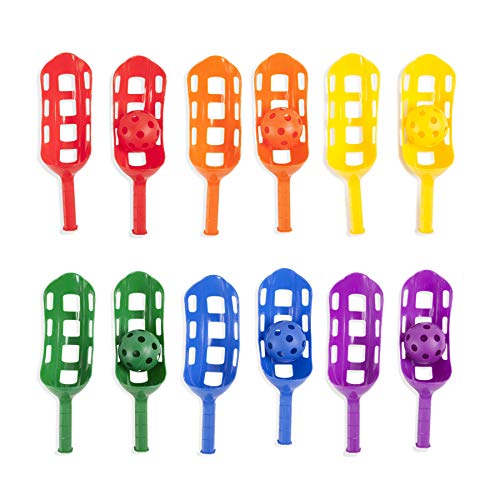
Champion Sports builds equipment for schools and PE programs, and this is the group version of its classic scoop ball game. The box holds six complete sets: twelve scoops and six perforated balls, with each pair of scoops in a different color — green, orange, purple, red, royal blue, and yellow. Color coding makes it easy to split a class or birthday party into pairs, or run relay races, without arguments about who gets which scoop.
The scoops are fifteen inches long and molded from high-density plastic, so they stand up to being dropped on driveways and tossed into equipment bins. The hollow perforated balls fly slowly, stay catchable in a light breeze, and are soft enough that a missed catch bouncing off a shin is a non-event.
This is the pick for anyone buying for more than two players: PE teachers, camp counselors, and families who host a yard full of neighbor kids. For a single child playing with one parent, it is more plastic than you need, and the two-player sets below are the better fit.
YoYa Toys Scoop Ball Set

The YoYa Toys set is the straightforward two-player version of the game: two catcher scoops, two airflow balls, and a PVC carrying case that keeps the pieces together between outings. The scoops have the classic curved, ribbed track that lets a player scoop a ground ball, cradle a catch, and launch a return throw with a flick of the wrist, which is the motion that makes scoop ball feel different from plain catch.
Having two balls in the box matters more than it sounds. Play does not stop while someone chases a ball into the flower beds, and two balls let a parent and child keep a rally going at close range, where younger players build confidence. The manufacturer rates the set for ages three and up, and the lightweight hollow balls suit that age well: easy to track, slow in the air, and forgiving when a catch is mistimed.
The carry case makes this the easiest set here to take to the beach, a park, or a campsite. It is a pair game only, so it will not stretch to a party, and the scoops are sized for casual family play rather than daily school use. For one or two children and a parent, though, it covers the game completely.
Battat Catch A Ball Playset

Battat’s Catch A Ball Playset comes from the brand’s classic toys line, and it keeps the format simple: two scoops and two hollow balls, rated for ages five and up. The styling is deliberately old-fashioned, closer to the scoop games many parents remember from their own childhoods than to a modern sports product, which makes it a natural grandparent purchase and a good fit for families who prefer toys without batteries, lights, or sounds.
The two-ball supply again keeps rallies alive, and the scoops are sized for school-age hands rather than toddlers, with enough length to give a throw some leverage. Children practice judging flight, moving to the ball, and cushioning a catch instead of snatching at it. Because the balls are hollow and light, the set works on a lawn, at the beach, or in a cleared living room on a rainy day without threatening lamps.
Choose this set when the players are five or older and you want a screen-free classic that stores in a toy bin. Families with three-year-olds should start with the softer self-stick games further down the list, and anyone equipping a whole class should look at the Champion Sports pack instead.
Franklin Sports Throw ‘N Stick Toss & Catch Set

The Franklin Sports Throw ‘N Stick changes the catching problem instead of asking the child to solve it. Each player wears a mitt with a self-stick surface and a spring-action handle, and the included ball is covered to match, so a throw that reaches the mitt stays on the mitt. For a child who flinches, turns away, or has not yet learned to time a closing catch, that guaranteed success is the difference between playing for two minutes and playing for twenty.
Franklin rates the set for ages six and up, and the mitt format suits that range well: players stand close and lob the ball at first, then back up as their confidence grows. The two mitts and one ball make it strictly a two-player game, and because the ball sticks on contact, rallies reward accuracy over power, which keeps the game calm enough for small yards.
The trade-off is that self-stick surfaces collect grass and lint outdoors and lose grip over time, so the mitts need an occasional rinse and indoor storage. Children who already catch confidently will also outgrow the format faster than a scoop set, since there is no cradling skill left to learn. As a first catch game for a hesitant beginner, though, it is the strongest option here.
Weehoey Toss and Catch Ball Set

The Weehoey set scales the self-stick idea up to a group. The box holds six hook-and-loop paddles and three balls in blue, green, and pink, so up to six children can play at once, either in pairs or in a circle where the ball moves from paddle to paddle. The manufacturer range starts at age three, and the soft sticky balls and strap-on paddles are gentle enough for preschoolers who would be frustrated by a scoop.
More paddles change the social shape of the game. Instead of one pair rallying while everyone else watches, a whole group stays involved. The paddles strap onto the hand rather than being gripped, which helps small children who cannot yet hold a scoop handle and swing at the same time. With three balls in play, a dropped ball does not stall the group.
Like all hook-and-loop games, the paddle faces pick up grass, sand, and pet hair, and they catch best when kept clean and stored indoors. The paddles are also a single size, so they fit children better than adults with large hands. For playdates, preschool groups, and mixed-age gatherings where the youngest player is three or four, this is the most inclusive set on the list.
How to choose
Start with the catching style. A scoop set teaches the real skill: tracking a ball into a moving target and cushioning it. A self-stick paddle set removes the timing almost entirely, because the ball grabs the paddle on contact. Children under five, and older children who get frustrated quickly, have more fun starting with self-stick.
Count the players honestly. Two-player sets are fine for one child and a parent, but they strand extra siblings and friends on the sideline. If three or more children will regularly play, a multi-set pack like the Champion Sports box or a six-paddle set like the Weehoey keeps everyone in the game and avoids buying twice.
Look at the balls. Hollow perforated balls fly slowly and are the safest choice for young children and small yards, but they drift in wind. Sets with two or three balls keep play moving and soften the loss of a ball over the fence. Sticky balls only work with their matching paddles, so check that replacements exist.
Finally, match the build to the setting. School and camp gear should be molded, thick plastic with no small parts to snap off. Family sets can be lighter, especially if they come with a case. Store self-stick paddles face to face or in a bag, because a paddle left face-down on carpet comes back covered in fluff and stops catching.
Who should skip
Skip scoop ball entirely if your child already plays catch with a glove and a real ball; the slow hollow balls will feel babyish, and a wiffle ball set is the better next step. Skip the self-stick games if you mainly play on sand or long grass, because the paddle faces foul quickly and the format works best on lawns, driveways, and gym floors.
Also skip the big group packs if storage is tight and only one child will ever play. Twelve scoops take up real bin space, and a two-player set covers the same game. And if your youngest player is under three, wait: these sets are sized for preschoolers and up, and a soft fabric ball is a safer first throwing toy.
FAQ
What age is scoop ball right for?
Most scoop sets suit children from about age four or five, once they can track a slow ball and hold a scoop with both hands. Self-stick paddle games work earlier, from around age three, because the ball sticks to the paddle and removes most of the timing.
What is the difference between scoop ball and toss and catch?
Scoop ball uses two curved scoops and a hollow ball, and the catch has to be cradled in the scoop, which builds real catching skill. Toss and catch games use self-stick paddles and a matching ball that grabs on contact, so almost every reachable throw becomes a catch.
Can these games be played indoors?
Yes, with the right set and a cleared space. Hollow perforated balls are light and slow, so a scoop set works in a hall or large room, and self-stick games are gentle enough for indoor play too. Move breakables first and keep throws short.
How do you clean self-stick paddles and balls?
Rinse the paddle faces and the ball under running water and let them air dry; most grass and lint wash straight off. Pick out any remaining fibers, and store the paddles pressed face to face or in a closed bag so they do not collect dust between games.
Final verdict
For a family buying one set, the YoYa Toys Scoop Ball Set is the balanced choice: two scoops, two balls, a storage case, and an age range that starts at three. For groups, the Champion Sports six-set pack is the practical buy, and the Battat Catch A Ball Playset is the classic, no-frills option for school-age children. Hesitant beginners should start with the Franklin Sports Throw ‘N Stick, while playdates with several young children are best served by the six-paddle Weehoey set.
Product and ASIN Reference
| Product | ASIN |
|---|---|
| Champion Sports Scoop Ball Set, 6 Sets (12 scoops, 6 balls) | B000KA2VGQ |
| YoYa Toys Scoop Ball Set | B071WKFRX7 |
| Battat Catch A Ball Playset | B09KKVJSBZ |
| Franklin Sports Throw ‘N Stick Toss & Catch Set | B07H91HLC8 |
| Weehoey Toss and Catch Ball Set, 6 Paddles | B0BR59KQKL |