Our Short List of 3

- Best for: Bedrooms, nurseries, and home offices where quiet, simple operation matters most.
- Best for: Small bedrooms, nurseries, and dorm rooms where the lowest possible noise level is the top priority.

- Best for: Medium bedrooms and living rooms, allergy households, and pet owners who want automatic air-quality control.
All 4 Picks at a Glance
| Product | Specs | Action |
|---|---|---|
| LEVOIT Core 300-P |
| Check price on Amazon |
| Blueair Blue Pure 511i Max |
| Check price on Amazon |
| Coway Airmega AP-1512HH |
| Check price on Amazon |
 WINIX 5520 |
| Check price on Amazon |
Key takeaways
- Discover the best air purifiers quiet and safe for bedrooms, nurseries, and living rooms, with low-noise sleep modes, True HEPA filters, and ozone-free designs.
A loud air purifier can undo much of the comfort it is meant to create. It hums through a video call, rattles beside a bed, and turns a nursery into a room with a constant background drone. A purifier that is quiet on paper but relies on an ozone-generating feature can raise a different concern, especially in a bedroom or nursery, where the air stays close to the people breathing it. The best air purifiers quiet and safe combine both qualities: a low sleep-mode noise level, sealed True HEPA filtration, and a design that avoids ozone as a cleaning method.
This guide focuses on that combination. Each pick below has a published low-noise figure, a True HEPA or HEPASilent filter, and safety certification or an ozone-free design noted in its listing. Coverage, delivery rate, and controls are compared below.
Disclosure: As an Amazon Associate, we earn from qualifying purchases.
Quick Picks at a Glance
| Product | Key Spec | Best For |
|---|---|---|
| LEVOIT Core 300-P | 24 dB sleep mode, 141 CFM CADR, 3-in-1 HEPA filter | Bedrooms and small living rooms |
| Blueair Blue Pure 511i Max | 19 dB on low, HEPASilent filtration, cleans 926 sq ft in one hour | Small bedrooms and nurseries |
| Coway Airmega AP-1512HH | 24.4 dB low, 4-stage filtration, 361 sq ft coverage | Medium rooms and allergy households |
| WINIX 5520 | 23.5 dB minimum, 253 CFM smoke CADR, True HEPA plus carbon filter | Large rooms and open-plan spaces |
How to Choose
1. Read the low-speed noise figure, not the headline
Manufacturers often advertise a single decibel number, and that number almost always comes from the lowest fan speed. Look for the full range, from low to high, and pay closest attention to the sleep-mode figure. A model rated at 19 to 24 dB on its lowest setting is close to the sound of rustling leaves, while a model that reaches 50 dB or more on high will be clearly audible across a room.
2. Check the filtration stages and what they capture
True HEPA filtration is the standard to look for in a quiet and safe purifier. A True HEPA filter captures 99.97 percent of airborne particles as small as 0.3 microns, including pollen, dust, pet dander, and many smoke particles.
3. Look for ozone-free design and recognized certification
Ozone is a lung irritant, and it has no place in a bedroom or nursery purifier. Look for a listing that states the unit is ozone free, and check for certification from recognized bodies such as CARB, the California Air Resources Board, ETL, FCC, or ENERGY STAR.
4. Match CADR and coverage to the real room size
Clean air delivery rate, known as CADR, measures how quickly a purifier removes smoke, dust, and pollen from the air. Use the smaller, stricter figure when you size a purifier.
5. Consider sleep mode, timers, and automatic controls
A good sleep mode dims or switches off the display lights and keeps the unit running steadily through the night. Automatic mode, guided by a built-in air-quality sensor, raises the fan speed when cooking smoke or dust appears and lowers it again when the air clears.
6. Factor in filter cost, filter life, and ease of changing
A quiet purifier is only as good as its filter, and filters are a recurring cost. Check how long the manufacturer rates each filter, whether a washable pre-filter is included, and whether the unit has a filter-life indicator.
7. Think about placement, size, and child safety
A purifier needs clear space around its air intake and outlet, so measure the spot where it will live before you buy. A compact cylindrical model fits easily beside a bed, while a larger rectangular model needs floor space and a few inches of clearance on each side.
Top Picks
LEVOIT Core 300-P
- Best for: Bedrooms, nurseries, and home offices where quiet, simple operation matters most.
Bedrooms, nurseries, and home offices where quiet, simple operation matters most.
The LEVOIT Core 300-P is the most straightforward pick in this guide. Its QuietKEAP technology drops the noise level to a near-silent 24 dB in Sleep Mode, and the display light can be turned off entirely. The 3-in-1 filter combines a pre-filter, a HEPA-grade main filter, and an activated carbon layer, capturing 99.97 percent of airborne particles from 0.1 to 0.3 microns, including pollen, dust, and animal dander. The listing gives a CADR of 141 CFM and coverage of up to 1095 square feet at one air change per hour, with a 45W high-torque motor. Three fan speeds, a timer for 2, 4, 6, or 8 hours, and a filter lifetime indicator keep daily use simple, and the unit measures 8.7 by 8.7 by 14.2 inches. Energy Star, CARB, FCC, and ETL credentials support its safety record.
Pros:
– Sleep Mode at 24 dB with a display light that can be switched off
– 3-in-1 HEPA and carbon filtration with a 99.97 percent capture claim
– CARB, Energy Star, FCC, and ETL credentials; compact footprint
Cons:
– No Wi-Fi, app control, voice control, or built-in air-quality sensor
– Coverage at the stricter air-change rate is smaller than the headline figure
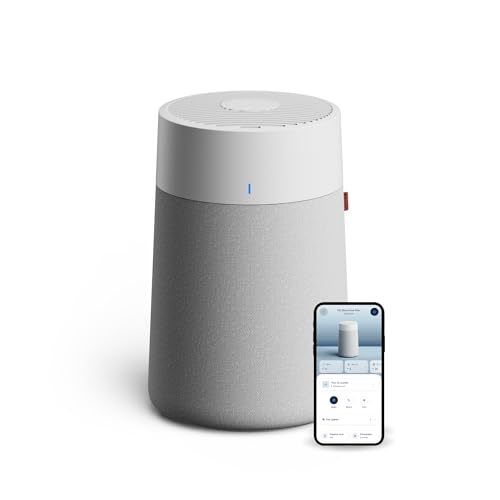
Blueair Blue Pure 511i Max
- Best for: Small bedrooms, nurseries, and dorm rooms where the lowest possible noise level is the top priority.
Small bedrooms, nurseries, and dorm rooms where the lowest possible noise level is the top priority.
The Blueair Blue Pure 511i Max is the quietest pick in this guide on its lowest setting, operating at 19 dB on low and never louder than 48 dB, according to the manufacturer. Its HEPASilent technology combines electrostatic charging with mechanical filtration, so particles are drawn to the filter fibers before they pass through, which helps the unit move air efficiently at low noise. The listing states that it cleans up to 465 square feet in 30 minutes, or 926 square feet in one hour. Independent comparison data lists a smoke CADR of 153 CFM, with dust at 159 CFM and pollen at 174 CFM, and power draw of 17 watts. Three customized replacement filters are available, including an original particle and carbon filter, a SmokeBlock filter, and an AllergenBlock filter. Wi-Fi and app control add remote scheduling.
Pros:
– 19 dB on low, the lowest sleep-level figure among these four picks
– HEPASilent filtration with three customized replacement filter options
– Low power draw, app control, and a washable pre-filter
Cons:
– Best suited to small and medium rooms rather than large open-plan spaces
– Replacement filters are model-specific and add to long-term running costs
Coway Airmega AP-1512HH
- Best for: Medium bedrooms and living rooms, allergy households, and pet owners who want automatic air-quality control.
Medium bedrooms and living rooms, allergy households, and pet owners who want automatic air-quality control.
The Coway Airmega AP-1512HH, also known as the Coway Mighty, is a long-standing favorite for medium rooms. Its noise range is 24.4 dB to 53.8 dB: on its lowest speed it is barely louder than a whisper, and it only rises when the air-quality sensor detects a problem. The unit is designed for rooms up to 361 square feet, with CADR figures of 246 for dust, 240 for pollen, and 233 for smoke. Its 4-stage filtration combines a pre-filter, a deodorization filter, a True HEPA filter, and a Vital Ion stage that can be switched on or off, capturing up to 99.97 percent of particles 0.3 microns in size. A pollution sensor shows indoor air quality through a colored LED, and Auto Mode adjusts the fan through three speeds. When no pollution is detected for 30 minutes, the unit enters Eco Mode. Power consumption is 77 watts, and the warranty covers the motor and electronic parts for three years.
Pros:
– Low-speed noise of 24.4 dB with automatic Eco Mode when the air is clean
– 4-stage True HEPA filtration with a switchable ion stage and odor reduction
– Real-time air-quality LED, Auto Mode, and a 1, 4, or 8 hour timer
Cons:
– Louder on high speed than the smaller bedroom models in this guide
– Larger and heavier than the compact cylindrical picks, so it needs floor space
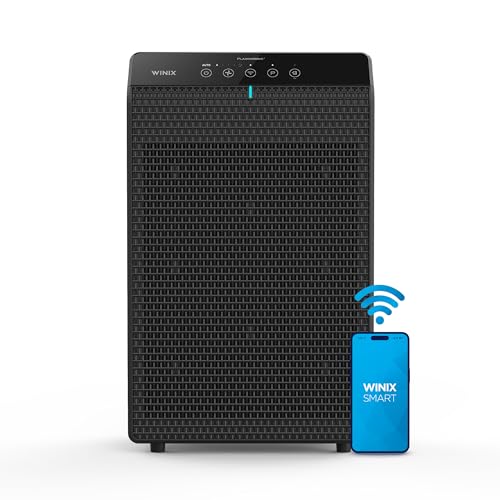
WINIX 5520
- Best for: Large bedrooms, living rooms, and open-plan spaces where strong airflow and quiet low-speed operation both matter.
Large bedrooms, living rooms, and open-plan spaces where strong airflow and quiet low-speed operation both matter.
The WINIX 5520 is the large-room pick in this guide, and it stays quiet while moving a lot of air. Its minimum noise level is 23.5 dB, which is remarkably low for a unit with a smoke CADR of 253 CFM, dust at 252 CFM, and pollen at 247 CFM. Those figures support a room of about 392 square feet at the stricter air-change rate, while the listing quotes up to 1882 square feet in one hour at a single air change per hour. True HEPA filtration captures fine particles, a high-deodorization carbon filter tackles smoke, cooking odors, and pet smells, and PlasmaWave technology is included as an additional stage. An air-quality monitor with a colored LED shows whether the air is good, fair, or poor, and Auto Mode adjusts the fan speed in response. Its Filter Q is rated for 12 months of use.
Pros:
– Minimum noise of 23.5 dB despite a high smoke CADR of 253 CFM
– True HEPA plus high-deodorization carbon filter for smoke and odors
– Air-quality monitor, Auto Mode, and Sleep Mode with dimmed lights
Cons:
– Larger and heavier than the bedroom models, so placement needs planning
– PlasmaWave is an extra stage that some buyers may prefer to switch off
Comparison Table
| Feature | LEVOIT Core 300-P | Blueair Blue Pure 511i Max | Coway Airmega AP-1512HH | WINIX 5520 |
|---|---|---|---|---|
| Lowest noise | 24 dB in Sleep Mode | 19 dB on low | 24.4 dB on low | 23.5 dB minimum |
| Filtration | 3-in-1 HEPA plus carbon | HEPASilent, True HEPA plus carbon | 4-stage True HEPA plus carbon | True HEPA plus carbon |
| Smoke CADR | 141 CFM | 153 CFM | 233 CFM | 253 CFM |
| Room coverage | Up to 1095 sq ft in one hour | Up to 926 sq ft in one hour | Up to 361 sq ft | Up to 1882 sq ft in one hour |
| Safety notes | CARB, Energy Star, FCC, ETL | CARB certified design, HEPASilent filtration | CARB, ETL, ENERGY STAR rated | True HEPA, PlasmaWave, air-quality monitor |
Buying Guide
Start with the room, not the purifier. Measure the space, note the ceiling height, and check whether doors stay open to adjoining rooms, because an open doorway effectively enlarges the area the purifier must clean. A bedroom of 150 to 250 square feet is well served by a compact model with a CADR of 140 to 160 CFM, while a living room of 350 to 400 square feet needs a CADR closer to 240 or 250 CFM.
Next, decide how much automation you want. A simple manual purifier with three fan speeds and a timer is easy to live with. A smart purifier with an air-quality sensor, Auto Mode, and app control adjusts itself through the day, keeping noise down when the air is clean and raising airflow only when cooking, dust, or pollen demands it. If you choose a model with an ionizer or PlasmaWave stage, check whether it can be switched off, and read the listing for an ozone-free statement and CARB certification.
Running costs deserve a clear-eyed look. Filter life varies from about six months to twelve months depending on the model and the air in your home, and a washable pre-filter can extend that interval by catching hair and large dust before it reaches the main filter. Energy use also varies: a compact model drawing 17 to 45 watts costs very little to run around the clock, while a larger model drawing 77 watts still uses far less energy than most household appliances,
Common mistakes are easy to avoid. Placing a purifier tight against a wall or behind furniture blocks its intake and forces the fan to work harder, which raises noise. Forgetting to replace the main filter on schedule gradually reduces airflow and filtration, and the unit may become louder as the clogged filter restricts air. Do not judge a purifier by its headline coverage figure alone.
Frequently Asked Questions
What noise level is considered quiet for an air purifier?
A sleep-mode or low-speed figure of 19 to 25 dB is generally considered very quiet, comparable to rustling leaves or a hushed room.
Are air purifiers safe to run in a nursery or bedroom overnight?
A purifier with True HEPA filtration, an ozone-free design, and CARB certification is designed for continuous use in bedrooms and nurseries. Choose a model with a sleep mode that dims the display, place it on a stable surface away from the crib or bed, keep the intake clear, and follow the filter-change schedule in the manual.
Does a higher CADR always mean a louder purifier?
No. CADR is measured at the highest fan speed, while the low-speed noise figure is measured separately. A larger purifier with a high CADR can often clean a room on low or medium speed, staying quiet, while a smaller purifier may need its highest, loudest speed to do the same job.
How often should I replace the filter?
Filter life depends on the model and on how dusty or smoky your home is, but many manufacturers rate a main filter for six to twelve months, with the WINIX 5520 rated for twelve months in this guide. A washable pre-filter should be cleaned regularly, and a filter-life indicator, where fitted, is a useful reminder.
Is an ionizer or PlasmaWave stage safe?
Ionizers and PlasmaWave stages are designed to help particles settle or be captured more easily, but some buyers prefer purely mechanical filtration. Look for a model where the stage can be switched off, and check the listing for an ozone-free statement and CARB certification.
Can a quiet air purifier remove smoke and cooking odors?
A True HEPA filter captures fine smoke particles, while an activated carbon layer adsorbs odors and volatile organic compounds from cooking and smoke.
Conclusion
Quiet and safe are not luxuries in an air purifier; they are the two qualities that decide whether you will actually leave it running. The LEVOIT Core 300-P is the best all-round bedroom choice, with a 24 dB Sleep Mode and a 3-in-1 HEPA filter. The Blueair Blue Pure 511i Max is the pick for light sleepers and nurseries, thanks to its 19 dB low setting. The Coway Airmega AP-1512HH suits medium rooms and allergy households, with automatic air-quality control and 4-stage filtration. The WINIX 5520 is the large-room answer, pairing a 253 CFM smoke CADR with a 23.5 dB minimum noise level. Measure your room first, then match coverage, noise, and certification to it.