Key takeaways
- Compare the best coffee grinders for home, from the Baratza Encore burr mill to the KRUPS blade grinder, with grind settings, burr types and capacities.
A home coffee grinder does one job: turn whole beans into grounds at the size your brewer needs, shortly before you brew. The five grinders in this guide cover the two designs sold for home kitchens. Four are electric burr grinders, which crush beans between two abrasive surfaces at a set gap, and one is an electric blade grinder, which chops beans with a spinning blade for as long as you hold the button down.
The picks below suit different routines. The Baratza Encore and Breville Smart Grinder Pro offer wide setting ranges that makers list for methods from espresso to cold brew. The OXO Brew and Cuisinart DBM-8 keep controls simple for drip and French press households. The KRUPS F203 is a compact blade model for small batches. Specs such as setting counts, burr size and hopper capacity are stated by each maker, and grind consistency or flavor outcomes are never guaranteed by any setting.
As an Amazon Associate, we earn from qualifying purchases.
Quick answer
For most home brewers, the Baratza Encore is the balanced pick: 40 maker-listed grind settings, 40 millimeter conical burrs and a hopper that twists to adjust. The Breville Smart Grinder Pro adds timed dosing and 60 settings for espresso-focused setups. On a simpler routine, the OXO Brew uses one-touch timing, the Cuisinart DBM-8 doses by cup count, and the KRUPS F203 blade grinder handles small, quick batches.
How to choose
Start with the burr-versus-blade decision. Burr grinders feed beans through a fixed gap, so the setting you choose maps to a grind size range the maker publishes for brew methods such as espresso, pour over, drip or French press. Blade grinders have no size setting at all: longer pulses chop finer, and the result varies from batch to batch. If you brew espresso at home, choose a burr model whose maker lists espresso among its intended methods.
Next, match the setting count and adjustment style to how often you switch methods. Stepped dials with 15 to 60 maker-stated positions are easy to return to day after day. A household that brews one way most mornings may never use the extremes of a wide range, while a household alternating between espresso and cold brew benefits from more positions at both ends.
Hopper and grounds-bin capacity decide how much you can grind in one run. Maker-stated hopper sizes in this guide run from 3 ounces on the blade model to 18 ounces on the Breville. Larger hoppers suit households that grind for a full pot every day; smaller ones keep less coffee sitting in the hopper between uses.
Finally, plan for cleaning before you buy. Every maker here directs users to unplug the grinder before cleaning and to keep the burr area dry, using a brush rather than water on the burrs. Removable hoppers and bins make that routine faster. Grind only coffee beans unless the maker states otherwise for a given model, and check each maker’s care page for the exact routine it publishes.
1. Baratza Encore Conical Burr Grinder (ZCG485BLK)

The Encore is Baratza’s long-running entry burr grinder, built around 40 millimeter conical steel burrs and a straightforward twist-the-hopper adjustment. Baratza lists 40 grind settings that run from espresso fine to cold brew coarse, with brew methods in between including pour over, drip brewers and French press. A front-mounted pulse button and a side on/off switch cover both small doses and full hopper runs.
The bean hopper holds 300 grams of whole beans according to Baratza, and grounds collect in a removable bin under the burrs. The DC motor is geared down so the burrs turn slowly, which Baratza says keeps noise, heat and static down during grinding. Replacement burrs and parts are sold by the maker, which matters for a grinder bought to serve for years.
Specs (as stated by Baratza):
- Burr type: 40 millimeter conical steel burrs
- Grind settings: 40 stepped settings
- Bean hopper capacity: 300 grams
- Controls: on/off switch plus front pulse button
- Listed brew range: espresso through cold brew
2. Breville Smart Grinder Pro (BCG820BSS)
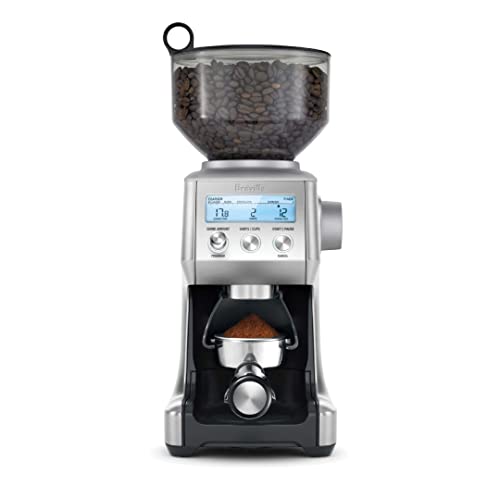
The Smart Grinder Pro is the espresso-leaning pick here. Breville fits it with stainless steel conical burrs, an LCD screen and its Dosing IQ system, which lets you program grind time in 0.2-second increments and store the setting for one or two shots or a chosen cup count. Breville lists 60 grind settings across its espresso-to-plunger range.
The airtight hopper holds 18 ounces of beans and locks in place for removal. Breville includes two portafilter cradles, sized for 50 to 54 millimeter and 58 millimeter baskets, so espresso users can grind directly into the portafilter; a sealing-lid grounds container is included for drip and press batches. The grind amount dial and shot/cup selector sit beside the display for quick changes between drinks.
Specs (as stated by Breville):
- Burr type: stainless steel conical burrs
- Grind settings: 60 settings
- Bean hopper capacity: 18 ounces, airtight locking hopper
- Dosing: programmable grind time in 0.2-second increments
- Included: 50-54 millimeter and 58 millimeter portafilter cradles, grounds container
3. OXO Brew Conical Burr Coffee Grinder (8717000)

OXO’s Brew grinder aims at one-touch mornings. Its interface is a single dial and button: pick one of the 15 maker-listed grind settings, and the one-touch timer starts grinding; the grinder remembers the last time setting used, so a repeated daily dose takes one press. OXO fits 40 millimeter stainless steel conical burrs and a hopper that holds up to 12 ounces of beans, with a tinted lid and a trap door that keeps beans in the hopper when you lift it off.
Grounds fall into a stainless steel container that OXO says reduces static cling compared with plastic bins. The setting range is narrower than the Baratza or Breville ranges, which keeps the dial simple for households that brew drip, pour over or French press and rarely change methods. A micro-adjustment within settings is not offered; the 15 positions are the full maker-stated range.
Specs (as stated by OXO):
- Burr type: 40 millimeter stainless steel conical burrs
- Grind settings: 15 settings
- Bean hopper capacity: up to 12 ounces (340 grams)
- Controls: one-touch start timer with last-setting memory
- Grounds container: stainless steel, static-reducing design
4. Cuisinart Supreme Grind Automatic Burr Mill (DBM-8P1)

The DBM-8P1 doses by cups rather than seconds. An 18-position grind selector runs from ultrafine to extra coarse on Cuisinart’s scale, and a slide dial sets the amount from 4 to 18 cups; the electric timer then runs the cycle and shuts the unit off when it finishes. The grind chamber holds enough ground coffee for up to 32 cups according to Cuisinart, so back-to-back batches for a crowd do not need emptying between runs.
The 8-ounce bean hopper lifts off for refilling and cleaning, and Cuisinart builds in a safety interlock so the mill will not run unless the hopper and grind chamber are seated. This is a block-style burr mill rather than a conical design, and its control layout suits households that brew pots of drip coffee and want the amount measured by the machine instead of a scale.
Specs (as stated by Cuisinart):
- Burr type: electric burr mill (block burr design)
- Grind settings: 18-position selector, ultrafine to extra coarse
- Bean hopper capacity: 8 ounces, removable
- Amount control: 4 to 18 cup slide dial with automatic shutoff
- Grind chamber: holds grounds for up to 32 cups
5. KRUPS F203 Electric Blade Grinder (F20342)

The F203 is the blade option, and it works differently from everything above it. A 200-watt motor spins stainless steel blades inside a fixed 3-ounce chamber; you press the lid button to grind and release it to stop, pulsing and shaking the unit to move beans through the blades. KRUPS states the chamber grinds enough beans for up to 12 cups of coffee, and that the same chamber can grind spices, which the maker lists as a supported use for this model.
There is no grind-size dial, so fineness depends on pulse time, and the grounds in any batch range from fine to coarse pieces. That trade-off buys a small footprint, a short parts list and very quick cleanup: the chamber wipes out and there are no burrs to brush. The lid carries a safety switch, so the blades only spin when the lid is closed and pressed. For French press or cold brew drinkers who grind small amounts and accept an uneven batch, it covers the basics.
Specs (as stated by KRUPS):
- Grind type: stainless steel blade, pulse controlled
- Motor: 200 watts
- Chamber capacity: 3 ounces (85 grams), up to 12 cups per maker
- Grind settings: none; fineness set by pulse duration
- Safety: lid-activated switch
Comparing these grinders with other routes
Two alternatives sit outside this list. Hand grinders use the same burr principle with a crank instead of a motor; they suit single cups and travel but make grinding for a full pot slow work. Built-in grinders on espresso machines save counter space, yet the setting range and bin sizes are fixed by the machine maker, and replacing one part usually means servicing the whole appliance.
Within the electric category, the split is between timed dosing (Breville, OXO, Cuisinart) and manual control (Baratza’s switch and pulse, KRUPS’s hold-to-grind lid). Timers help repeat a daily dose without a scale; manual control makes one-off amounts simpler. None of these designs guarantees a particular extraction or flavor result, since the coffee, water and brewer all change the cup. Choose by the methods and batch sizes you actually brew, using each maker’s listed range as the guide.
FAQ
Is a burr grinder always better than a blade grinder?
Not always. A burr grinder gives you a repeatable setting that maps to a maker-listed size range, which matters most for espresso and pour over. A blade grinder like the KRUPS F203 is smaller and simpler, and for French press or cold brew, where a coarse and less uniform grind is commonly used, many households find it adequate.
How fine can these grinders go for espresso?
Baratza lists the Encore’s 40 settings as running from espresso fine upward, and Breville lists the Smart Grinder Pro for espresso with portafilter cradles included. Whether a given setting suits your machine depends on the espresso maker and dose, so treat the makers’ ranges as the starting point and adjust one step at a time.
How do I clean a burr grinder?
Unplug the grinder first, empty the hopper, and brush loose grounds out of the burr area and chute, keeping the burrs dry. Each maker publishes its own routine: Baratza, Breville, OXO and Cuisinart all direct users to brush rather than rinse the burr set, and to wash only the removable bins or hoppers as their manuals state.
How much coffee should I grind at once?
Match the batch to the maker’s stated capacities. The Cuisinart doses 4 to 18 cups per cycle, the KRUPS chamber holds 3 ounces of beans, and the Breville and Baratza hoppers hold 18 ounces and 300 grams for storage, not single doses. Grinding close to brew time is the usual maker guidance for aroma, so most households grind per pot rather than filling the grounds bin ahead.
Final verdict
The Baratza Encore is the default recommendation for brewed coffee at home: a wide maker-listed range, conical burrs and simple controls. Choose the Breville Smart Grinder Pro if espresso is part of your routine and timed dosing appeals. The OXO Brew and Cuisinart DBM-8 simplify drip and press brewing in different ways, one by time and one by cup count. Keep the KRUPS F203 in mind for small kitchens and small batches where a blade design is enough.
Product and ASIN Reference
| Product | ASIN |
|---|---|
| Baratza Encore Conical Burr Grinder (ZCG485BLK) | B007F183LK |
| Breville Smart Grinder Pro (BCG820BSS) | B00OXGXW8O |
| OXO Brew Conical Burr Coffee Grinder (8717000) | B07CSKGLMM |
| Cuisinart Supreme Grind Automatic Burr Mill (DBM-8P1) | B00018RRRK |
| KRUPS F203 Electric Blade Grinder (F20342) | B00004SPEU |