Key takeaways
- Compare the best inflatable pools for kids and toddlers, from compact gator play centers to roomy family lounge pools with slides, sprayers, and shade.
An inflatable pool turns an ordinary backyard afternoon into the part of summer your kids talk about all year. The current lineup ranges from shallow toddler play centers with built-in shade to wide family lounge pools where a parent can sit in the water too. The catch is that these products look similar in photos while differing a lot in footprint, water depth, setup effort, and how much active play they actually support. A giant play center is wonderful on a big lawn and a storage headache in a small yard, while a simple lounge pool bores an energetic five-year-old in about ten minutes. This guide compares five inflatable pools for kids and toddlers, explains how their sizes and features map to different ages, and flags the ownership realities, from patching vinyl to draining, before you buy.
As an Amazon Associate, we earn from qualifying purchases.
Quick answer
For most families, the Intex Ocean Play Center hits the sweet spot: two pools, a slide, and a hose-fed sprayer in a footprint that still fits a modest yard. Toddlers do best with the smaller, shallower Gator Play Center, while the Dinoland and Jungle Adventure centers suit preschoolers who want games with their splashing. Families with older kids should look at the Swim Center Family Lounge Pool.
Intex Ocean Play Center (57454EP)

The Ocean Play Center is really two pools in one inflatable. A smaller wading pool sits in front for toddlers, and the larger main pool behind it holds deeper water for bigger kids, with a small water slide connecting the two zones. An inflatable palm tree, turtle, and whale give younger children something to grab and climb around, and the ring toss game plus the built-in sprayer, which attaches to a standard garden hose, keep the play going once plain splashing loses its novelty.
At roughly 100 by 77 inches inflated, it needs a clear patch of lawn about the size of a large picnic blanket, and it fills to a depth that works for seated play rather than swimming. That makes it a strong default choice for mixed-age siblings: the toddler stays in the shallow end while an older child uses the slide and main pool, and one adult can supervise both from the edge. The trade-offs are the usual ones for a multi-chamber design. There are several valves to inflate and deflate, the sprayer only works while the hose runs, and the whole unit should be dried before storage so the folded vinyl does not mildew. A repair patch is included for small punctures.
Intex Gator Play Center (57165EP)

The Gator Play Center is the toddler-first option in this group. It measures about 6.6 by 5.6 feet, so it fits patios and small yards where the bigger centers simply will not go, and its shallow wading depth suits children who are still unsteady on wet surfaces. The friendly alligator theme does real work here: the gator itself, two inflatable fish, and a baby duck give a two-year-old targets to grab, carry, and dunk, and the included fishing bucket turns the pool into a scoop-and-pour station.
A small slide adds just enough thrill for the preschool crowd, and the inflatable mushroom shade covers part of the pool, which matters more than it sounds. Toddlers overheat and burn quickly, and a shaded corner lets you stretch a session without constantly repositioning the pool. Because the footprint is compact, filling and draining are fast, and the whole thing folds down to a manageable bundle for a closet shelf. The limits follow from the size: children much past age four will find the slide short and the water shallow, and there is no sprayer, so the hose games of the bigger centers are off the menu. For a first backyard pool for a one- to three-year-old, though, this is the most sensible shape and scale on the list.
Intex Jungle Adventure Play Center (57161)

The Jungle Adventure Play Center is built for households with two or more kids who play at different speeds. It links two pools with a slide, so one child can wade and splash in the shallower section while another loops the slide into the larger pool. At about 96 by 78 inches and 28 inches tall at its highest points, it is one of the bigger footprints here, and it earns that space with an unusually full set of inflatable extras: a monkey, flamingos, a hippo, and a crocodile, plus a play panel and ball games that give older preschoolers something to do besides splash.
A built-in sprayer connects to the garden hose for extra water play on hot days. In practice, this is the center that keeps a mixed group of three- to six-year-olds occupied longest, because the activities are spread across two pools instead of crowded into one basin. The costs are setup time and storage. More chambers and more inflatable accessories mean more minutes with the pump at both ends of the day, and the folded bundle is bulky. Families with a single toddler will get more value from the Gator, but for siblings or regular playdates, the Jungle Adventure justifies its size.
Intex Dinoland Play Center (57135EP)
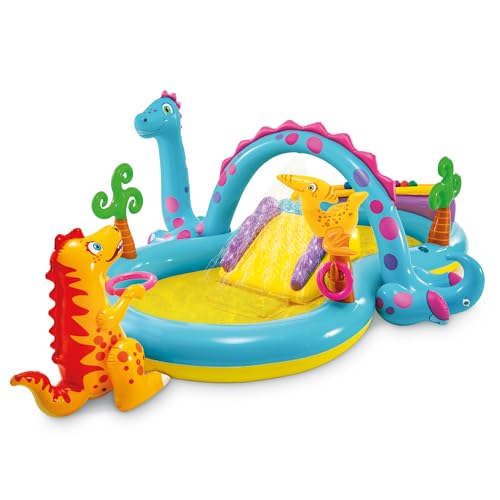
Dinoland is the biggest and most game-focused center in this roundup. Inflated, it stretches about 131 by 90 inches, with the tallest features reaching 44 inches, and it packs four activities into that footprint: a water slide with a soft landing mat, a movable Dino Arch sprayer that attaches to a garden hose, a Dino Hoops game, and a Volcanic Ball Roller game that comes with six colorful balls. The wading pool holds about 74 gallons filled to six inches of wall height, and Intex rates the maximum weight capacity at 178 pounds, which helps parents judge how many kids can pile in at once.
The dinosaur theme is more than decoration. The hoops and ball roller give four- and five-year-olds a reason to stay in the water and practice aim and turn-taking, and the movable arch lets you aim the spray where the kids actually are. Intex grades it for ages three and up, and that guidance fits: younger toddlers can use the shallow pool area, but the games and slide are aimed at preschoolers. A drain plug in the pool floor speeds up emptying, and a repair patch is included. You do need a genuinely large, flat yard, and drying a pool this size before storage takes planning on a sunny day.
Intex Swim Center Family Lounge Pool (57190EP)

The Swim Center Family Lounge Pool takes a different approach: instead of games, it offers space and a place for adults to sit. It inflates to about 90 by 86 inches with walls around 31 inches high, holds roughly 156 gallons, and has a built-in bench along one side with cup holders, so a parent can sit in the water at kid level instead of perching on the edge. That single feature changes how the pool gets used. Supervision is closer and more comfortable, and older children who have outgrown play centers still get a real pool to cool off in.
With no slide, sprayer, or inflatable characters, this is the calm-water option for families whose youngest children are past the toddler stage, or for anyone who wants one pool the whole family shares rather than a play structure only the kids use. The deeper fill means longer fill and drain times than the play centers, and the larger water volume deserves the same safety seriousness as any pool: empty it or secure it when it is not in use, every time. Setup is otherwise the simplest here, with fewer chambers and accessories to manage, and the wide, open interior makes cleaning easier than the multi-pool centers.
How to choose
Start with space and age, in that order. Measure the flat area you can give the pool, then add room to walk around it; the Dinoland and Jungle Adventure centers need a genuinely large lawn, while the Gator fits a patio. Match depth and features to the youngest child who will use it: shallow water and shade for toddlers, slides and games for preschoolers, and open water with adult seating for older kids.
Next, think about water and maintenance. Bigger pools hold more gallons, which means longer fills, more draining, and a stronger case for a small pump and a cover. Check whether a sprayer matters to you, since sprayer models need a garden hose connection nearby. Finally, plan storage before you buy: multi-chamber centers fold into bulky bundles and must be fully dry first, so households with little storage space are usually happier with a compact pool.
Who should skip
Skip inflatable pools entirely if your yard has no flat, debris-free patch of ground, since sharp sticks and stones under thin vinyl end in punctures. Families who cannot commit to active, arm’s-reach supervision for toddlers should wait, because even shallow wading water demands constant attention. If your children are all older than about seven, play centers will feel babyish; choose the family lounge pool or a different style of pool instead. Anyone hoping to leave a pool filled and uncovered for weeks should also skip: standing water attracts insects and algae, and these pools are designed to be drained regularly.
FAQ
How long do inflatable kiddie pools take to set up?
Plan on roughly ten to twenty minutes of inflation for a play center with an electric pump, plus fill time that depends on the pool’s capacity and your hose. Simple lounge pools inflate faster. Deflating, draining, and drying usually take longer than setup, so start teardown before the sun goes down.
Can inflatable pools be used on a deck or patio?
Small, shallow models like the Gator Play Center are commonly used on smooth patios. Larger centers belong on level grass: they are heavy when filled, and hard or uneven surfaces stress the seams. Whatever the surface, clear away sharp objects first and use a ground cloth where the manufacturer allows one.
How should I store an inflatable pool for winter?
Drain it fully, let every chamber dry completely, and dust the vinyl lightly if the manufacturer suggests it to keep folds from sticking. Fold loosely rather than creasing sharply, and store it indoors away from rodents and sharp tools. Keep the repair patch with the pool so it is easy to find next season.
Are these pools safe for babies under one year old?
These pools are graded by their manufacturers for toddlers and older children, starting at age two or three depending on the model, and they are not infant products. Babies who cannot sit steadily should not be placed in them. For any child, constant adult supervision within arm’s reach is the rule, and pools should be emptied after each use.
Final verdict
The Ocean Play Center is the best all-round pick for most households, balancing size, a slide, and a sprayer across two pools. Choose the Gator for a first pool for a toddler, the Jungle Adventure for siblings who play at different speeds, Dinoland for game-loving preschoolers with a big yard, and the Swim Center Family Lounge when adults want to be in the water too.
Product and ASIN Reference
| Product | ASIN |
|---|---|
| Intex Ocean Play Center (57454EP) | B000VSAEYI |
| Intex Gator Play Center (57165EP) | B07V6GV9D4 |
| Intex Jungle Adventure Play Center (57161) | B07MBHK9SY |
| Intex Dinoland Play Center (57135EP) | B00HIWWKPQ |
| Intex Swim Center Family Lounge Pool (57190EP) | B00OTJ5HZQ |