Key takeaways
- Discover the best kids basketball hoops for toddlers, young players, and teens, with adjustable heights, sturdy bases, and indoor and outdoor options.
A kids basketball hoop turns a driveway, a backyard, a garage, or a bedroom door into a place where a child can practice, play, and burn off energy every day. The right hoop matches the age of the player, the space you have, and how seriously the child plays, so a toddler gets an oversized rim that rewards every shot while an older child gets a taller, sturdier system that can grow with them. This guide covers the five best kids basketball hoops across those needs, from a first toddler set to a full-size portable system, so you can pick one that fits your home and your player.
As an Amazon Associate, we earn from qualifying purchases.
Table of Contents
- How to Choose a Kids Basketball Hoop
- Age and Height: Matching the Hoop to the Player
- Hoop Types: Freestanding, Portable, and Over the Door
- Base and Stability: What Keeps a Hoop Upright
- Indoor or Outdoor: Where the Hoop Will Live
- Ball Size and What Comes in the Box
- Little Tikes Easy Score Basketball Set
- Step2 Shootin Hoops Junior Basketball Set
- Franklin Sports Over the Door Mini Basketball Hoop
- SKLZ Pro Mini Hoop Outdoor Basketball System
- Spalding NBA Portable Basketball System
- Keeping Play Safe Around Any Hoop
- Setting Up a Kids Basketball Hoop
- Frequently Asked Questions
- Conclusion
- Product and ASIN Reference
How to Choose a Kids Basketball Hoop
Shopping for a kids basketball hoop is simpler than it looks once you sort the options by player age, available space, and how the hoop will be used. A toddler needs a low rim and a light ball, while a ten-year-old needs a taller rim and a backboard that can take harder shots. A family with a driveway can fit a portable system with a fillable base, while a family in an apartment may do better with an over-the-door hoop that needs no floor space at all. The sections below walk through each decision in turn, and the five picks that follow show how those decisions play out in real products. Keep the age of the youngest regular player in mind first, then check the space, and let the rest of the features follow from those two answers.
Age and Height: Matching the Hoop to the Player
Height adjustment is the single most useful feature on a kids basketball hoop, because children grow quickly and a fixed-height hoop becomes too easy or too hard within a season or two. Toddlers and preschoolers do best with a rim set between about two and four feet high, where they can reach the basket with a two-handed push and see the ball go in often enough to stay interested. Children in the early elementary years usually play best with a rim between five and six feet high, which challenges their shooting form without making every attempt feel out of reach. Older children and young teens can handle rims from six feet up toward regulation height, and a system that adjusts up to ten feet can serve a player for years.
The oversized rim found on toddler sets is worth looking for as well. A wider rim forgives off-center shots, which matters when a young child is still learning to aim and to judge distance. As children grow, a regulation-size rim teaches better accuracy, so the move from a toddler hoop to a youth portable system is a natural step. When you compare adjustable hoops, check how the height changes: a telescoping pole with clear locking points is easier for a parent to adjust than a system that needs tools every time, and a hoop that a child can help adjust under supervision encourages them to take ownership of their practice. Also consider the backboard size at each height. A small backboard suits a toddler set, while a larger backboard gives an older child a real target for bank shots and rebounding practice.
Age guidance from the maker is a helpful starting point, but the height range matters more than the label on the box. A tall seven-year-old may be ready for a youth portable system, while a smaller nine-year-old may still enjoy a mid-size hoop. Measure the space where the hoop will stand, note the ceiling height for indoor use, and choose a hoop whose lowest setting suits the youngest player and whose highest setting leaves room to grow. A hoop that grows with the child is the best value over time, because it avoids a replacement purchase after a single growth spurt.
Hoop Types: Freestanding, Portable, and Over the Door
Kids basketball hoops fall into three broad types, and each one suits a different home. Freestanding toddler hoops are light plastic sets with a wide base and a low rim, designed for indoor playrooms and patios. They assemble in minutes, move easily from room to room, and pack away when playtime ends. Their low height and soft ball make them the safest choice for the youngest players, and their small footprint fits homes where a full-size system would crowd the yard.
Portable systems are the middle ground and the most popular choice for families with a driveway or backyard. A portable hoop has a pole, a backboard, a rim, and a base that fills with water or sand for stability, plus wheels so an adult can roll it into place. Youth portable systems have smaller backboards and lower maximum heights than adult systems, which keeps the proportions right for children while still giving a real basketball feel. A portable system takes more assembly time than a toddler set, and it needs a flat surface, but it rewards that effort with years of use and a much more realistic game.
Over-the-door hoops are the space-saving option. They hang on a bedroom or office door, need no floor space, and come with a mini basketball for quick games indoors. They suit older children and teens who want to shoot around in their room, and they also work well in homes where outdoor space is limited or the weather keeps play inside for much of the year. The trade-off is a smaller backboard and a lighter build, so over-the-door hoops are best for casual shooting rather than full games. Some families pair an over-the-door hoop with an outdoor portable system, giving children a way to practice in any weather and in any room.
Base and Stability: What Keeps a Hoop Upright
A basketball hoop is only as good as its base. A toddler hoop with a wide, low base is hard to tip, and many toddler sets let you add sand or water to the base for extra weight. A portable youth system depends on its fillable base even more, because a taller pole and a larger backboard catch more wind and more force from missed shots. Before buying, check the base capacity and whether the maker recommends water, sand, or either one. Sand is heavier than water by volume and does not freeze or leak, which makes it a good choice for hoops that stay outside through cold months. Water is easier to fill and drain, which helps when a hoop needs to move between a driveway and a garage.
Wheels on the base make a real difference for portable systems. A base that rolls lets one adult move the hoop for mowing, parking, or shade, while a base without wheels turns every move into a two-person job or a full drain and refill. Check whether the wheels sit at the front or the back of the base, and whether the hoop tilts back onto them easily. Also look at the pole design. A round steel pole with several sections is standard on youth portable systems, and a telescoping design that locks at set heights is simpler to adjust than a pole that slides freely. The rim matters too: a solid steel rim with a spring or breakaway action handles harder shots and enthusiastic play better than a thin plastic rim, and an all-weather net lasts longer outdoors than a plain cord net.
For indoor hoops, stability means something different. An over-the-door hoop should have padded hooks that grip the door without scratching it, and a backboard that sits flat against the door so the rim does not wobble with every shot. A freestanding toddler hoop should have a base wide enough that a child leaning on the pole cannot tip it forward. In every case, adult supervision during assembly and play is the simplest safety measure, and a quick check of bolts, hooks, and base fill before each season keeps the hoop steady.
Indoor or Outdoor: Where the Hoop Will Live
Where the hoop will live decides which materials and features matter most. Outdoor hoops face sun, rain, and temperature swings, so weather-resistant plastic, powder-coated steel, and fade-resistant graphics hold up better than untreated parts. A backboard made from high-density polyethylene or polycarbonate resists cracking and fading, while a steel pole with a rust-resistant coating keeps its finish through wet seasons. An all-weather net is a small detail that pays off, because a net that rots or frays in the rain needs replacing far sooner than the rest of the hoop.
Indoor hoops have a different set of needs. A soft foam or rubber ball protects walls, furniture, and floors, and a smaller backboard keeps the game in proportion to a bedroom or playroom. Over-the-door hoops are the natural indoor choice, and a toddler set with a soft ball works well on a playroom floor. If a hoop will move between indoors and outdoors, look for a light frame, a base that empties easily, and a ball that suits both surfaces. A hoop that lives outside all year should sit on a flat, level surface away from slopes, and a hoop that moves indoors for winter should be cleaned and dried before storage so the net and base stay in good shape.
Think about the playing surface as well. A driveway or patio gives a true bounce and a smooth footing, while grass softens falls but makes dribbling harder and can leave the base uneven. A portable system on grass may sink or tilt over time, so a paved spot is the better home for it. For indoor play, a rug or mat under a toddler hoop protects hard floors and keeps the base from sliding. The best hoop is the one that fits the space you actually have, not the space you wish you had, so measure before you buy and leave room around the hoop for shooting, rebounding, and safe landings.
Ball Size and What Comes in the Box
The ball that comes with a kids basketball hoop is part of the product, and its size shapes how a child learns the game. Toddler sets usually include a small, light ball that a young child can grip with both hands and lift above their head. Youth portable systems often include a junior-size ball, which is smaller and lighter than an adult ball and easier for a child to control. Over-the-door hoops come with a mini ball, sometimes with a small pump, sized for close-range indoor shooting. A ball that is too big or too heavy frustrates a young player and teaches poor shooting form, while a ball that fits the hand builds confidence and good habits.
Check what is included before you buy, because some hoops ship with a ball and some do not. A set that includes one or more balls is ready to play on arrival, which matters for a gift or a first hoop. A system that ships without a ball needs a separate purchase, so factor that into your planning. Spare balls are useful in any case, because balls get lost over fences and left at friends’ houses, and a hoop with no ball quickly becomes a decoration. Also note the net: a hoop that includes a net is ready to play, while a hoop without one needs a replacement net before the first game. The five picks below all include a ball, a net, or both, and the specs for each one say exactly what comes in the box.
Little Tikes Easy Score Basketball Set
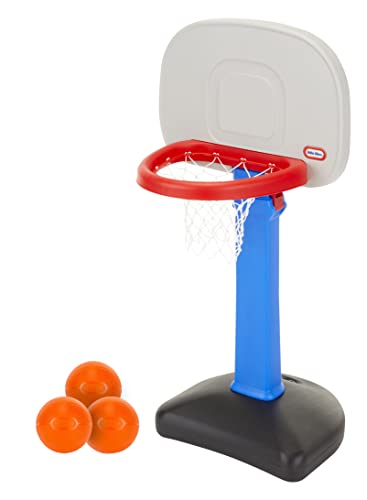
The Little Tikes Easy Score Basketball Set is the classic first hoop, and it has earned that place by doing one thing very well: letting very young children score. The oversized rim is wider than a standard rim, so shots that would bounce off a regulation hoop drop through, and that early success keeps toddlers coming back to the game. The set includes three junior basketballs, so a lost ball never ends playtime, and the balls are light and soft enough for small hands to grip, lift, and throw without strain. The height adjusts to several settings, so the rim can start low for a toddler and rise as the child grows and their shot improves.
Assembly is simple, with a plastic pole that slots into a wide base and a backboard that clips into place. The whole set is light enough for a parent to carry from a playroom to a patio, and the base can be weighted with sand or water for extra stability outdoors. The blue colorway has bold, friendly graphics that suit a playroom or a backyard, and the plastic construction wipes clean after outdoor play. Parents often keep this hoop in a living room or playroom for rainy days, then move it outside when the weather turns fair, and its small footprint fits both places without crowding the room.
What sets this hoop apart from other toddler sets is the combination of the oversized rim and the three included balls. Many first hoops include a single ball, which means play stops the moment it rolls under a sofa or over a fence. Three balls keep the game going, and they also let siblings or friends play together, taking turns and learning to share the hoop. The adjustable height means the set stays useful from the first wobbly throws at eighteen months through confident shooting at age five, which is a long life for a toy in this age range. The set is aimed squarely at toddlers and preschoolers, so older children will outgrow it, but for its intended age group it is hard to beat.
The Easy Score set works best as a first hoop for a child between eighteen months and five years old, and it suits families who want a light, portable, indoor-friendly option. It is not a training tool for older players, and it will not survive the hard play of a ten-year-old, but that is not its job. Its job is to make basketball fun from the very first shot, and the oversized rim, the light balls, and the adjustable height do exactly that. For a birthday or holiday gift for a toddler, it is one of the most reliable choices on the market, and its long history as a best seller reflects how many families have started their children on this exact hoop.
Specs
- Tier: Budget
- Age range: 18 months to 5 years
- Backboard: Durable plastic with an oversized rim
- Height: Adjustable to several settings up to 61 inches
- Base: Wide base that fills with sand or water
- Balls included: 3 junior basketballs
- Use: Indoor and outdoor
- Dimensions: 23.75 x 22 x 61 inches
Step2 Shootin Hoops Junior Basketball Set

The Step2 Shootin Hoops Junior Basketball Set is a sturdy toddler hoop built for both indoor and outdoor play, with a design that has stayed popular for years. The rim is oversized, which helps young shooters score, and the pole adjusts in height so the hoop can grow with a child through the toddler and preschool years. The base is wide and low, and it fills with sand or water to keep the hoop steady when a child leans on it or a ball hits the rim hard. The set includes a junior basketball sized for small hands, so it is ready to play as soon as it is assembled.
Step2 builds its toys from thick, durable plastic, and this hoop shows that approach in its solid pole, its chunky base, and its backboard. The plastic resists fading in the sun and wipes clean after muddy outdoor play, which matters for a toy that will spend time in a yard. The hoop assembles without special tools, and the parts fit together with the kind of simple connections that a parent can manage in a few minutes. Once assembled, the hoop is light enough to move between a playroom and a patio, yet heavy enough when the base is filled to stay put during a game.
The junior size is the key to this hoop. It is taller and sturdier than the smallest toddler hoops, which makes it a good step up for a child who has outgrown a first hoop but is not ready for a full portable system. The adjustable height covers the preschool years well, and the oversized rim keeps scoring within reach while shooting form develops. The set suits a child who plays every day and needs a hoop that can take daily use, and it suits a family who wants one hoop to serve from the toddler years into early elementary school.
This hoop is a good fit for families with a patio, a driveway, or a large playroom, and for parents who want a durable first hoop rather than the lightest one. It handles outdoor weather well, and its wide base gives it stability on flat surfaces. It is not the right pick for an older child who wants a regulation rim and a real backboard, and it is not an over-the-door option for a bedroom, but as a junior freestanding hoop it covers its age range with confidence. For a child between two and five years old who is ready for regular shooting practice, it is a strong and dependable choice.
Specs
- Tier: Budget
- Age range: Toddlers and preschoolers
- Backboard: Durable plastic with an oversized rim
- Height: Adjustable pole for growing players
- Base: Wide base that fills with sand or water
- Balls included: 1 junior basketball
- Use: Indoor and outdoor
- Material: Thick molded plastic
Franklin Sports Over the Door Mini Basketball Hoop

The Franklin Sports Over the Door Mini Basketball Hoop is the pick for families who have no floor space to spare. It hangs on a standard interior door, needs no assembly beyond hooking it in place, and comes with a mini basketball so a child can start shooting within a minute of opening the box. The backboard is sized for a door, the rim is springy enough to handle enthusiastic dunks from close range, and the whole set weighs little enough that it can move from a bedroom door to a playroom door whenever the game moves. For apartments, small bedrooms, and homes where the yard is not an option, it is the simplest way to bring basketball indoors.
The over-the-door design has practical advantages that go beyond saving space. There is no base to fill, no pole to assemble, and no footprint to trip over, which makes it easy to set up and easy to store. The padded hooks grip the top of the door and protect the finish, and the backboard sits flat enough that the rim stays steady during play. The mini basketball is small and light, so it will not damage walls or furniture the way a full-size ball would, and it is easy for a child to palm and shoot with one hand. Many families hang the hoop on a bedroom door for after-school shooting practice, then move it to a basement or garage door for a change of scene.
This hoop suits older children and teens best, because the smaller backboard and the close shooting distance reward a player who can already aim and control a shot. Younger children enjoy it too, especially with a parent’s help to hang it at a reachable height, but the mini ball and the door mount make it a casual game rather than a training system. It also suits adults who want a quick shooting break in a home office, and it makes a good gift for a basketball fan who has a favorite team, since Franklin offers team versions of the same hoop. The classic version covered here is the plain over-the-door set, which fits any room without a team theme.
The main trade-off is scale. An over-the-door hoop cannot replace a portable system for a child who wants to practice layups, free throws, and rebounding at real distances. Its rim is smaller, its backboard is smaller, and its door mount limits how hard a player can shoot. But for quick games, for rainy days, and for rooms where a freestanding hoop would not fit, it is the right tool. It is also the lowest-commitment hoop in this guide: no tools, no filling, no floor space, and no assembly time. For a child who wants to shoot hoops in their bedroom tonight, it delivers immediately.
Specs
- Tier: Budget
- Age range: Kids and teens
- Backboard: Compact backboard sized for a standard door
- Mount: Over-the-door hooks with padding
- Rim: Spring-action rim for mini-ball play
- Balls included: 1 mini basketball
- Use: Indoor
- Material: Durable plastic backboard with a steel rim
SKLZ Pro Mini Hoop Outdoor Basketball System
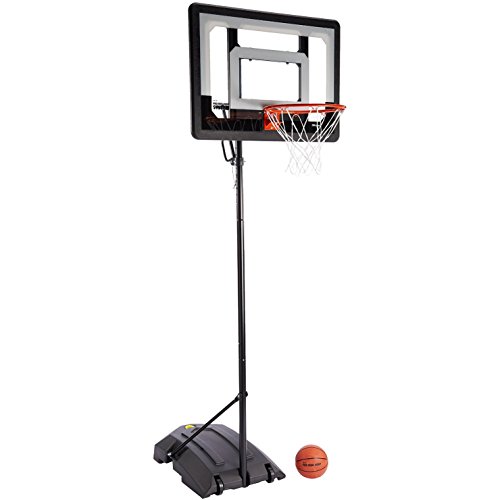
The SKLZ Pro Mini Hoop Outdoor Basketball System is a freestanding outdoor hoop that bridges the gap between a toddler set and a full portable system. It has an adjustable-height pole, a clear shatterproof backboard, and a breakaway rim, which gives it a more realistic feel than a plastic toddler hoop while keeping the size and weight manageable for a family yard. The set includes a seven-inch ball, so it is ready to play outdoors as soon as it is assembled, and the pole adjusts to suit players of different heights, which makes it a good shared hoop for siblings.
The clear backboard is the standout feature. It looks like a real basketball backboard, it gives a true rebound, and its shatterproof build handles hard shots and outdoor weather. The breakaway rim flexes under pressure, which protects the backboard and the pole when a player hangs on the rim or shoots with force. The pole telescopes to several heights, so a younger child can play at a low setting while an older sibling or parent uses a higher one. The base fills for stability, and the whole system is light enough for an adult to move around a yard or patio when the base is empty.
This hoop suits families who want a real basketball feel without the size and weight of a full portable system. It fits a patio, a small driveway, or a flat corner of a yard, and it works well for children who have outgrown a toddler hoop and want to practice shooting with a proper backboard and rim. It also suits a family that plays together, because the adjustable pole lets players of different heights share the same hoop in one session. The seven-inch ball is smaller than a standard ball, which keeps the game in proportion to the hoop, and it is easy for a child to handle and shoot.
The outdoor build is worth noting for buyers who plan to leave the hoop outside. The backboard and rim are made for outdoor use, and the pole and base handle rain and sun better than an indoor-only toy. Like any outdoor hoop, it lasts longest when the base stays filled, the bolts stay tight, and the net is checked from time to time. For a child between about five and ten years old who wants a serious step up from a toddler hoop, this system offers a realistic game in a size that still fits a family yard, and its adjustable height means it can serve that child for several seasons.
Specs
- Tier: Mid-range
- Age range: Kids and youth players
- Backboard: Clear shatterproof backboard
- Height: Adjustable-height pole
- Rim: Breakaway steel rim
- Base: Fillable base for stability
- Balls included: 1 seven-inch basketball
- Use: Outdoor
- Material: Steel pole with a shatterproof backboard
Spalding NBA Portable Basketball System

The Spalding NBA Portable Basketball System with a 44-inch backboard is the premium pick in this guide, and it is the closest thing to a real court that fits in a family driveway. The 44-inch polycarbonate backboard is large enough for bank shots and rebounding practice, the pole adjusts from seven and a half feet up to ten feet, and the portable base has wheels so an adult can roll the system into place. It is built for players who have moved past toddler and junior hoops and want a full-size game at home, and it can serve a family from the elementary years through the teen years and beyond.
The size of the backboard changes the game. A 44-inch board gives a shooter a real target, and it rewards good shooting form in a way that a small board cannot. The polycarbonate material is strong and weather resistant, so it holds up outdoors through sun and rain, and the steel frame behind it keeps the board rigid during hard play. The height adjustment covers the full range from a youth-friendly seven and a half feet to regulation ten feet, which means the hoop grows with the player and never needs replacing as skills improve. The base fills with water or sand, and the built-in wheels make it possible for one adult to move the system for parking, mowing, or shade.
This system suits families with a driveway or a large flat backyard, and players who practice several times a week. It is the right pick for a child who plays on a school or community team and wants to practice free throws, layups, and jump shots at home. It also suits a household where parents play too, because the ten-foot maximum height gives adults a regulation game. Assembly takes longer than a toddler hoop, and the system needs a flat, level surface, but the result is a hoop that feels like a real court and lasts for years.
The trade-off is size and weight. A 44-inch portable system is a substantial piece of equipment, and it needs a dedicated spot in a driveway or yard. It is not a toy to move indoors for winter, and it is not the right choice for a toddler. But for a family that has the space and a player who is ready for a full-size game, it is the best long-term investment in this guide. The combination of the large backboard, the full height range, and the wheeled portable base makes it a hoop that a child can grow into rather than grow out of, and that is the best value a basketball hoop can offer.
Specs
- Tier: Premium
- Age range: Kids, teens, and adults
- Backboard: 44-inch polycarbonate backboard
- Height: Adjustable from 7.5 to 10 feet
- Rim: Steel rim with an all-weather net
- Base: Portable base with wheels, fills with water or sand
- Included: All-weather net
- Use: Outdoor
- Material: Steel pole with a polycarbonate backboard
Keeping Play Safe Around Any Hoop
A basketball hoop is a piece of sports equipment, and a few simple habits keep play safe for every child who uses it. Adult supervision matters most for the youngest players, who may climb on a base or hang on a rim without understanding the risk. Teach children early that the rim is for shooting, not for hanging or climbing, and that the pole and backboard are not climbing frames. A portable hoop with a filled base is stable during normal play, but it is not designed to hold the weight of a child, so hanging on the rim should be off limits for younger players.
Check the hoop regularly, especially at the start of each season. Tighten bolts, check that the base is still full, look at the net for fraying or loose knots, and make sure the backboard and rim are firmly attached. A net with loops or openings that can catch a small child’s head should be replaced, and a damaged net should come off the rim until a new one arrives. Modern toy basketball sets ship with nets that attach securely to the rim, and keeping the net in good condition is the simplest way to avoid the kind of hazard that led to safety recalls of toy basketball nets in earlier decades. If a net looks worn or its knots slide, replace it before the next game.
The playing area deserves attention too. Clear the space around the hoop of toys, garden tools, and other tripping hazards, and make sure the surface is flat and dry. A portable hoop should sit on level ground, because a tilted base shifts weight to one side and makes the hoop less stable. Children should wear proper footwear for outdoor play, and they should drink water and take breaks during hot weather. For indoor hoops, keep the area around the door clear and remind children to close the door gently when the hoop is mounted. A quick safety check takes a minute and keeps the game fun, which is the whole point of having a hoop at home.
Setting Up a Kids Basketball Hoop
Setting up a kids basketball hoop is a straightforward job when you follow the maker instructions and give yourself enough time. Start by choosing the spot, checking that the ground is flat and level, and clearing enough room around the hoop for shooting and rebounding. Read the instructions all the way through before opening the parts, and lay out the pieces in order so nothing goes missing. Most toddler hoops assemble in a few minutes with no tools, while a portable system needs more time, a wrench, and a second pair of hands for lifting the pole and backboard into place.
Fill the base only after the hoop is in its final position, because a filled base is heavy and hard to move. Water is the easiest fill, and sand is the heavier and more permanent choice for a hoop that will stay outside. If you use water in a cold climate, drain the base before freezing weather or switch to sand, because frozen water can crack a plastic base. Once the base is filled, set the height to suit the youngest regular player, attach the net, and test the hoop with a few gentle shots before the first real game. Check that the pole is upright, the backboard is level, and the rim sits flat.
Keep the instructions and any spare parts after assembly, because they help with height adjustments and seasonal checks later. If the hoop will move between indoors and outdoors, empty the base before moving it, and clean and dry the parts before storing them. A little care at setup and a quick check each season keep a kids basketball hoop safe and playable for years, and a hoop that is easy to use is a hoop that gets used every day.
Frequently Asked Questions
What age is best for a first basketball hoop?
A first hoop suits a child from about eighteen months old, when a low rim and a light ball let a toddler push the ball through an oversized rim. Toddler sets with adjustable heights stay useful through age five, and a child who has outgrown a toddler hoop is usually ready for a junior freestanding hoop or a youth portable system. The right age depends on the child, so choose by height and ability rather than by the number on the box.
What height should a kids basketball hoop be set to?
Set the rim low enough that the child can reach it with a normal shooting motion, usually between two and four feet for toddlers, between five and six feet for early elementary players, and from six feet upward for older children. A rim that is too high teaches poor form, while a rim that is too low stops challenging the player. Adjustable hoops let you raise the rim as the child grows, so start low and raise it in small steps.
Should the base be filled with water or sand?
Both work, and the choice depends on how the hoop will be used. Sand is heavier by volume, does not freeze, and suits a hoop that stays outside in one spot all year. Water is easier to fill and drain, which suits a hoop that moves between a driveway and a garage. Whichever you choose, fill the base fully, because a partly filled base lets the hoop shift during play.
Can a kids basketball hoop be used indoors?
Yes, and the best indoor choices are toddler freestanding hoops with a soft ball and over-the-door hoops with a mini ball. Both need little space and protect walls and floors. A portable outdoor system is too large and too heavy for most indoor rooms, so keep it outside on a flat, paved surface. For indoor play, clear the area around the hoop and use a ball sized for the room.
Conclusion
The best kids basketball hoop is the one that fits the player, the space, and the way your family plays. A toddler does best with a low, light hoop and an oversized rim that rewards every shot, while a young player ready for a real game does best with an adjustable portable system and a proper backboard. Families short on space can bring the game indoors with an over-the-door hoop, and families with a driveway can invest in a full-size system that grows with the player for years. Start with the age and height of the player, check the space where the hoop will live, and pick the hoop that matches both. The right hoop turns an ordinary driveway or bedroom door into a court, and that is a gift that keeps giving every day.
Product and ASIN Reference
| Product | ASIN |
|---|---|
| Little Tikes Easy Score Basketball Set | B01C5A2WJO |
| Step2 Shootin Hoops Junior Basketball Set | B00DQADRUQ |
| Franklin Sports Over the Door Mini Basketball Hoop | B003GWJT0Q |
| SKLZ Pro Mini Hoop Outdoor Basketball System | B002MAF47A |
| Spalding NBA Portable Basketball System | B000H38LGK |