Key takeaways
- Searching for the best piano keyboards under 500? Compare four 88-key digital pianos with weighted keys, clear sound, and practice features for home use.
Finding the Best Piano Keyboards Under 500
Shopping for the best piano keyboards under 500 means balancing three things: a full 88-key range, keys that feel close to an acoustic piano, and a sound that stays pleasant through long practice sessions. A budget cap does not mean giving up on all three, but it does mean choosing carefully: models in this class differ far more in key action and sound than in appearance.


The quick answer: the Yamaha P-71 is the safest all-round choice for most beginners, with graded hammer action and an included sustain pedal and power supply. If key feel matters most, the Roland FP-10 is the strongest alternative, while the Donner DEP-20 gives you the most sounds and the loudest speakers. The Alesis Recital is the lightest-touch entry point.
Every pick below is a full-size digital piano with its own speakers, piano sound, and sustain pedal connection, not a compact keyboard or a MIDI controller. Read the key action section first if you are buying for lessons: key feel is the one feature you cannot change later.
Quick Picks
Our Short List of 3
All 4 Picks at a Glance
| Product | Specs | Action |
|---|---|---|
| 1. Yamaha P-71 — Safest All-Round Choice | Check price on Amazon | |
| 2. Roland FP-10 — Best Key Feel | Check price on Amazon | |
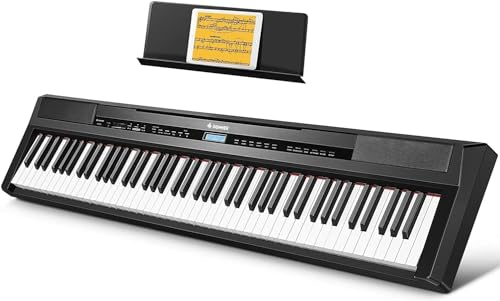 3. Donner DEP-20 — Most Sounds and Features | Check price on Amazon | |
 4. Alesis Recital — Lightest Touch and Lowest-Cost Entry | Check price on Amazon |
How to Choose
Start With 88 Full-Size Keys
A piano for serious practice should have 88 full-size keys, the same range as an acoustic piano. Shorter keyboards force you to shift octaves mid-piece, which breaks the flow of a lesson. All four pianos here have the full range, so you can compare them on action, sound, and features instead of worrying about missing notes.
Understand Key Action Before Anything Else
Key action is the mechanism under the keys, and it decides how the instrument feels. Graded hammer action makes the low keys feel heavier than the high keys, just as on an acoustic piano. Fully weighted hammer action uses a hammer mechanism across the whole keyboard. Semi-weighted keys use springs with added weight, so they feel lighter and spring back faster, but they do not reproduce the resistance of a real piano action.
If you are taking lessons, or you expect to play an acoustic piano at school or a teacher’s studio, choose a hammer-action model. Your fingers will build the right strength and control, and the move to an acoustic piano will feel natural. Semi-weighted keys suit casual playing or learning basic chords only, if you accept that the feel differs from a piano.
Listen for Piano Tone, Not the Number of Voices
A long list of voices looks impressive, but the piano voice is the one you will use most. A good piano voice should sound warm in the low register, clear in the middle, and clean at the top without turning thin or harsh. Extra voices matter far less than the quality of the main piano sound, unless you want organ, electric piano, strings, and synth sounds for composing or playing in a band.
Polyphony is the number of notes the piano can sound at once, and it matters when you hold the sustain pedal down through overlapping notes. A 64-note polyphony suits most beginner and intermediate pieces, but 96-note or 128-note polyphony gives more headroom for dense chords and layered sounds.
Check the Speakers and the Headphone Socket
Built-in speakers decide how the piano sounds in a room, and a headphone socket decides how it sounds to everyone else in the house. Look for speakers loud enough to fill a practice room without distortion, and a standard headphone socket for quiet evening practice. Every piano here has both, but speaker power differs, and louder models suit larger rooms. If you play with other musicians, check for an auxiliary output for an external speaker or amplifier.
Count What Is in the Box
A piano that arrives without a sustain pedal or a power supply is not ready to play, and buying those parts separately adds cost and delay. Check the included accessories before you order: a sustain pedal, a power adapter, a music rest, and a stand matter most. Some models include the pedal and power supply but no stand, while others include a stand in a separate bundle listing, so confirm the exact listing rather than assuming every version includes the same parts.
Think About Space, Weight, and Portability
A full-size digital piano is usually around four feet wide, and it needs a stable stand and a bench or chair at the right height. Measure your space before ordering, and leave room for the music rest and your elbows. Weight matters if you move the piano between rooms or take it to lessons: lighter models are easier to carry, heavier ones feel more planted on a stand. If you want to play away from a wall socket, check whether the model can run on batteries, which are almost always sold separately.
The Best Piano Keyboards Under 500 Reviewed
1. Yamaha P-71 — Safest All-Round Choice
The Yamaha P-71 is the Amazon-exclusive version of the Yamaha P-45, the same instrument under a different model name, so buyers sometimes see both names. It has 88 Graded Hammer Standard keys, which feel heavier in the bass and lighter in the treble, following the pattern of an acoustic piano. That graded feel is why this model is so often recommended for beginners: it builds finger strength the right way from the first lesson, and it feels familiar the first time a student sits at a real piano.
Yamaha’s sampled grand piano voice leads a list of ten voices, including electric piano, organ, strings, and harpsichord. Dual mode layers two voices together, and Duo mode splits the keyboard into two identical ranges so a teacher and student can play side by side. Polyphony is 64 notes, enough for beginner and intermediate repertoire, though long sustained passages may expose the limit sooner than on a higher-polyphony model.
The P-71 includes a sustain pedal, a power supply, and a music rest, so it is ready to play once on a stand. Its built-in speakers suit a bedroom or practice room, a standard headphone socket covers quiet practice, and simple buttons plus a volume slider keep the focus on playing, with no screen to learn. USB connectivity links the piano to a computer for lesson apps and recording software.
The trade-offs are modest. The pedal in the box is a simple footswitch rather than a full three-pedal unit, so it gives sustain but not the soft or sostenuto pedals of an acoustic piano. The voice list is short next to feature-heavy rivals, and no stand or bench is included. None of that changes the core: a well-built, honestly voiced piano with keys that feel right.
2. Roland FP-10 — Best Key Feel
The Roland FP-10 is the pick for buyers who put key feel above everything else. Its PHA-4 Standard keyboard uses a hammer mechanism with escapement and an ivory-feel key surface, which gives each key a small click of resistance partway down, just as an acoustic piano key gives way when the hammer is released. That detail makes soft, controlled playing easier, and the action is the strongest in this budget class.
The sound engine is Roland’s SuperNATURAL piano technology, with fifteen tones that include grand piano, electric piano, strings, and organ sounds. Polyphony is 96 notes, which gives more room for sustained chords and layered playing than the 64-note Yamaha in this guide. Twin Piano mode splits the keyboard into two matching ranges for lessons. Bluetooth MIDI connects to the Roland Piano app and other compatible lesson apps on a phone or tablet, a genuine help for structured practice.
The FP-10 is a compact slab-style piano, so it takes up little depth on a stand and is easy to move between rooms. It includes a DP-2 footswitch pedal, a music rest, and a power adapter. The built-in speakers are compact, so the sound is clear at practice volume but less room-filling than the larger speaker systems on some rivals. For the fullest sound, use good headphones or an external speaker through the auxiliary output.
Two limits are worth knowing. First, the Bluetooth connection carries MIDI data, not audio, so it will not stream music from your phone through the piano speakers; it connects lesson and recording apps instead. Second, this listing is for the piano only, with no stand or bench included. If you want the best key action in the under-500 class and you are happy to add a stand, the FP-10 is the most convincing choice here.
3. Donner DEP-20 — Most Sounds and Features
The Donner DEP-20 is the feature leader in this group. It has 88 fully weighted hammer-action keys, 238 tones, 200 rhythms, and 128-note polyphony, plus a backlit LCD screen that shows the selected voice, rhythm, and settings. That screen makes the piano much easier to navigate than models with small buttons and no display, especially when exploring the large voice list or using the built-in recording function.
The speakers are two 25-watt units, the most powerful in this guide, so the DEP-20 fills a room more easily than its rivals and works well for family practice sessions and small gatherings. Dual tone mode layers two sounds, and USB-MIDI connects the piano to computer software for recording and lessons. The piano-only listing includes a sustain pedal and a power supply, so it is ready to play once it is on a stand.
One point needs care when ordering. The DEP-20 is sold in more than one configuration, and the furniture-stand version with a three-pedal unit is a different listing from the piano-only version linked here. If you want the stand and three pedals, confirm you are ordering that exact configuration. The key action is Donner’s own hammer action: weighted, but without the graded resistance or escapement detail of the Yamaha and Roland actions, and the piano tone is clear though less refined at the softest dynamics.
For a beginner who wants a complete, feature-rich instrument with a display, recording, and plenty of voices, the DEP-20 is a strong choice. It also suits a household where more than one person will play, since the rhythm and voice options give casual players more to enjoy beyond the piano sound.
4. Alesis Recital — Lightest Touch and Lowest-Cost Entry
The Alesis Recital is the entry point of this guide, included with a clear flag: its keys are semi-weighted, not hammer action. That distinction matters, and it is why this piano sits last. Semi-weighted keys use springs with added weight, so they feel lighter and faster than hammer-action keys, and they do not reproduce the graded resistance of an acoustic piano. For a casual player, a songwriter sketching ideas, or a beginner who wants the lightest possible touch, that can be a genuine advantage. For a student taking formal lessons, it is a compromise to understand before buying.
What the Recital does give you is a full 88-key range, five voices covering acoustic piano, electric piano, organ, synth, and bass, 128-note polyphony, and two built-in 20-watt speakers. Split, Layer, and Lesson modes are included, so you can play two voices at once, split the keyboard for bass and melody, or share the keyboard with a teacher. The piano runs on the included power adapter or on six D-cell batteries. At around 16 pounds it is the lightest piano in this guide, and the easiest to lift on and off a stand.
Two practical points deserve attention. First, a sustain pedal is not included, so you will need to add one before the piano is fully ready for lesson pieces that use the pedal. Second, the five-voice list is the shortest here, so if you want a wide range of sounds, the Donner will give you more to explore. Buy it knowing what it is: a light, portable, full-size keyboard for getting started, rather than a long-term substitute for a hammer-action piano.
What to Check Before You Buy
Before you order, work through a short checklist. First, confirm the exact listing: the same model name can cover a piano-only version, a bundle with a stand, and a bundle with headphones or a bench, with different accessories in each. Second, check that the listing is for the current version of the model, because older generations such as the original Alesis Recital Pro are being phased out and may show as unavailable. Third, budget for parts not in the box, usually a stand, a bench, and sometimes a sustain pedal.
Fourth, measure your space and check the piano’s weight if you will move it often. Fifth, confirm the connections you need: a headphone socket for quiet practice, USB for lesson apps and recording, and an auxiliary output for external speakers. Sixth, read the return terms before ordering, so you know your options if the key feel is not what you expected. A piano is a personal choice, and the right to return it matters more here than for most purchases.
Finally, think about who will play the piano and how. A child starting lessons needs hammer-action keys and a teacher-friendly layout. An adult returning after years away may care more about sound quality and a simple interface. A household with several players may value the extra voices, rhythms, and recording features of the Donner DEP-20. Match the piano to the player, not to the longest feature list.
Frequently Asked Questions
Do I really need 88 keys for a first piano?
Yes, if you plan to take lessons or play real piano music. Pieces written for piano use the full range, and a shorter keyboard forces you to shift octaves mid-piece. All four have 88 full-size keys, so you will not outgrow the range as you progress.
Is hammer action important for a beginner?
It is important if the beginner is taking lessons or expects to play an acoustic piano elsewhere. Hammer-action keys build finger strength and control as an acoustic piano does, and they teach the difference between soft and loud playing through touch rather than volume alone. Semi-weighted keys are workable for casual playing, but a teacher will usually ask for weighted keys, so buy them from the start if lessons are part of the plan.
Can a piano in the under-500 class sound good?
Yes. The piano voices in this class are sampled from real grand pianos, and in a normal practice room they sound warm and convincing, especially through headphones. The differences show up in the details: the softest notes, the realism of the sustain, and the clarity of the top octave. Those details matter more to advanced players than to beginners, and every piano here is good enough to learn on.
What else do I need besides the piano?
Most buyers need a stable keyboard stand and a bench or chair. Some models include a sustain pedal and power supply, and some do not, so check the box contents on the exact listing you order. Headphones are useful for quiet practice, and a sustain pedal is essential once lesson pieces start using it.
Should I choose the piano with the most voices?
Not necessarily. Extra voices are fun, and they help with composing and playing in a band, but the piano voice is the one you will use most, and its quality matters more than the size of the list. Choose the piano with the key action and piano sound you like best, then treat the extra voices as a bonus. The Donner DEP-20 is the right choice if you want many voices; the Yamaha P-71 and Roland FP-10 are the right choices if piano tone and key feel come first.
Bottom Line
The best piano keyboards under 500 are not the ones with the longest feature lists. They are the ones that get the fundamentals right: 88 full-size keys, a key action that teaches good technique, a piano sound you enjoy hearing every day, and the pedal and power supply you need to start playing. The Yamaha P-71 covers those fundamentals most safely, the Roland FP-10 does it with the best key feel, the Donner DEP-20 adds the most features and the loudest speakers, and the Alesis Recital gives casual players the lightest way in. Choose the one that matches the player, check the exact listing before you order, and put the rest of your attention into practice: that is what turns a good keyboard into real progress.
Disclosure: As an Amazon Associate, we may earn from qualifying purchases.