Key takeaways
- Find the best low power gaming graphics cards for small PCs, with slot-powered picks, key specs, power needs, and advice for smooth 1080p play.
Not every gaming PC has room, cooling, or power supply headroom for a large graphics card. Small form factor cases, slim office desktops, and older prebuilt systems often have no spare power cables for the graphics card at all, and many ship with modest power supplies never meant to feed a hungry GPU. Low power gaming graphics cards solve that problem directly. The strongest of them draw all of their power from the PCIe slot itself, stay within a tight thermal budget, and still deliver smooth gaming at 1080p in a wide range of popular titles.

This guide focuses on cards that keep power draw low without giving up real gaming ability. Every pick below is a genuine gaming graphics card of the same type the keyword calls for, and each one runs at 75 watts or less. That ceiling matters, because 75 watts is what a standard PCIe x16 slot can supply on its own. A card at or under that limit needs no extra power connector, which makes it a realistic drop-in upgrade for compact and prebuilt machines that would reject a conventional gaming card outright.
As an Amazon Associate, we earn from qualifying purchases.
How to Choose a Low Power Gaming Graphics Card
Start with the power budget
Power draw is the defining limit in this category, so it comes first. Cards that run entirely on slot power remove the most common upgrade barrier in small and prebuilt PCs: the missing graphics power cable. Before choosing a card, check the wattage of the power supply already in the system and look inside the case for any spare PCIe power connectors. If there are none, only a slot-powered card will work without a power supply swap. If the system does have a spare connector and a stronger supply, a slightly higher-draw card becomes possible, but that moves outside the low power idea behind this guide.
Match the card to the case
Physical fit is the second filter. Low profile cards are half height and usually ship with both a full-height and a low-profile bracket, so they fit slim desktops that reject standard cards. Short dual-slot cards fit most small towers and many mini cases, while short single-fan designs suit the tightest home theater and office enclosures. Measure the available length, height, and slot width before ordering, and leave a little clearance for airflow, since a card that blocks the only intake path will run hot and loud.
Understand what the memory figures mean
Video memory, usually shortened to VRAM, holds textures and frame data. Six gigabytes is a comfortable amount for 1080p gaming in this class, while four gigabytes can still handle esports titles and older games well, sometimes with texture settings turned down in newer releases. Memory bus width and speed shape bandwidth, but real gaming results also depend on the GPU itself, so treat memory figures as one part of the picture rather than the whole story.
Set honest expectations for 1080p
Low power cards are built for 1080p. Esports and competitive games are the sweet spot, where high frame rates are realistic at sensible settings. Demanding open-world and story-driven games are playable at 1080p too, usually at medium settings, and upscaling features such as DLSS on NVIDIA cards can lift frame rates further by rendering at a lower internal resolution and reconstructing the image. Expecting native high-refresh gaming at 1440p or 4K from a slot-powered card is unrealistic, and buyers with those goals need a different class of hardware and a stronger power supply.
Check the display outputs
Compact cards sometimes cut back on ports to save bracket space. Count the outputs and match them to the monitors in the setup. HDMI 2.1 suits modern displays and televisions, DisplayPort is the common choice for high-refresh gaming monitors, and a few low profile cards still include DVI-D for older screens. The port mix decides how many displays can run at once and at what refresh rate.
Consider drivers, features, and encoding
The three GPU makers here take different approaches. NVIDIA cards bring mature drivers, DLSS upscaling, and hardware video encoding that streamers and recording software can use. AMD offers a very low power design in the RX 6400, though that chip leaves out hardware video encoding, which matters to anyone planning to stream or record gameplay. Intel Arc cards include AV1 encoding, rare at this power level, and Arc drivers have improved steadily, though checking recent driver notes for a favorite game is still sensible before buying.
The Best Low Power Gaming Graphics Cards
1. MSI GeForce RTX 3050 LP 6G OC
The MSI GeForce RTX 3050 LP 6G OC is the most complete low profile option in this roundup. It pairs the 6GB version of the RTX 3050 with a half-height, dual-fan design, so it fits slim cases that cannot accept a standard card while still cooling properly under load. The card draws 70 watts and takes all of it from the PCIe slot, so there is no power cable to find, route, or worry about. That combination of fit and simplicity makes it an easy recommendation for upgrading a compact prebuilt system.
On the gaming side, the RTX 3050 chip brings DLSS support, ray tracing cores, and a hardware encoder, which is a fuller feature set than most slot-powered cards offer. Six gigabytes of GDDR6 memory on a 96-bit interface running at 14 Gbps gives it enough headroom for 1080p gaming across esports titles and a broad library of story-driven games at adjusted settings. Display output is generous for a low profile card, with two HDMI 2.1 ports and one DisplayPort 1.4a connection, so a gaming monitor and a television can stay connected at the same time.
Specs
| Item | Detail |
|---|---|
| GPU | NVIDIA GeForce RTX 3050 |
| Video memory | 6GB GDDR6 |
| Memory interface | 96-bit |
| Memory speed | 14 Gbps |
| Boost clock | 1492 MHz |
| Power draw | 70 watts, slot powered, no external connector |
| Outputs | 1 x DisplayPort 1.4a, 2 x HDMI 2.1 |
| Form factor | Low profile, dual fan |
| ASIN | B0CTJZCJH1 |
Who It Suits
This card suits owners of slim PCs who want the strongest all-round slot-powered gaming upgrade that fits a half-height slot, and players who value DLSS and a built-in encoder for recording or streaming. Buyers with a full-height case may prefer the ASUS Dual below for its larger cooler, and anyone chasing high-refresh 1440p play should look at a more powerful class of card instead.
2. ASUS Dual GeForce RTX 3050 OC Edition 6GB
The ASUS Dual GeForce RTX 3050 OC Edition takes the same efficient 6GB RTX 3050 chip and wraps it in a full-height, two-slot design with a larger cooler. At 20 cm long it still fits many small chassis, and the two Axial-tech fans move more air than a low profile cooler can, which helps the card hold its boost clock quietly during longer sessions. The fans also support a 0dB mode that stops them entirely under light load, so the PC stays silent during desktop work and video playback. Like the MSI card, it runs on slot power alone at 70 watts.
Performance expectations mirror the other RTX 3050 pick: capable 1080p gaming, DLSS for extra frame rate headroom in supported games, and ray tracing best used lightly at this level. The boost clock reaches 1537 MHz in OC mode, and the card carries IP5X dust resistance plus a stainless steel bracket, durability touches that suit a PC expected to run for years. One HDMI 2.1 output and one DisplayPort 1.4a output cover a typical one- or two-monitor desk setup.
Specs
| Item | Detail |
|---|---|
| GPU | NVIDIA GeForce RTX 3050 |
| Video memory | 6GB GDDR6 |
| Memory interface | 96-bit |
| Boost clock | 1537 MHz in OC mode, 1507 MHz default |
| Power draw | 70 watts, slot powered, no external connector |
| Outputs | HDMI 2.1, DisplayPort 1.4a |
| Form factor | Full height, 2-slot, 20 cm long, dual Axial-tech fans |
| ASIN | B0CVCG2VPK |
Who It Suits
This card suits builders with a standard-height case who want a quiet, cool-running, slot-powered card for 1080p gaming, and anyone upgrading a prebuilt tower that has the height for a full-size bracket but no spare power cables. It does not suit slim low profile cases, where the MSI card above is the right shape, and it shares the same 1080p ceiling as every other pick in this guide.
3. Sparkle Intel Arc A380 ELF
The Sparkle Intel Arc A380 ELF brings something unusual to the low power class: a modern media engine with AV1 encoding, alongside AV1, VP9, and H.265 decoding support that makes the card attractive for a living room PC as well as a gaming box. The ELF is a compact single-fan card powered by the Intel Arc A380 GPU, running at the 75-watt slot limit with no external power connector. Its short length and modest cooler suit small cases, home theater builds, and office desktops being converted into light gaming machines.
For gaming, the A380 carries 6GB of GDDR6 memory on a 96-bit interface, matching the RTX 3050 cards above. That capacity helps at 1080p, where the A380 handles esports titles comfortably and plays many larger games at medium settings. Display output is a strength, with one HDMI 2.0 port and three DisplayPort 2.0 ports, the widest monitor support in this guide. Two practical notes apply to Arc cards. First, the system should have Resizable BAR enabled in its firmware, because Arc performance depends on it more than the other brands do. Second, Intel updates Arc drivers frequently, so installing the latest driver at setup is part of getting the best from the card.
Specs
| Item | Detail |
|---|---|
| GPU | Intel Arc A380 |
| Video memory | 6GB GDDR6 |
| Memory interface | 96-bit |
| Boost clock | 2000 MHz |
| Power draw | 75 watts, slot powered, no external connector |
| Outputs | 1 x HDMI 2.0, 3 x DisplayPort 2.0 |
| Form factor | Compact, single fan |
| Model | SA380E-6G |
| ASIN | B0C74RQV9K |
Who It Suits
This card suits buyers who want one compact card to cover light 1080p gaming, multi-monitor desktop work, and modern video tasks including AV1 encoding in a small or home theater PC. It also suits tinkerers who are comfortable keeping drivers current. Players who want the most predictable experience in older games, or whose motherboard lacks Resizable BAR support, will be better served by one of the NVIDIA picks above.
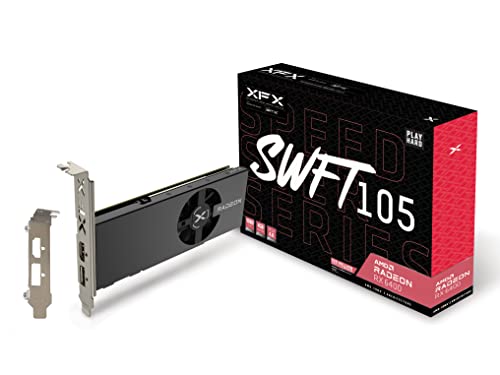
4. XFX Speedster SWFT105 Radeon RX 6400
The XFX Speedster SWFT105 Radeon RX 6400 is the lowest power card in this guide, and that is its whole appeal. The RX 6400 chip draws about 53 watts, comfortably under the slot limit, so the card runs cool and quiet in systems with weak airflow or very small power supplies. XFX builds it in a low profile design with a low profile bracket included, and its single-fan cooler keeps the card short enough for cramped slim desktops. For an aging office PC with a tiny power supply, this can be the difference between a card that works and one that cannot be installed at all.
The trade-offs are clear. Memory is 4GB of GDDR6 on a 64-bit interface, enough for esports games and older titles at 1080p and for newer games at reduced settings, but texture-heavy releases will push against that capacity sooner than they push the 6GB cards above. The boost clock reaches 2321 MHz, and memory runs at 16 Gbps. The RX 6400 also has no hardware video encoder, so it is a poor fit for streaming or recording that relies on the GPU. Judged as an efficient way to play lighter games on minimal power, though, it does its job well.
Specs
| Item | Detail |
|---|---|
| GPU | AMD Radeon RX 6400 |
| Video memory | 4GB GDDR6 |
| Memory interface | 64-bit |
| Memory speed | 16 Gbps |
| Boost clock | 2321 MHz |
| Power draw | 53 watts, slot powered, no external connector |
| Outputs | HDMI, DisplayPort |
| Form factor | Low profile, single fan, low profile bracket included |
| Model | RX-64XL4SFG2 |
| ASIN | B09Y7358KJ |
Who It Suits
This card suits owners of very small or low-wattage systems, especially slim prebuilt desktops, who mainly play esports and lighter games and want the lowest possible power draw. It also suits a quiet secondary PC for a bedroom or living room. It does not suit streamers, because of the missing hardware encoder, or players focused on the newest texture-heavy games, who should choose a 6GB card from this guide instead.
How These Cards Compare
The two RTX 3050 cards are the strongest gaming picks here and differ mainly in shape and cooling: the MSI suits cases that demand a low profile bracket, while the ASUS Dual suits full-height cases where quiet operation matters. The Sparkle Arc A380 matches their memory capacity and adds the best display output mix and AV1 encoding, at the cost of a little more driver upkeep. The XFX RX 6400 gives up memory and features for the lowest power draw of the group, the right trade for the weakest power supplies. None of these cards needs a power supply upgrade in a typical prebuilt PC, and that shared trait is the reason this category exists.
FAQ
Do low power graphics cards need a power cable from the power supply?
No, and that is the main reason to buy one. Every card in this guide draws 75 watts or less and takes all of its power from the PCIe x16 slot, so no PCIe power connector is required. That makes them suitable for prebuilt and small form factor PCs whose power supplies have no spare graphics cables. The only checks that remain are physical fit and a power supply in reasonable health.
What games can a slot-powered graphics card actually run?
At 1080p, quite a lot. Esports and competitive titles are the natural fit and can run at high frame rates on the RTX 3050 and Arc A380 cards here. Larger story-driven games are playable at 1080p with medium settings, and upscaling features such as DLSS on the NVIDIA cards can add further headroom in supported titles. The 4GB RX 6400 is best kept to lighter games and reduced settings. High-refresh 1440p and 4K gaming are beyond this class and call for a more powerful card and power supply.
Will one of these cards fit a slim office desktop?
Often, yes, if the card is a low profile model. The MSI RTX 3050 LP and the XFX RX 6400 in this guide are half-height designs and include or support low profile brackets for slim cases. Measure the slot area before ordering, confirm the case accepts a dual-slot or single-slot card as needed, and check that the desktop has a full PCIe x16 slot rather than only smaller expansion slots. Full-height cards such as the ASUS Dual will not fit a slim case regardless of their low power draw.
Is 4GB or 6GB of video memory enough for gaming now?
For this class of card at 1080p, both can work, with 6GB the safer choice. Six gigabytes handles current games at 1080p more comfortably, particularly texture settings, and gives the card a longer useful life. Four gigabytes remains fine for esports titles, older games, and newer games at lowered texture settings, which is the workload the RX 6400 is aimed at. Buyers planning to keep a card for several years should lean toward a 6GB model from this guide when the budget and the case allow it.
Final Verdict
Low power gaming graphics cards turn PCs that looked finished into PCs that can play games, without a power supply swap or a new case. For most buyers, the MSI GeForce RTX 3050 LP 6G OC is the best starting point, combining the strongest slot-powered feature set here with a low profile shape that fits the systems most likely to need it. Owners of full-height cases who value quiet cooling should take the ASUS Dual version of the same chip. The Sparkle Arc A380 ELF is the pick for media-heavy, multi-monitor small PCs, and the XFX RX 6400 is the answer when the power budget is tightest. Choose by case shape first, power supply second, and favorite games third.
Product and ASIN Reference
| Product | ASIN |
|---|---|
| MSI GeForce RTX 3050 LP 6G OC | B0CTJZCJH1 |
| ASUS Dual GeForce RTX 3050 OC Edition 6GB | B0CVCG2VPK |
| Sparkle Intel Arc A380 ELF | B0C74RQV9K |
| XFX Speedster SWFT105 Radeon RX 6400 | B09Y7358KJ |