Key takeaways
- Compare the best pottery wheels for kids, from plug-in wheels with centering arm tools to foot-pedal kits and a playful cat-shaped starter set.
A pottery wheel gives a child something most craft kits cannot: a skill that visibly improves with practice. The first bowls wobble, the second batch stands up straighter, and within a few weekends most kids can center a lump of clay, open it, and pull up a wall without help. The five kits below are the strongest starting points on sale today. They split into two camps. Plug-in and pedal wheels from National Geographic and MindWare behave most like real studio equipment, while the battery kits from Faber-Castell, Made By Me, and Insnug trade some power for portability, lower prices, and gentler first projects. Every kit here ships with air-dry clay, so finished pieces harden on a shelf instead of needing a kiln.
As an Amazon Associate, we earn from qualifying purchases.
Quick answer
For most kids ages 8 and up, the National Geographic Kids Pottery Wheel is the easiest first wheel: it plugs in, runs at two speeds, and its arm attachments help small hands center clay. The MindWare wheel suits kids who want a foot pedal and real technique, while the Insnug cat-shaped kit fits younger beginners who learn best through play.
National Geographic Kids Pottery Wheel
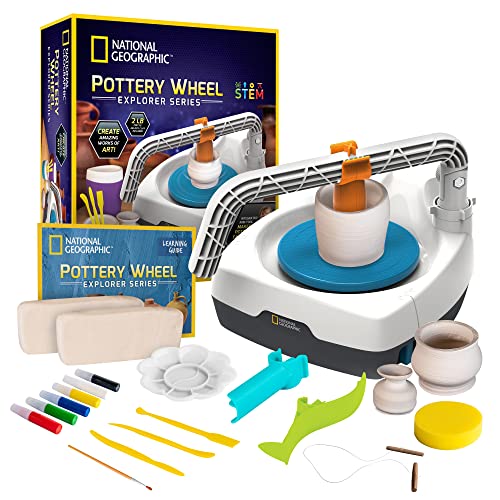
The National Geographic kit is the most forgiving place to start, because it attacks the hardest part of pottery head-on. Centering clay on a spinning wheel takes hand strength and timing that most 8-year-olds do not have yet, so this wheel adds an articulating arm that locks one of three attachments over the wheelhead. A centering tool steadies the lump, an opening tool starts the hollow, and a shaping tool smooths the wall, which means a beginner produces a recognizable bowl in the first session instead of a pile of collapsed attempts.
The motor plugs into a wall outlet and runs at two speeds, so the spin stays steady when a child leans in too hard, and there are no batteries to die mid-project. The box is genuinely complete: 2 pounds of air-dry clay, three sculpting tools, a wire cutting tool, a sponge, six paint colors with a palette and brush, an apron, and an illustrated learning guide with video lessons. The guide teaches actual technique in short steps, which helps an adult coach without knowing pottery.
The trade-offs are reach and ceiling. The cord ties the wheel to one table near an outlet, and two fixed speeds will eventually limit a child who falls in love with the craft. For a first wheel that maximizes early success, though, nothing else here is as well thought out.
MindWare Pottery Wheel for Beginners

MindWare’s wheel is the pick for a child who wants to learn pottery the way studios teach it. It runs from an AC adapter and is controlled by a foot pedal, so both hands stay on the clay while the foot manages the spin. Two speeds cover slow centering and faster shaping, and a switch reverses the rotation direction, a rare feature that makes the wheel equally natural for left-handed children.
A Safety Stop feature cuts the motor when a child presses down too hard, which protects the motor from overheating and quietly teaches the light touch that real throwing requires. A splatter shield keeps slip off the table and the child. The kit includes 2.5 pounds of pre-mixed air-dry clay, sculpting and cutting tools, a sponge, 12 paints, a brush, and a guide book, and the wheel surface measures about 5 inches across, big enough for cups and small bowls.
Expect a learning curve and some noise. Coordinating a pedal with two hands takes a few sessions, the motor is audible across a room, and the safety stop can trip when an enthusiastic beginner mashes the clay. For ages 7 and up with a little patience, this is the kit that builds transferable skills.
Faber-Castell Pottery Studio

The Faber-Castell Do Art Pottery Studio is the strongest choice when the wheel needs to travel or live away from an outlet. It runs on four C batteries, works through a foot pedal or a simple switch, and arrives fully assembled, so a child can open the box at a grandparent’s house and be shaping clay within minutes. Two speeds keep the pace manageable for beginners.
The kit leans educational. Alongside 3 pounds of natural air-dry clay, the most clay in this group, it includes a six-piece tool set, an apron, a table cover, 12 pots of paint, a glaze, a sponge, and two brushes. The illustrated instructions cover hand-building as well as wheel work and add a short history of pottery, which suits kids who like to understand a craft as well as do it. Projects range beyond pots to ornaments and beads, so the box keeps giving after the first bowls are done.
Battery power is the compromise. The motor turns gently and can slow under heavy pressure, and a household will go through C batteries if the hobby sticks. Treat it as an excellent, portable introduction rather than a long-term studio wheel.
Made By Me Motorized Power Pottery Wheel

Horizon Group’s Made By Me wheel targets younger beginners, ages 6 and up, and lowers the difficulty in smart ways. A three-piece bowl maker and an adjustable tool arm help a child form even shapes before their hands can do it alone, and the motor runs from a foot pedal or a switch, so kids can start with the switch and graduate to the pedal as coordination improves.
The kit includes 2 pounds of terra cotta air-dry clay in two bags, a carving knife, a double-sided shaping tool, a round sponge, a cutting cord, a ceramic paint strip, and a paintbrush. The terra cotta clay is a nice touch: finished pieces look like real fired pottery once dry, which makes the results feel grown-up to a young maker. The unit is compact and light, so it stores on a shelf between sessions.
Power and size are the limits. It is battery powered, the work area is small, and determined kids will outgrow the guided tools within a season or two. As a first taste of pottery for the 6-to-8 crowd, it is well judged.
Insnug Pottery Wheel for Kids

The Insnug kit wraps a real two-speed electric wheel in a cat-shaped housing, and the design does genuine work: children who might ignore a plain craft box will ask to use the cat. Under the ears it is a complete starter set, with three packs of air-dry clay, 12 paints, sculpting tools, brushes, a sponge, and an apron, so a child can shape, dry, and paint several pieces before anything runs out.
Two speeds are enough for the small bowls, cups, and dishes this size of wheel handles well, and the themed design pairs naturally with the painting stage, since kids often spend as long decorating as throwing. It suits the 8-to-12 range best, with younger children joining in under supervision.
Keep expectations in line with its class. This is a lightweight toy wheel, not studio equipment: the motor is modest, pieces stay small, and the novelty shape matters more to a 7-year-old than to a 12-year-old. Availability on this listing has fluctuated, so check that it is in stock before promising it as a gift. For a child who learns through play, it is the most inviting door into the craft here.
How to choose
Start with power. Plug-in wheels (National Geographic, MindWare) hold a steadier spin and cost nothing to run, but they anchor the hobby to one table. Battery wheels (Faber-Castell, Made By Me, Insnug) work anywhere and suit occasional use, though their motors are gentler and batteries become a running errand. For a child likely to stick with pottery, plug-in power is the better long-term buy.
Next, match the controls to the child. A foot pedal teaches real technique and frees both hands, but it demands coordination that most under-8s are still building; a switch or a guided arm tool gives younger kids success sooner. Left-handed children benefit from the MindWare wheel’s reversible spin, a feature almost nothing else in this class offers.
Then look at what is in the box. Every kit here includes air-dry clay, tools, and paints, but quantities differ: Faber-Castell ships 3 pounds of clay, MindWare 2.5, and the rest about 2 to 3 packs. Clay runs out fast, so budget for a refill block. Finally, plan the mess: a splatter shield, apron, and table cover save real cleanup time, and air-dry pieces need one to three days to harden before painting.
Who should skip
Skip this whole category if your child dislikes getting their hands dirty or rarely finishes multi-session projects; pottery rewards patience, and a wheel that is used twice helps no one. Skip the toy wheels entirely for a teen who has thrown clay at school or camp: they will outgrow two speeds and small wheelheads immediately, and a variable-speed hobby wheel or a class with real equipment is a better gift. Skip battery models if the wheel will see weekly use, because the weaker motors frustrate improving kids. And skip any kit for children under 3, since the tools and small parts are not made for toddlers.
FAQ
What age is a kids pottery wheel for?
Most kits here suit ages 6 to 12. The Made By Me wheel starts at 6, the MindWare at 7, and the National Geographic, Faber-Castell, and Insnug kits at 8. Younger children can join in with an adult doing the centering, but the coordination a wheel needs usually arrives around age 7 or 8.
Do kids need a kiln for these pottery wheels?
No. Every kit in this roundup ships with air-dry clay that hardens at room temperature over one to three days and then takes paint. The finished pieces are decorative rather than food-safe or waterproof. A kiln only enters the picture if a child moves on to real ceramic clay at a studio or class.
Are kids pottery wheels safe?
They are low-speed appliances with small parts, so adult supervision is the rule, and none of these kits is for children under 3. One caution from the recall record: in 2018, Michaels recalled its Creatology pottery wheel kits because the battery compartment could overheat. None of the five kits here is that product, but it is a good reason to check battery compartments for heat and to store batteries out of the wheel between uses.
How much clay should a beginner start with?
A lump about the size of a tennis ball is right for learning to center; bigger lumps wobble and frustrate beginners. The 2 to 3 pounds included in these kits covers roughly a weekend of practice pieces. Buy a refill block of air-dry clay once your child is centering reliably, because that is when the clay starts disappearing quickly.
Final verdict
For most families, the National Geographic Kids Pottery Wheel is the buy: plug-in power, a complete box, and arm tools that turn the hardest step into the easiest one. Choose the MindWare wheel when a child wants real technique, a foot pedal, or left-handed spinning. The Faber-Castell studio is the portable, clay-rich alternative, the Made By Me wheel is the gentlest start for ages 6 to 8, and the Insnug cat kit wins over reluctant crafters. Any of the five beats a screen for a Saturday afternoon.
Product and ASIN Reference
| Product | ASIN |
|---|---|
| National Geographic Kids Pottery Wheel | B093MCN1QQ |
| MindWare Pottery Wheel for Beginners | B012TT5KYU |
| Faber-Castell Pottery Studio | B00MTKRTBC |
| Made By Me Motorized Power Pottery Wheel | B08FZ11BZL |
| Insnug Pottery Wheel for Kids | B0F21XFG6B |