Key takeaways
- Discover the best science kits for kids, with chemistry, earth science and early lab sets that spark curiosity at home and in the classroom.
- Top Pick: National Geographic Amazing Chemistry Set
- Runner-up: National Geographic Earth Science Kit
- Also consider: National Geographic Junior Chemistry Set
A good science kit turns a kitchen table into a small laboratory and a rainy afternoon into a lesson a child remembers. The best science kits for kids invite questions, encourage careful observation, and give children a safe way to see cause and effect in action. A child who mixes two liquids and watches the colour change learns something a textbook alone cannot teach. A child who grows a crystal over several days learns patience alongside geology. When an activity is well designed, learning feels like play, and the play feels worthwhile.
Each kit below was chosen for clear guidance, age-appropriate tools, and activities that build real understanding, covering chemistry, earth science, and first laboratory work for younger children.
As an Amazon Associate, we earn from qualifying purchases.
Quick answer
The best science kits for kids balance clear instructions, safe materials, and activities that teach a real idea rather than repeating one trick. A broad chemistry set suits older children, while a junior chemistry set or primary lab set suits younger children. Earth science kits suit children who love rocks, crystals, and volcanoes. Choose by age, interest, and adult help available.
National Geographic Amazing Chemistry Set

The National Geographic Amazing Chemistry Set is a strong starting point for children aged eight and up who want a broad introduction to chemistry. It includes more than one hundred experiments, covering colour changes, fizzing reactions, crystal growing, and simple polymer activities. That range matters, because a child can try a new idea each session instead of repeating the same reaction. The guide explains the science behind each activity in plain language, which helps parents answer follow-up questions without needing a science degree.
The kit supplies test tubes, beakers, and other basic laboratory tools, along with the chemicals needed for the listed experiments. The instructions include safety notes about adult supervision, eye protection, and hand washing. Parents should read the guide first and set up a clear workspace with a tray or newspaper.
The main limitation is that supplies are consumable. Once the included chemicals run out, some experiments cannot be repeated without replacements. Treat the kit as a guided introduction rather than a permanent laboratory.
National Geographic Earth Science Kit

The National Geographic Earth Science Kit focuses on geology, weather, and the natural world rather than chemistry alone. It also includes more than one hundred activities, with crystal growing, a volcano model, rock specimens, and experiments that explore erosion, water cycles, and soil. For a child who collects stones on walks or asks about mountains, this focus feels more personal than a general chemistry set. The specimens give the kit a tangible quality, and a child can start a small collection by comparing textures and colours.
The instructions are clear and well illustrated, with explanations that connect each activity to a real feature of the Earth. The volcano activity gives a dramatic result, while crystal growing teaches patience, since the best results appear over several days. The kit works well as a shared activity for siblings or a small classroom group.
Adult supervision is still needed, especially for activities that use hot water or small parts. The kit is recommended for ages eight and up, and younger children may need help with measuring and pouring.
National Geographic Junior Chemistry Set

The National Geographic Junior Chemistry Set is designed for younger scientists, generally ages four to six, and it fills an important gap. Many science kits are made for older children, leaving younger ones with toys that look scientific but teach little. This set offers fifty experiments with more than twenty laboratory tools, scaled down for small hands and simple steps. Activities use familiar materials such as baking soda and vinegar, along with safe powders and colour tablets, so the focus stays on observation rather than handling strong chemicals.
The tools are a highlight. Children get beakers, test tubes, a funnel, pipettes, and safety goggles that fit a young child. Using real tools builds confidence and fine motor skills. The guide uses pictures and short instructions, and experiments are short, which suits a young attention span.
This kit works best as a guided activity rather than an independent toy. An adult should lead each session, read the instructions aloud, and ask simple questions such as what changed or what colour appeared. That conversation is where much of the learning happens.
Doctor Jupiter My First Amazing Science Kit
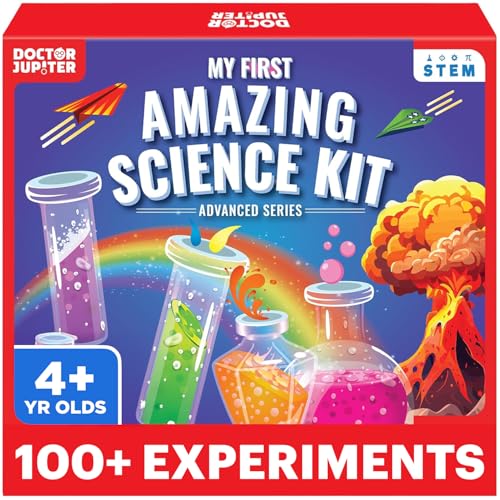
The Doctor Jupiter My First Amazing Science Kit is another strong choice for children aged four to eight, with more than one hundred experiments built around simple, safe materials. It is designed as a first science experience, with a friendly guide, colourful tools, and activities that use everyday items alongside the included supplies. The emphasis is on wonder and discovery rather than formal chemistry, which makes it inviting for a child who is new to science.
The experiments cover fizzing reactions, colour mixing, floating and sinking, and simple eruptions, with each activity explained in short steps. The kit includes beakers, test tubes, a funnel, measuring tools, and safety goggles, so a child learns the names and uses of laboratory equipment from the start.
One advantage is flexibility. The kit works at home on a kitchen table, in a classroom as a demonstration, or as a gift, because the activities need little preparation. Adult supervision is essential, both for safety and for learning.
Learning Resources Primary Science Deluxe Lab Set

The Learning Resources Primary Science Deluxe Lab Set takes a different approach. It is a forty-five piece laboratory set for ages three and up, focused on tools, observation, and open-ended exploration rather than a fixed list of chemical reactions. It includes a microscope viewer, test tubes, beakers, a funnel, tweezers, a magnifying glass, and activity cards that suggest experiments. The set is built for durability, with chunky tools that survive drops and repeated use in a busy home or classroom.
This kit suits younger children best, especially those who like to pour, sort, mix, and examine objects closely. A child can use the tools with water, sand, leaves, or kitchen ingredients, which means the kit stays useful long after the first week. The activity cards give structure without limiting imagination.
The kit does not include chemicals, so parents need to supply safe materials such as water, food colouring, oil, and baking soda. That is also a strength, because it encourages families to use what they already have.
How to choose
Start with age, because it shapes everything else. A kit for ages eight and up assumes a child can read instructions, measure carefully, and follow safety rules. A kit for ages four to six assumes an adult will lead while a child observes, pours, and describes. Choosing above a child’s level leads to frustration, while choosing below it leads to boredom. Read the age guidance, then consider the individual child. A careful seven-year-old may manage an eight-plus kit with help, while a lively nine-year-old may prefer a kit with more building and movement.
Next, consider the child’s interests. A child who loves rocks and volcanoes will get more from an earth science kit than from a pure chemistry set. A child who loves mixing and colour changes will enjoy a chemistry kit more than a tool-only lab set. Ask the child what they are curious about, and look at what they already enjoy. A kit that matches an existing interest is more likely to be used more than once, which is where real learning happens.
Look for kits that include safety goggles, clear warnings, and instructions that state when an adult must be present. Set up a workspace that is easy to clean, keep chemicals and small parts stored out of reach, and teach the child to wash hands after each session and never to taste an experiment.
Who should skip
Families with very young toddlers should skip chemistry kits with small parts and powders, even if an older sibling would enjoy them. Small test tubes, tablets, and specimens can be a choking hazard, and chemicals should not be within reach of a child under three. A tool-only lab set with larger pieces is a safer starting point, and the chemistry kit can wait until the youngest child is older or the kit can be stored securely.
Families with limited storage or limited time for supervision should think carefully before buying a large kit. A smaller kit may be a better fit, and schools should check that a consumable kit fits the budget for refills, or choose a reusable tool set instead.
FAQ
What age is best for a first science kit?
A first science kit works well from age three or four when it is a sturdy tool set with simple activities and adult guidance. Chemistry kits with powders and small parts suit ages eight and up better, because they need careful measuring and safety awareness.
Are science kits safe for children to use at home?
Science kits made for children are designed with safety in mind, but adult supervision is still essential. Use the included goggles, follow the instructions, work on a protected surface, and wash hands after each session. Store chemicals and small parts out of reach, and never let a child taste an experiment.
How many experiments should a good science kit include?
A good kit does not need the highest number on the box. A set with forty clear, varied experiments often teaches more than a set with two hundred near-identical activities. Look for variety, clear explanations, and activities that can be repeated with household materials.
Can science kits be used in a classroom?
Yes, many kits work well in a classroom when the teacher leads the activity and children take turns with the tools. Tool sets and specimen kits suit group work best, because they are reusable and easy to share. Chemistry kits work well as demonstrations.
Final verdict
The best science kit is the one that matches the child in front of you, not the one with the longest list on the box. For older children, the National Geographic Amazing Chemistry Set offers breadth with clear explanations. For children who love the natural world, the Earth Science Kit connects science to rocks, volcanoes, and weather. For younger children, the Junior Chemistry Set, the Doctor Jupiter kit, and the Learning Resources Deluxe Lab Set each offer a safe first step. Choose one kit, set aside regular time to use it, and treat each session as a conversation. Ask what the child expects to happen, watch together, and talk about what changed. That routine turns a box of tools into a habit of curiosity.