Key takeaways
- Learn how to choose a baby first aid kit for home, with five ready-made kits compared, from newborn care sets to a full family first aid kit.
- Top Pick: Frida Baby Basics Kit
- Runner-up: Safety 1st Deluxe Healthcare and Grooming Kit
- Also consider: The First Years American Red Cross Deluxe Health and Grooming Kit
A scraped knee, a sudden fever at two in the morning, a tiny fingernail that needs trimming before it scratches a cheek. New parents meet these small moments often, and a well-stocked baby first aid kit turns a scramble into a calm, quick response, keeping the tools you reach for most in one place.
There are two kinds of kits worth knowing about. Baby healthcare and grooming kits focus on everyday infant care: a thermometer, a nasal aspirator, nail clippers, a medicine dispenser, and a brush and comb. General family first aid kits focus on wound care: adhesive bandages, gauze, antiseptic wipes, and ointments. Most homes benefit from one of each, and this guide compares five ready-made kits sold on Amazon to help you build that setup.
As an Amazon Associate, we earn from qualifying purchases.
Quick answer
Start with a baby healthcare kit for daily care, such as the Safety 1st Deluxe kit or the Frida Baby Basics Kit, and add a general wound-care kit such as the First Aid Only 298-piece kit for cuts and scrapes. Keep a small travel kit in the diaper bag, check expiry dates twice a year, and store the main kit where every adult can find it fast.
Frida Baby Basics Kit

The Frida Baby Basics Kit is a six-piece newborn care set built around the tools new parents reach for first. It includes the NoseFrida Snotsucker nasal aspirator, NailFrida nail files, the Windi gas relief tool, the DermaFrida bath brush, and a silicone carry case that holds everything together. Each tool tackles one small, common problem: stuffy noses, sharp newborn nails, trapped gas, and dry, flaky scalp skin.
What makes this kit stand out is its focus. Instead of covering every possible injury, it covers the fussy-baby situations that come up again and again in the first months. The soft, compact carry case fits a diaper bag or a nursery drawer, so the tools stay together, and the nail files are gentler than clippers for very small nails.
There are limits to know about. This kit has no thermometer, no medicine dispenser, and no bandages, so it cannot stand alone as your only first aid kit. Pair it with a general first aid kit for wound care, and note that the gas relief tool sees less use once your baby passes the newborn stage.
Safety 1st Deluxe Healthcare and Grooming Kit
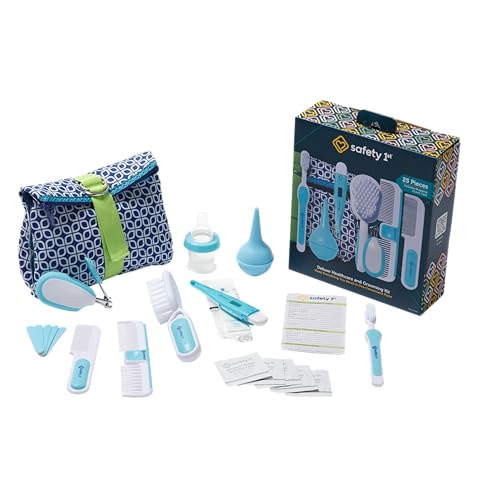
The Safety 1st Deluxe Healthcare and Grooming Kit is a 25-piece set that aims to be the single kit a nursery needs for daily care. It includes a 3-in-1 thermometer, a nasal aspirator, nail clippers, a medicine dispenser, a brush and comb, and several smaller grooming tools, all stored in a zippered case. It comes in Arctic Blue and other color options.
This kit works well as a first purchase because it covers both health and grooming in one case. The thermometer reads oral, underarm, or rectal temperatures, the medicine dispenser delivers liquid medicine with less mess, and the emery boards smooth tiny nails after clipping. The case keeps everything organized, so you can find the aspirator or the thermometer without emptying a drawer.
The trade-off is that this is still a care kit rather than a wound-care kit. It has no adhesive bandages, gauze, or antiseptic wipes, so scraped knees need a separate general first aid kit. The case is also larger than a travel kit, so it suits a nursery shelf better than a crowded diaper bag.
The First Years American Red Cross Deluxe Health and Grooming Kit

The First Years American Red Cross Deluxe Health and Grooming Kit brings a trusted name to the nursery shelf. It includes a digital thermometer with a carrying pouch, a medicine dispenser, a medicine spoon, a nasal aspirator, nail clippers, nail scissors, a comb, a brush, a fingertip toothbrush, a toddler toothbrush, and a baby wellness and safety guide, all packed in a convenient tote, model Y7057A4.
The wellness and safety guide is the feature that sets this kit apart. It explains when and how to use each tool, which helps first-time parents still learning what each item is for. The kit also gives you choices: a standard or fingertip toothbrush, a medicine dispenser or spoon, scissors or clippers.
As with the other baby care kits here, wound care is not the focus, so you will still want bandages and antiseptic supplies from a general first aid kit. The tote is roomy rather than compact, so it works best as a home base kit for parents who value clear guidance alongside the tools.
First Aid Only 298-Piece All-Purpose First Aid Kit

The First Aid Only 298-Piece All-Purpose First Aid Kit, model FAO-442, is the wound-care half of a complete home setup. It packs adhesive bandages in assorted sizes, antiseptic towelettes, antibiotic ointment packets, burn cream, gauze pads, adhesive tape, gloves, scissors, tweezers, a cold compress, moleskin, an emergency blanket, and a one-time-use thermometer into a soft-sided zippered pouch with clear plastic pockets. At about 9.25 by 3 by 7 inches, the pouch fits in a backpack, a glove box, a desk drawer, or a kitchen cabinet.
The clear pockets are the best feature. In a moment of stress, you can see the bandages, the wipes, and the ointment without unzipping every compartment. The range of bandage sizes handles small nicks as well as larger scrapes, and the burn cream and cold compress cover minor kitchen and playground injuries once babies become mobile.
Keep two things in mind. This is a general kit, so it has no baby thermometer, no nasal aspirator, and no nail care tools. The medicines and ointments inside also have expiry dates, so check the kit twice a year and replace anything past its date.
Johnson & Johnson First Aid to Go Portable Mini Travel Kit
The Johnson & Johnson First Aid to Go Portable Mini Travel Kit is the smallest kit in this guide, with 12 pieces in a pocket-sized pouch. It holds adhesive bandages, gauze pads, and cleansing wipes in a format designed to slip into a diaper bag, a purse, a stroller pocket, or a car door pocket. It is the kit you carry everywhere so that a scraped knee at the park never catches you without supplies.
Its strength is its size. A full home kit stays home, but this mini kit goes everywhere, and the kit you actually have with you is the one that helps. The contents cover the most common minor injuries: small cuts and scrapes that need a bandage and a wipe. It also works as a backup in the car.
The limit is obvious: 12 pieces run out quickly, and the kit has no tools, no thermometer, and no supplies for larger injuries. Treat it as a supplement, not a replacement, for your home kits, and refill it after each use.
How to choose
Start by deciding where the kit will live. A home kit can be larger and more complete, while a diaper bag kit must be compact and light. Many families keep a full kit in the nursery or kitchen, a mini kit in the diaper bag, and another small kit in the car.
Check the contents against a simple list: a digital thermometer, a nasal aspirator, nail clippers or files, a medicine dispenser, adhesive bandages in several sizes, gauze pads, antiseptic wipes, antibiotic ointment, tweezers, scissors, gloves, and a cold compress. If a kit is missing half the list, pair it with a second kit.
Look at the case. Clear pockets, labeled compartments, and a sturdy zipper make a real difference when you are in a hurry, and a case that opens flat is easier to use than a deep bag where small items sink to the bottom.
Think about expiry dates from the start. Ointments, wipes, and medicines all expire, so check every kit when the clocks change and replace anything expired. Keep the kit where every adult can find it quickly, out of reach of toddlers, and away from heat and damp.
Who should skip
If you already have a well-stocked home kit and a travel kit, you may not need another full set. A few missing pieces bought on their own can fill the gaps. Parents of older children may find that a general family first aid kit is enough, since baby-specific tools matter most in the first year.
Families who prefer to build a custom kit from scratch can also skip ready-made sets. If you know exactly which thermometer, aspirator, and bandage brands you want, buying them one by one gives you full control, while ready-made kits trade that control for convenience.
Anyone with a child who has a medical condition should talk to a pediatrician about what belongs in their kit, since specific conditions may call for supplies that no ready-made kit includes.
FAQ
What should a baby first aid kit include?
A good baby first aid kit includes a digital thermometer, a nasal aspirator, nail clippers or files, a medicine dispenser, adhesive bandages in several sizes, gauze pads, antiseptic wipes, antibiotic ointment, tweezers, scissors, gloves, and a cold compress. Keep emergency contact numbers written on a card inside the lid.
Do I need a separate kit for the diaper bag?
Yes, a small travel kit is worth having. The home kit stays home, so a pocket-sized kit in the diaper bag covers scrapes and small cuts at the park, on errands, and on trips. Refill it after each use and check it whenever you restock diapers and wipes.
How often should I check and restock a first aid kit?
Check your kits twice a year, when the clocks change, and after any illness or injury that used supplies. Look at expiry dates on ointments, wipes, and medicines, replace anything expired or used up. A quick check takes only a few minutes and keeps the kit ready.
When should I call a doctor instead of using the kit?
Call a doctor or seek urgent care for a fever in a baby under three months old, trouble breathing, a deep or wide cut, a burn larger than a coin, a head injury, or signs of dehydration. A first aid kit handles minor injuries, but it never replaces medical advice when a symptom seems serious.
Final verdict
The best setup for most new parents is a pair of kits: a baby healthcare kit for daily care and a general first aid kit for wound care. The Safety 1st Deluxe kit is the strongest all-around daily care set, with a thermometer, aspirator, medicine dispenser, and grooming tools in one case. The Frida Baby Basics Kit is the best choice for newborns, since its aspirator, nail files, and gas relief tool target the first months so well.
For the wound-care half, the First Aid Only 298-piece kit is the clear pick, with clear pockets and a broad range of bandages in a compact pouch. Add the Johnson & Johnson mini kit to the diaper bag and the car, and your family is covered at home and on the go.