Key takeaways
- Compare the best camping kettles for backpacking and car camping, from light aluminum boilers to stainless fire-ready kettles, and pick the right size.
The best camping kettle for most campers is the GSI Outdoors Halulite Tea Kettle in the 1.8 liter size, because it holds enough water for two people to make hot drinks and still have water left for a dehydrated meal, while weighing about eight and a half ounces and packing flat enough to fit a compact camp kitchen. Campers who cook over open flames should look at the Fire-Maple Antarcti instead, since its stainless steel body is made for stove and fire use, and campers who need the most water in a single boil should look at the Bulin 2.2 liter kettle, which carries the largest capacity in this guide at the lowest carried weight per liter. The five kettles below cover solo backpacking, two-person trips, family car camping, and fire-side cooking, so the right choice depends on how many people need hot water, how the kettle will be heated, and how much weight the trip allows.
A camping kettle earns its place by doing one job better than a cook pot: boiling water and pouring it exactly where it needs to go. A pot can boil water, but its wide rim spills, its lid slides, and its handle sits close to the heat. A kettle adds a spout shaped for a controlled pour, a lid that stays put while the water moves, and a handle placed to keep hands clear of steam and hot metal. That control matters most in the morning, when the kettle is full of boiling water and the target is a narrow mug, a pour-over dripper, or a meal pouch with a small opening. A good pour keeps the water in the cup and off hands and gear, without needing a second pair of hands or a steady surface that camp rarely provides.
Capacity is the first decision, and it is also the one campers get wrong most often. A kettle that holds about one liter serves one person well and stretches to two when drinks are small and meals are simple. A kettle in the one and a half to two liter range covers two people comfortably, with room for a second round of drinks or a meal pouch alongside the morning coffee. A kettle above two liters suits a family or a group, where one boil needs to cover several mugs, a pot of oatmeal, and washing water before the stove is packed away. Buying too small means boiling twice, which uses more fuel and more time than a slightly larger kettle would have cost in weight. Buying too large means carrying water capacity that never gets used, and a full large kettle is heavier and harder to pour safely than a full small one.
Material sets the character of a kettle almost as much as size does. Hard-anodized aluminum heats fast, weighs little, and suits campers who boil water on a canister stove and count every item in the pack. Stainless steel weighs more for the same capacity, but it tolerates rough handling, direct flame, and years of scraping against other gear without denting or losing its shape. The two materials also behave differently at the stove: aluminum spreads heat quickly and boils fast on a controlled burner, while steel takes a little longer to come up to temperature and holds heat longer once it is hot. Neither material is better in every situation, which is why this guide includes both, grouped so the trade-offs are easy to compare.
As an Amazon Associate, we earn from qualifying purchases.
Table of Contents
- At a Glance: The Five Kettles
- How to Choose a Camping Kettle
- Capacity and Group Size
- Material: Aluminum or Stainless Steel
- Heat Source: Stove, Fire, or Both
- Pour Control, Handles, and Lids
- Weight, Pack Size, and Nesting
- GSI Outdoors Halulite Tea Kettle 1.8L
- Fire-Maple Antarcti Stainless Steel Camping Kettle 1L
- Overmont Camping Kettle 1.2L
- Snow Peak Kettle No.1 CS-068R
- Bulin Camping Kettle 2.2L
- Common Mistakes When Buying a Camping Kettle
- Frequently Asked Questions
- Conclusion
- Product and ASIN Reference
At a Glance: The Five Kettles
| Kettle | Capacity | Material | Best For | Group |
|---|---|---|---|---|
| GSI Outdoors Halulite Tea Kettle 1.8L | 1.8 liters | Hard-anodized aluminum | Most campers and couples | Mid-range |
| Fire-Maple Antarcti Stainless Steel Camping Kettle 1L | 1.0 liter | Stainless steel | Open-fire and stove cooking | Mid-range |
| Overmont Camping Kettle 1.2L | 1.2 liters | Aluminum | Budget stove camping | Budget |
| Snow Peak Kettle No.1 CS-068R | 0.9 liters | Stainless steel | Solo cooking and pouring | Premium |
| Bulin Camping Kettle 2.2L | 2.2 liters | Hard-anodized aluminum | Groups and family breakfasts | Budget |
The budget group covers the Overmont and the Bulin, the mid-range group covers the GSI Halulite and the Fire-Maple Antarcti, and the premium group holds the Snow Peak Kettle No.1, a compact stainless vessel for solo campers who want one piece of gear to boil, pour, and cook.
How to Choose a Camping Kettle
Choosing a camping kettle starts with the trip, not the product page. A solo backpacker crossing ridges needs the lightest kettle that still pours cleanly, while a family at a drive-up site needs capacity first and can accept a heavier steel body. A camper who cooks over a wood fire needs a kettle that tolerates flame around its sides, while a camper who uses a canister stove needs a kettle with a flat, stable base that sits squarely on small pot supports. Writing down the answers to three questions before shopping makes the choice far easier: how many people need hot water at once, what will heat the kettle, and how will it be carried. Every section below follows from those three answers.
Capacity and Group Size
Capacity decides how many boils a morning takes, and each extra boil costs fuel, time, and patience. A solo camper who drinks one mug of coffee and eats one dehydrated meal needs about half a liter of boiling water, so a one liter kettle leaves comfortable headroom and still pours easily when full. Two people sharing a morning routine need closer to one and a half liters: two mugs, plus water for oatmeal or a meal pouch, adds up quickly, and a kettle filled to its brim pours worse than one filled to about three quarters. A family of four needs either a kettle above two liters or a willingness to boil twice, and the second boil is rarely as convenient as it sounds when children are waiting for breakfast and the stove is the only heat source at the site.
Safe fill volume matters as much as listed capacity. A kettle filled to the brim spills through the spout as soon as it tips, so the usable volume of a one liter kettle is closer to three quarters of a liter when pouring carefully. Treat the listed number as a ceiling and choose the next size up when the group sits near the boundary between two sizes.
Material: Aluminum or Stainless Steel
Hard-anodized aluminum is the lightest practical kettle material and the fastest to heat on a controlled burner. Its anodized surface resists scratches better than bare aluminum and does not react with water the way untreated metal can, which keeps the inside easy to clean after a trip. The weakness is denting: a thin aluminum body dents when it is dropped on rock or crushed against a hard object in a loaded pack, and a dented spout pours worse than a straight one. Aluminum kettles also need more care around open flame, since flames wrapping around the body can overheat handles and lids that were designed for a burner below the base.
Stainless steel is heavier and slower to heat, but it forgives the treatment that dents aluminum. It tolerates direct flame, scrapes, and stacking without losing its shape, and it cleans up well after sooty fire use with a wipe and a little water. Steel also holds heat longer after the burner is off, which keeps the second mug warm while the first is being poured. Campers who cook over wood, who pack gear loosely in a vehicle, or who want one kettle to last for many seasons tend to prefer steel, while campers who carry everything on their backs tend to accept aluminum and protect it inside the pack.
Heat Source: Stove, Fire, or Both
A canister stove concentrates flame under the base of the kettle, which suits almost every kettle design, but small kettles can wobble on wide pot supports and wide kettles can overhang a small burner and heat unevenly. Before a trip, set the kettle on the stove that will be used, fill it with water, and check that it sits level and stable. A kettle that rocks on its supports will spill when it is full of boiling water, and no spout design fixes a base that does not sit flat. Two-burner propane stoves are more forgiving, since their grates are wide and flat, but the same check applies: the kettle should sit without rocking, and the handle should clear the second burner and any windscreen.
Open fire is a different contract. Flames wrap around the body, heat the handle and lid hardware, and coat the outside in soot, so a kettle used over fire needs a metal handle or bail that can take heat, a lid that stays on when the kettle is lifted by that handle, and a body that will not warp when one side runs hotter than the other. Stainless steel handles this better than thin aluminum, and a bail handle that stands above the body lets the kettle hang from a tripod or a branch without the handle sitting in the flames. Even a fire-rated kettle needs care: keep flames below the base where the maker directs, use a glove or pot holder when lifting, and let the kettle cool before packing it against fabric or plastic gear.
Pour Control, Handles, and Lids
The spout is the part of the kettle that gets used every single time, so it deserves more attention than it usually gets. A short, well-shaped spout pours a steady stream into a narrow mug without dribbling down the side of the kettle, while a long or poorly aimed spout throws water past the target when the kettle is full. A spout with a pronounced lip and a slight divot at the tip, like the one on the most refined pouring kettles, breaks the stream cleanly when the pour stops, which keeps the last drops from running down the outside of the body and onto hands. Campers who make pour-over coffee or fill narrow meal pouches should treat spout shape as a primary feature, not a detail.
Handles decide whether a full kettle is safe to lift. A folding handle that locks upright keeps hands above the steam and away from the hot body, and a coated or insulated grip stays comfortable when the kettle has been on the burner for several minutes. A bail handle, the wire loop that arches over the top of the kettle, suits hanging and fire-side use, but it can swing and needs a firm grip when the kettle is full. Whatever the design, the handle should lock or hold its position while pouring, since a handle that folds mid-pour drops a full kettle of boiling water. Lids matter in the same way: a lid that stays on during a steep pour is a safety feature, and a lid that slides off needs a finger or a gloved hand to steady it, which is one more thing to manage when the water is at a rolling boil.
Weight, Pack Size, and Nesting
Weight is usually quoted without water, and water is the heavy part of any kettle, so the difference between an eight ounce kettle and a ten ounce kettle matters less than the difference between a one liter fill and a two liter fill. Still, on a backpacking trip where every item is carried for miles, two ounces saved on the kettle is two ounces that can go to food or water, and the lightest kettle in this guide weighs about the same as a small apple. Car campers can ignore these differences entirely and choose on capacity and material instead, since the kettle rides in a vehicle and only moves from the storage box to the stove.
Pack size is about shape as much as weight. A kettle with a folding handle and a low profile slides into the gaps between other gear, while a kettle with a fixed handle needs its own space. Several kettles in this guide can hold a compact canister stove, a lighter, or a few tea bags inside the body during transit, which turns empty volume into storage. That nesting only works when the lid fits well enough to keep the contents inside. Measure the kettle against the space it will live in before deciding that a larger capacity is worth its packed size.
GSI Outdoors Halulite Tea Kettle 1.8L

The GSI Outdoors Halulite Tea Kettle in the 1.8 liter size is the best all-around camping kettle in this guide, and it earns that place by solving the problem that limits most ultralight kettles: volume. A single boil covers two large drinks and still leaves water for oatmeal or a dehydrated meal, so a couple can run the whole morning routine on one fill of the kettle and one burn of the stove. At the same time, the published weight is only about eight and a half ounces, so the extra capacity does not turn the kettle into car-camping-only gear. It is light enough for short backpacking trips and comfortable in a car-camping kitchen, which is a rare combination in a kettle of this size.
The body is hard-anodized aluminum, a proprietary alloy that GSI calls Halulite, and it conducts heat quickly and evenly on a canister stove. The wide base captures heat from the burner instead of letting it spill around the sides, which shortens boil times and saves fuel on trips where every gram of gas matters. The hard-anodized surface resists scratches better than bare aluminum, so the kettle survives being packed against other metal gear. The low-profile shape keeps the center of gravity close to the stove, which helps stability on small pot supports, and the short spout pours a clean stream into mugs and meal pouches.
The handle folds flat for packing and locks upright for pouring, and the coated grip stays comfortable while the kettle is hot. With the handle locked upright, the hand sits above the steam path and clear of the body, which makes a full pour feel controlled. The wide lid is easy to remove for filling and cleaning, and the broad opening lets the kettle double as storage: a compact canister stove, a lighter, and a few tea bags fit inside during transit, so the kettle carries part of the kitchen instead of just taking up space.
The trade-offs are the ones that come with thin aluminum. The body dents more easily than stainless steel, so the kettle needs a little protection in a loaded pack, ideally packed inside a pot or wrapped in a soft item rather than rattling loose against hard gear. The lid does not lock, and several owners note that it needs a steadying hand during a deep pour, especially when the kettle is full. That is a manageable habit rather than a flaw, but it is worth knowing before the first morning at camp. The kettle is also not the first choice for direct campfire use: the aluminum body and coated handle are made for a burner below the base, and flames wrapping around the sides will heat parts that were not designed for it. Campers who cook mainly over wood should look at the Fire-Maple pick instead.
For most campers, though, the Halulite is the kettle that fits the most trips. It boils enough water for two people, weighs little, pours cleanly, and packs well. It suits backpacking couples, car campers who want a light kettle for the camp kitchen, and anyone who boils water for drinks plus meals from the same vessel. It is the mid-range pick in this guide, and the extra capacity over a solo kettle is worth the small weight gain for anyone who regularly shares the morning boil.
Specs
- Capacity: 1.8 liters
- Material: hard-anodized aluminum
- Published weight: about 8.5 ounces
- Model number: 50168
- Folding handle that locks upright for pouring
- Wide lid opening for filling, cleaning, and nesting gear inside
- Short spout shaped for a controlled pour into mugs and meal pouches
- Low-profile body with a wide base for stable stove use and fast heating
- Works on canister stoves and two-burner camp stoves
Fire-Maple Antarcti Stainless Steel Camping Kettle 1L

The Fire-Maple Antarcti Stainless Steel Camping Kettle in the one liter size is the fire-ready pick in this guide, built for campers who want real stove-and-fire flexibility rather than the lowest possible weight. The body is stainless steel, and the maker lists the kettle explicitly for camp stoves and open flames, which is a stronger statement than most kettle listings make. That matters because open fire is where kettles fail: flames wrap around the body, heat the handle, and punish thin metal, and a kettle that was only designed for a burner below the base will show it quickly. The Antarcti is designed for the harder job from the outset.
At one liter, the Antarcti is compact enough for solo use and for two-person hot-water duty, and the size keeps it easy to pack for bushcraft, canoe camping, and trips where the kettle moves between a gas burner, a grill grate, and a carefully managed fire. The published weight is 295 grams, about ten and four-tenths ounces, so the penalty over ultralight aluminum is real but modest, roughly the weight of a small snack bar. The stainless body tolerates dents, scraping, and rough camp use far better than thin aluminum, and it cleans up well after sooty fire use, which is a practical advantage for anyone who cooks over wood more than once a season.
The handle is a bail, a metal loop that stands above the body, and it suits hanging and fire-side setups better than a side handle does. The kettle can be suspended from a tripod or a branch and lifted clear of the flames, and the bail folds down for packing. The pour is clean and controlled, with a spout that aims the stream into a mug, and the lid stays in place during a normal pour. The steel body takes a little longer to heat than thin aluminum, but it holds heat well once hot, which keeps the second cup warm while the first is served.
The limits are the ones that come with a one liter steel kettle. One liter is small for family breakfast rounds, and a group that needs several mugs at once will boil twice or choose the Bulin instead. The steel body is heavier than a similarly sized aluminum kettle, and the bail can still become hot when flames reach upward around the kettle, so a glove or pot holder belongs in the kit even though the handle is metal. The kettle is also a little slower to boil than the aluminum picks in this guide, which matters on a cold morning when the group is waiting. Those are fair trades for the durability and fire tolerance, but they are trades, and campers who only ever use a canister stove will get more capacity for less weight from the GSI or the Bulin.
For the camper who cooks over wood, the Antarcti is the right choice in this guide. It is the mid-range pick, it is built for the fire as well as the stove, and its one liter capacity covers solo and two-person trips without carrying more steel than the job needs. Bushcraft campers, canoe campers, and anyone who regularly uses both a camp stove and an open fire will find it the most honest kettle here: it does not promise the lightest weight, it promises to survive the fire, and it keeps that promise.
Specs
- Capacity: 1.0 liter
- Material: 304 stainless steel
- Published weight: 10.4 ounces, 295 grams
- Bail handle that stands above the body for hanging and fire-side use
- Listed for camp stoves and open flames
- Compact one liter size for solo or two-person hot-water duty
- Folding bail for a compact packed profile
- Spout shaped for a controlled pour into mugs
- Lid fits for pouring without sliding off during a normal pour
Overmont Camping Kettle 1.2L
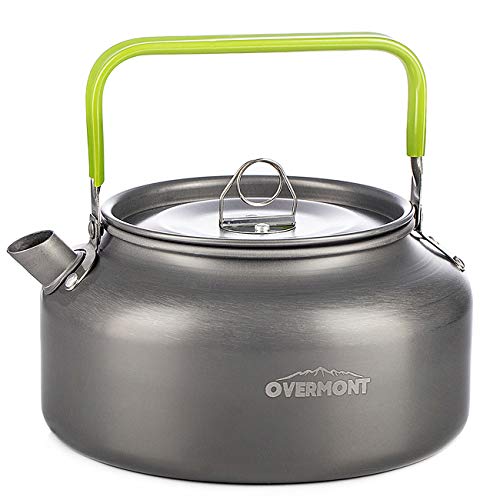
The Overmont Camping Kettle in the 1.2 liter size is the budget pick in this guide, a straightforward kettle for campers who use a stove and want an easier pour than a basic cook pot. It does the simple kettle jobs correctly: it sits stably on a camp stove, heats quickly, and pours with more control than a pot rim, and 1.2 liters is enough for a couple of mugs or a drink plus a meal. For weekend camping, festivals, and budget camp kitchens built around a propane or canister stove, that is the whole job, and the Overmont does it without asking for a large outlay or a lot of care.
The body is aluminum, anodized for a harder surface that resists scratches and heats efficiently on a controlled burner. The wide base sits flat on common camping stoves, which keeps a full kettle stable while the water comes to a boil, and the spout gives a more controlled stream than pouring from a pot. The handle is coated in silicone, which keeps the grip comfortable while the kettle is hot and gives a secure hold even with damp hands, and it folds to the side when the kettle is packed. The lid is stainless steel, which resists heat and wear better than a coated lid, and the kettle comes with a carry bag that keeps soot and residue off other gear and keeps the kettle together in a storage box or a pack.
The 1.2 liter capacity is a useful middle size, large enough for two people to have a hot drink each, or for one person to have a drink and a meal from the same boil, without the weight and packed size of a two liter kettle. The published weight is about eleven and two-tenths ounces, heavier than the larger GSI Halulite, but the difference is small in a car-camping kit. The mesh carry bag lets the kettle air out after washing and keeps it from rattling against other metal in transit.
The lid is the point to respect. It is not locked in place, and owners note that it can shift if the kettle is tipped too aggressively during a pour. Pouring with the kettle at a controlled angle and keeping a finger or a gloved hand ready to steady the lid is a manageable habit, but it is also why the Overmont sits behind the more refined designs in this guide. The aluminum body is also less dent-resistant than stainless steel, so the kettle benefits from being packed inside the carry bag and kept clear of hard objects in a loaded vehicle. It is better suited to a controlled stove than an open fire, and campers who cook mainly over wood should choose the Fire-Maple instead.
For the role it fills, the Overmont is hard to fault. It is the budget pick, it boils water, pours it cleanly, and packs away in its own bag, and it does so at a cost that leaves room in the kit for the stove, the mugs, and the coffee itself. First-time campers, families building a first camp kitchen, and anyone who wants a spare kettle that lives in the car will find it a practical choice.
Specs
- Capacity: 1.2 liters
- Material: aluminum with an anodized surface
- Published weight: about 11.2 ounces
- Model number: Kettle-1.2L
- Silicone-coated handle that folds for packing
- Stainless steel lid
- Carry bag included for storage and transport
- Wide base for stable use on common camping stoves
- Spout shaped for a controlled pour into mugs and meal pouches
Snow Peak Kettle No.1 CS-068R

The Snow Peak Kettle No.1 in the current CS-068R version is the premium pick in this guide, and it is the pick for campers who would rather carry one small stainless vessel for boiling, pouring, soup, and simple cooking. Its advantage is shape: a wide mouth and a short, pot-like body let the kettle heat soup, noodles, oatmeal, and simple one-pot food, then serve from the same vessel. That can eliminate a separate pot in a minimalist camp kitchen, which matters more than comparing the kettle alone on a scale. For solo campers and compact cook kits, one vessel that does two jobs is worth more than a slightly faster boil.
The kettle is made from stainless steel, with a polished finish that resists corrosion and cleans up well after use. The capacity is 0.9 liters, or 30.4 fluid ounces, and the published weight is 10.2 ounces, or 290 grams. Snow Peak lists the current model at 5.9 by 5.5 by 3.7 inches, and the CS-068R is a wider, revised version of the original Kettle No.1, so older dimensions attached to the discontinued CS-068 should not be mixed with the current model. The two handles fold flat against the body for packing, which keeps the packed profile compact and lets the kettle slide into the gaps in a camping box that fixed-handle kettles cannot fit.
The wide opening is the feature that sets this kettle apart. Filling is easy, even from a stream or a large water container, and cleaning is easy too, since a hand and a cloth can reach the whole inside of the body. The same opening makes the kettle useful as a small cooking pot: noodles, soup, and oatmeal can be stirred and served from the vessel, and the spout still pours cleanly when the job is just boiling water for tea. The lid keeps heat in while the water boils, and the folding handles give two grip points, which helps control when the kettle is full and hot.
The trade-offs are real. At 0.9 liters, the capacity is the smallest in this guide, and it suits one person, or two people drinking small cups, rather than a group. It is not the quickest pure water boiler here, and the foldable handles can feel less secure than a fixed handle when the kettle is full, while the lid can move during a steep pour. The metal handles also get hot, so a glove or pot holder is needed when lifting a kettle that has been on the burner for several minutes, and Snow Peak warns that flames should not extend beyond the base. Treat it as a compact cooker with a useful spout, not as a cool-touch home kettle, and it will serve well for many seasons.
For solo campers who value versatility over volume, the Snow Peak is the most refined kettle in this guide. It is the premium pick, it is built to last, and it replaces two pieces of gear with one. Campers who regularly boil water for more than two people, or who want maximum boil efficiency above all else, should choose the GSI or the Bulin instead, but for a solo kit where every item must earn its place twice over, the Kettle No.1 earns its place.
Specs
- Capacity: 0.9 liters, 30.4 fluid ounces
- Material: stainless steel
- Published weight: 10.2 ounces, 290 grams
- Model number: CS-068R
- Dimensions: 5.9 by 5.5 by 3.7 inches
- Two folding handles that pack flat against the body
- Wide mouth opening for filling, cooking, serving, and cleaning
- Works as a kettle and as a small cooking pot
- Lid included for heat retention while boiling
Bulin Camping Kettle 2.2L

The Bulin Camping Kettle in the 2.2 liter size is the capacity-first pick in this guide, built for the moment when one boil needs to cover a family breakfast, several mugs, or multiple dehydrated meals. A 0.9 liter kettle creates repeat boils for a group, and each repeat boil costs fuel and time while people wait. A 2.2 liter kettle can often do the entire round at once, which is why group campers keep coming back to this size even though the kettle is larger to pack and heavier when full. For families and small groups, that single-boil convenience is the feature that matters most.
The body is hard-anodized aluminum, and the published weight is about six-tenths of a pound, about nine and a half ounces, which is remarkably light for a kettle of this capacity. The wide base sits stably on a two-burner propane stove and on larger canister stove supports, and the aluminum body heats efficiently, so a full kettle still comes to a boil in a reasonable time. The listing describes the kettle as suitable for a group of two or three people per boil, and the capacity matches that description when drinks and meals are counted together.
The handle is insulated and shaped to resist heat during pouring, which matters more on a kettle of this size than on a solo kettle, since a full 2.2 liter kettle carries more than two kilograms of water and the pour needs a firm, comfortable grip. The spout is shaped for a steady stream into mugs and meal pouches, and the carry bag included with the kettle keeps it together in transit and keeps residue off other gear in the storage box. The kettle is listed for stove use and for open fire, though the fire claim should not be the main reason to buy it: the aluminum body and insulated handle are at their best on a controlled burner, and the kettle earns its place on capacity and weight rather than fire tolerance.
The limits follow from the size. A full kettle is heavy and needs a level surface and a stable stove, and pouring a full 2.2 liters needs both hands and a careful angle, especially when the target is a small mug. The kettle is also larger to pack than any other pick in this guide, so backpackers should measure it against their pack before choosing it over the GSI. The lid needs the same respect as the lids on the other aluminum kettles here: it stays put during a normal pour, but a steep tip will shift it, so a controlled pour is part of using the kettle well. For car campers and family groups, those are small prices for the capacity, and the kettle is the budget pick alongside the Overmont, which makes it an easy addition to a family camp kitchen.
For group camping, the Bulin is the right kettle in this guide. It carries the most water for the least weight, it boils enough for the whole table in one round, and it does so without the cost or the weight of a steel kettle of the same size. Solo campers should look elsewhere, but anyone who cooks for three or four people at camp will feel the difference on the first morning.
Specs
- Capacity: 2.2 liters
- Material: hard-anodized aluminum
- Published weight: about 0.6 pounds, about 9.5 ounces
- Model number: BL200-Tea
- Insulated handle shaped to resist heat during pouring
- Carry bag included for storage and transport
- Wide base for stable use on two-burner stoves and larger canister supports
- Spout shaped for a steady stream into mugs and meal pouches
- Listed for stove use and open fire
Common Mistakes When Buying a Camping Kettle
The most common mistake is buying on capacity alone without thinking about the pour. A kettle that holds two liters but pours badly is worse than a kettle that holds one liter and pours cleanly, because every use of the large kettle is a negotiation with a spout that throws water past the mug. The spout, the handle, and the lid decide how the kettle feels in use, and those parts are used on every single boil. A kettle with a good spout and a locking handle is worth more than a kettle with an extra half liter that nobody can pour safely when it is full.
The second mistake is matching the kettle to the wrong heat source. Campers who cook over wood buy a thin aluminum kettle made for a canister stove, then watch the handle overheat and the body warp when flames wrap around the sides. Campers who only ever use a canister stove buy a heavy steel kettle made for fire, then carry weight they never needed. The heat source should be decided first, and the material should follow: steel and a bail handle for fire, light aluminum and a folding handle for the stove. A kettle that is honest about its heat source will say so in the listing, and that statement is worth more than any claim about boil speed.
The third mistake is filling the kettle to the brim. A kettle filled to its total capacity spills through the spout as soon as it tips, and boiling water bubbles toward the lid even before the pour starts. Filling to about three quarters keeps the pour controlled and leaves room for the water to move without spilling, and choosing the next size up is a better answer than overfilling a small kettle. Campers who plan around usable volume rather than listed volume end up with the right size the first time.
The fourth mistake is forgetting the stove. A kettle and a stove are a pair, and a kettle that rocks on its supports or overhangs a small burner is a hazard when it is full of boiling water. Setting the kettle on the stove before the trip, filling it with water, and checking that it sits level takes a minute at home and saves a spill at camp. The same check applies to windscreens and pot supports: a kettle that sits well on a calm morning can still wobble when a windscreen shifts or a support folds under load.
The fifth mistake is treating a kettle like a pot. A kettle is for boiling water and pouring it, not for frying or for storing food. Cooking thick food in a narrow kettle scorches the base and clogs the spout, and stored food leaves residue that is hard to clean from the spout and the lid seat. The Snow Peak is the exception, since its wide mouth is made for simple cooking, but even there the cooking should stay to soups, noodles, and oatmeal. Keep the kettle for water and light cooking, clean it after every trip, and dry it fully before packing it away.
Frequently Asked Questions
What size camping kettle do I need for two people?
A kettle in the one and a half to two liter range covers two people comfortably for morning drinks plus a meal, with room for a second round without a second boil. A one liter kettle stretches to two people when drinks are small and meals are simple, but it leaves little headroom, so the 1.8 liter GSI Halulite is the safer choice for a couple that drinks coffee and eats a hot breakfast. Solo campers can use a kettle under one liter, while a family of three or four should look at a kettle above two liters, like the 2.2 liter Bulin, to cover the whole table in one boil.
Can I use a camping kettle over an open fire?
It depends on the kettle. Stainless steel kettles with metal handles, like the Fire-Maple Antarcti and the Snow Peak Kettle No.1, are made for stove and controlled fire use, while thin aluminum kettles with coated handles are made for a burner below the base. Even a fire-rated kettle needs care: keep flames below the base, use a glove or pot holder when lifting, and let the kettle cool before packing it against fabric. Never leave a kettle over a fire unattended, and never use a kettle with a plastic handle or a coated grip over open flame.
Is aluminum or stainless steel better for a camping kettle?
Aluminum is lighter and heats faster, so it suits backpackers and campers who boil water on a canister stove and count every item in the pack. Stainless steel is heavier and slower to heat, but it tolerates direct flame, dents, and rough handling far better, so it suits fire cooking and campers who want one kettle to last for many seasons. The right material follows the heat source and the way the kettle will be carried, and this guide includes both so the trade-off is easy to compare.
How do I keep a camping kettle from spilling when I pour?
Fill the kettle to about three quarters rather than to the brim, so the water has room to move without reaching the spout opening before the pour starts. Hold the handle firmly, tip the kettle slowly, and keep the spout aimed at the center of the mug or pouch. Steady the lid with a finger or a gloved hand if the lid is loose, and set the kettle down on a level surface between pours rather than holding a full kettle in the air. A kettle with a well-shaped spout and a locking handle makes all of this easier, which is why spout and handle design matter more than capacity alone.
Conclusion
A camping kettle is a small piece of gear that gets used on every morning of every trip, so it deserves more thought than its size suggests. The right kettle holds enough water for the group, pours it cleanly into the cup that needs it, sits stably on the stove that heats it, and packs away without taking up space that other gear needs. The wrong kettle boils twice, spills, wobbles, or dents, and it does so on the coldest morning of the trip, when patience is thinnest.
For most campers, the GSI Outdoors Halulite Tea Kettle in the 1.8 liter size is the best first choice. It covers two people in a single boil, weighs little, pours cleanly, and packs well, and it suits both backpacking couples and car campers. Campers who cook over wood should choose the Fire-Maple Antarcti, which is built for stove and fire use and tolerates the treatment that dents aluminum. Campers on a tight kit budget should look at the Overmont for solo and two-person stove camping, or the Bulin when the group needs more than two liters in a single boil. Solo campers who want one vessel to boil, pour, and cook should choose the Snow Peak Kettle No.1, the most versatile kettle in this guide.
Whichever kettle fits the trip, the habits matter as much as the purchase. Fill to three quarters, pour slowly, steady the lid, check the kettle on the stove before the trip, and dry it fully before packing it away. A kettle bought with the trip in mind and used with care will serve for many seasons of mornings at camp, and that is the whole point of choosing well.
Product and ASIN Reference
| Product | ASIN |
|---|---|
| GSI Outdoors Halulite Tea Kettle 1.8L | B06XGPVWYT |
| Fire-Maple Antarcti Stainless Steel Camping Kettle 1L | B07YY51LNW |
| Overmont Camping Kettle 1.2L | B06XFQ664S |
| Snow Peak Kettle No.1 CS-068R | B0BKQB1JBP |
| Bulin Camping Kettle 2.2L | B083JTL2YX |