Key takeaways
- Compare the best kids wiffle ball and softball sets for backyard games, with classic perforated balls, curveball sets and replica bats for older kids.
Once kids outgrow hitting off a tee, the next step is a pitched ball they can actually track, swing at and miss without anyone getting hurt. Wiffle ball and plastic softball sets fill that gap: the perforated balls move slowly, curve in the air and sting far less than a real baseball, while the long plastic bats give older kids a full-size swing in an ordinary backyard. This guide compares five sets that suit that stage, from the classic yellow bat bundle for first pitched games to curveball and replica-bat sets built for bigger kids who want a real challenge.
As an Amazon Associate, we earn from qualifying purchases.
Quick answer
For most families, the official WIFFLE 32-inch bat and 3-ball bundle is the safest starting point: real perforated balls, a light bat and simple rules. Kids playing in pairs should pick the two-bat WIFFLE pack, while older children ready for movement step up to the Blitzball Starter Pack. The Easton Pro Stix and Louisville Slugger Replica suit kids who want a bat that swings like a wooden one.
WIFFLE 32″ Bat & 3 Baseball Set Bundle

This is the original backyard setup: one 32-inch yellow plastic bat and three official WIFFLE baseballs, made in the USA by the company that invented the game. The balls are regulation baseball size with the familiar pattern of oblong perforations on one hemisphere, which is what makes them float, dip and curve instead of flying straight and hard.
For a first pitched-ball game, that flight is the whole point. A parent can lob the ball underhand from a short distance and a seven-year-old has time to read it and swing, while the hollow ball stays slow enough that a swing and a miss carries no risk to windows or younger siblings standing nearby. The bat weighs only a few ounces, so smaller kids can hold it up through a whole game without their arms dropping.
The trade-offs are simple ones. Three balls disappear into hedges quickly, and one bat means fielders wait idle while one child hits. Families planning regular games should treat this as the starter bundle and expect to add spare balls later. As a first taste of pitched play for ages five to nine, though, nothing here needs explaining or assembly.
WIFFLE 2-Pack 32″ Bats & 6 Baseballs Set
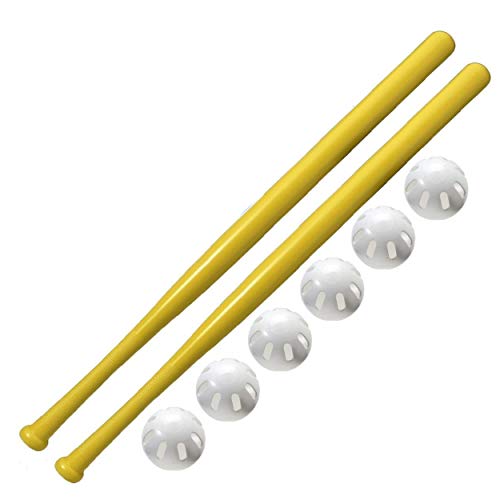
This eight-piece pack doubles everything in the starter bundle: two 32-inch bats and six official-size WIFFLE baseballs. That changes the kind of game a family can play. Two bats allow head-to-head formats, a hitting station and a fielding station at the same time, or a simple rule that the on-deck batter practices shadow swings while the other hits.
Six balls matter more than they sound. Backyard games stall when every foul ball means a trip into the flower beds, and a half-dozen balls keep a bucket by the pitcher filled through several innings. The balls and bats use the same hollow, rubbery plastic as the single set, so flight and feel stay consistent for kids learning to judge the curve.
Because the equipment is identical in design to the classic bundle, this pack is best understood as the group version rather than an upgrade in performance. It suits siblings close in age, cousins visiting for the summer and neighborhood games where two teams each need a batter ready. If only one child will ever swing, the smaller bundle covers the same ground.
BLITZBALL Starter Pack

Blitzball is the step up for kids who have mastered the gentle float of a wiffle ball and started asking for real curveballs. The starter pack pairs one Power Bat with three official Blitzballs. The balls use a patented design with raised, curved panels instead of perforations, and they break sharply: thrown with a flick of the wrist, a pitch can curve, slide or rise in ways a wiffle ball cannot match.
That movement makes this set a genuine skill game for roughly ages ten and up. Pitching becomes as interesting as hitting, and kids spend as much time learning grips and releases as they do swinging. The bat is a full-size plastic model with a wider barrel than the classic yellow bat, which helps batters connect with pitches that move late.
Parents should know the learning curve is real. Younger children may find the movement frustrating rather than fun, because even a slow Blitzball pitch can dodge the bat entirely. The balls are still lightweight plastic and safe for backyard play, but this is a set for kids who already track a pitched ball well and want the backyard version of a breaking pitch.
Easton Pro Stix Plastic Bat & Ball Set

Easton takes a different approach: instead of perforations, the Pro Stix ball is a seamed plastic training ball molded to look and feel like a leather baseball, and the 33-inch bat is modeled on a professional wood bat with a natural finish. The idea is to bridge backyard play and real baseball practice.
The seamed ball flies straighter and truer than a perforated wiffle ball, so this set works well for batting practice where the goal is clean contact rather than trick pitches. The bat is ultra-light for its length, which lets kids take many swings in a session without fatigue, and the oval-shaped handle gives smaller hands a secure hold. At 33 inches it runs an inch longer than the classic wiffle bat, suiting taller children and early teens.
Two cautions apply. The plastic bat is built for plastic balls only; hitting a real baseball or a hard softball can dent it. And because the ball lacks perforations, it travels faster and farther than a wiffle ball, so it needs a little more space. For kids in their first seasons of organized baseball who want backyard reps that feel closer to the real thing, it is the most training-focused set in this guide.
Louisville Slugger Replica Bat and Ball Combo

This combo pairs a plastic replica of the Louisville Slugger C271, the 34-inch big-league turning model, with one Stee-Rike 3 premium training ball. The bat carries an authentic wood grain pattern, so it looks like the genuine article in a way the bright yellow bat never tries to.
At 34 inches, this is the longest bat in the guide, and that length is the main buying decision. It suits older kids and teens who find 32-inch bats short, and it makes a fun shared set for parents who want to join the game rather than only pitch. The included ball has perforations on one half, like a classic wiffle ball, and is made from a harder, durable plastic that holds its shape well.
With only one ball included, families will want spares, and the size rules it out for younger children, who will struggle to control the barrel through the swing. Treat it as the set for the kid who has played two or three summers of wiffle ball, wants equipment that looks serious, and has the strength to swing a full-size bat on plane.
How to choose
Start with the ball, because the ball decides the game. Perforated wiffle balls fly slowly and curve gently, which makes them right for first pitched games and small yards. Blitzballs move much more aggressively and reward older kids who pitch as much as they hit. Seamed plastic balls, like the Easton design, fly straighter and suit practice aimed at real baseball contact.
Next, match bat length to the child. A 32-inch bat suits most kids from about age five through the early teens. A 33 or 34-inch bat only helps a taller, stronger child; for a smaller kid it adds barrel weight they cannot control, and late, looping swings follow. When in doubt, choose the shorter bat.
Count the pieces honestly. One bat and three balls is enough for a pitcher, a batter and a bucket that empties fast. Two bats and six balls support siblings, teams and longer games without constant ball retrieval. If the set will be the only one on the street, the bigger pack earns its keep quickly.
Finally, check where the game will happen. Perforated balls are the forgiving choice near windows, cars and fences, because they lose speed quickly. Straighter, denser plastic balls carry farther and deserve a park or a deep yard. Whatever the set, agree on ground rules first: no head-high pitching to young batters, and a called-off swing zone when toddlers wander into the field.
Who should skip
Skip these sets if your child is still at the tee ball stage. A pitched ball, even a plastic one, frustrates a three or four-year-old who is learning to swing at a stationary target; a tee set and a foam bat will serve them better for another season or two.
Skip them, too, if your child is preparing for competitive softball with a regulation ball. Plastic sets build timing and confidence, but the weight and bounce are different enough that a player moving into league play needs practice with real softballs and a proper bat alongside any backyard set.
Families with only a small patio or a shared courtyard should also think twice about the longer bats and the straighter-flying balls. The perforated wiffle sets can work in tight spaces, but the Easton and replica-bat sets need room to swing and room for the ball to land.
FAQ
What age are wiffle ball sets best for?
Most kids do well with a classic wiffle set from about age five, once they can track a slow underhand pitch. The official balls are rated for young children, but the game itself works best when the batter can wait for a pitch rather than swing at everything. Blitzball suits roughly age ten and up.
What is the difference between a wiffle ball and a Blitzball?
A wiffle ball is hollow with perforations on one half, so it floats and curves gently and loses speed quickly. A Blitzball uses a solid panel design that grips the air and breaks much harder, letting pitchers throw curveballs, sliders and rising pitches. Wiffle is the beginner-friendly option; Blitzball is the challenge option.
Can these plastic bats be used with real baseballs or softballs?
No. Plastic bats in these sets are designed for lightweight plastic balls only. Hitting a real baseball, a regulation softball or even a hard training ball can dent or crack the barrel and can send the harder ball off at speeds the game is not designed for. Keep each bat paired with its own kind of ball.
How many balls should a family buy?
Three balls is the minimum for a workable game, and six is noticeably better. Balls roll under decks, land in gutters and split after a season of hard swings, so a set with spares keeps games moving. Extra official wiffle balls are sold in multi-packs and match the balls in these sets.
Final verdict
For a first pitched-ball game, buy the official WIFFLE bat and 3-ball bundle and add spare balls as the originals wander off. Families with two or more players should go straight to the two-bat, six-ball WIFFLE pack. When a child starts asking how curveballs work, the Blitzball Starter Pack is the right next step, while the Easton Pro Stix serves practice-minded players and the Louisville Slugger Replica suits the older kid who wants a bat that looks like the real thing.
Product and ASIN Reference
| Product | ASIN |
|---|---|
| WIFFLE 32″ Bat & 3 Baseball Set Bundle | B01068TD58 |
| WIFFLE 2-Pack 32″ Bats & 6 Baseballs Set | B07CPDZ6BK |
| BLITZBALL Starter Pack | B01H51MVFS |
| Easton Pro Stix Plastic Bat & Ball Set | B001Q9RUFW |
| Louisville Slugger Replica Bat and Ball Combo | B00BFNLYS8 |