Key takeaways
- Compare the best portable camping toilets for tents, vans, and RV trips, with flush, cassette, and folding picks sorted by tank size and ease of emptying.
A good portable camping toilet turns a remote campsite into a comfortable basecamp. The best portable camping toilets pair a stable seat with a sealed waste tank, a flush that works without a hookup, and an emptying routine that stays clean and simple. The short answer is that most campers should start with a cassette-style flush toilet with a waste tank of around five gallons, because that size balances the number of uses between emptying trips against the weight of a full tank. Folding bucket-style toilets suit ultralight trips and short stays, while larger flush models suit families, longer stays, and anyone who wants the closest experience to a home toilet.
As an Amazon Associate, we earn from qualifying purchases.
Table of Contents
- How to Choose a Portable Camping Toilet
- Camco Portable Toilet 41541
- SereneLife Portable Toilet
- Thetford Porta Potti 365
- Alpcour Portable Toilet
- TRIPTIPS Foldable Portable Toilet
- Side-by-Side Comparison
- Frequently Asked Questions
- Conclusion
How to Choose a Portable Camping Toilet
Start with the toilet type
Portable camping toilets fall into three broad families, and the family matters more than any single feature. Cassette flush toilets have two stacked sections: a fresh-water tank on top and a sealed waste tank below. A pump or bellows moves water into the bowl, and a slide valve seals the waste tank shut between uses. These are the closest to a home toilet, and they are the right default for car camping, van trips, and family camping.
Bucket toilets use a seat over a bucket or a bag. They are lighter, simpler, and cheaper, and they fold flat for storage. They suit solo hikers, overlanders who count every pound, and campers who only need a toilet for overnight stops. Their trade-off is that every use relies on a disposable bag, and there is no flush to rinse the bowl.
Composting and separating toilets split liquid and solid waste into separate chambers. They suit long off-grid stays and van conversions, but they need more setup, more ventilation, and a learning curve that most weekend campers do not need. This guide focuses on the two families most campers actually buy: cassette flush toilets and folding bucket toilets.
Match the waste tank to the length of the trip
Waste tank capacity decides how often the toilet must be emptied. A tank of around five gallons serves two people for about two to three days of regular use, while a smaller tank suits solo campers and single overnights. A bigger tank sounds better, but a full five-gallon tank weighs more than forty pounds, so a tank that is too large becomes awkward to carry to a dump station. The practical rule is to pick the smallest tank that covers the gap between planned emptying stops, then confirm that the campsite, rest area, or dump station on the route accepts chemical toilet waste.
Fresh-water capacity matters too. A flush toilet needs water in the upper tank for every flush, so a toilet with a small fresh-water tank needs refilling more often than its waste tank needs emptying. Models with a level indicator remove the guesswork by showing when the waste tank is near full, which is the single most useful feature for avoiding a surprise at the wrong moment.
Check the flush mechanism
Three flush styles dominate the market. Bellows flushes use a flexible pump that pushes a measured amount of water into the bowl with each press. They are simple, reliable, and easy to repair, and they use little water per flush. Piston pump flushes use a hand pump that builds pressure and delivers a stronger rinse, which helps keep the bowl clean with less scrubbing. Electric flushes run on batteries and deliver a push-button rinse, but they add weight, a battery to maintain, and a part that can fail far from help.
For most campers, a manual bellows or piston flush is the safer choice. It works in cold weather, it never needs charging, and it uses less water than an electric flush. The flush style also affects bowl hygiene: a model with a sprayer or a rotating rinse reaches more of the bowl surface, which keeps cleaning quick.
Weigh the toilet, then weigh it full
A portable toilet is carried twice on every trip: once empty on the way in, and once full on the way out. The published dry weight tells only half the story. A cassette toilet that weighs around eleven pounds empty weighs close to fifty pounds when its waste tank is full, so the carry handle, the tank latch, and the pour-out spout matter as much as the headline weight. Look for a handle that stays comfortable with a full tank, latches that hold the two halves together during transport, and a spout that rotates so the tank can be emptied without tipping the whole unit.
Folding toilets are a different calculation. They weigh only a few pounds, but they rely on bags, and the bag is what gets carried out. Campers who hike to a site should weigh the toilet plus the bags for the whole trip, not just the frame.
Look at the seat and the footprint
Seat height decides comfort more than any other dimension. A seat close to standard home height is easier on knees and backs, and it matters most for taller campers and older campers. A low seat can feel fine for a quick overnight stop and tiring across a week. Seat shape matters too: an elongated seat gives more room than a round one, and a seat that lifts off makes cleaning faster.
Footprint decides where the toilet can live. Measure the tent vestibule, the van corner, or the privacy shelter before buying, and leave room to open the lid fully and to pull the waste tank out sideways. A toilet that fits the storage space but cannot be serviced in place creates a daily annoyance that no feature list can fix.
Plan the emptying routine before the first trip
Every portable toilet needs a legal disposal point. Chemical toilet waste goes to a dump station, a campground chemical disposal point, or a toilet connected to a sewer system. It never goes into a storm drain, a watercourse, or onto open ground. Bag-based toilets use waste bags that seal shut, and those sealed bags go into regular trash only where local rules allow it, so check the rules for the area before the trip.
A rotating pour-out spout, a vent button that prevents splashing, and a cap that seals the tank during transport are the three emptying features worth paying for. A toilet with a level indicator helps with timing, because emptying a half-full tank is far easier than wrestling a full one. Practice the routine at home with clean water before the first trip: fill the fresh-water tank, run the flush, separate the tanks, and carry the waste tank to a practice spot. A dry run at home reveals a stiff latch or an awkward handle before it matters.
Decide on chemicals and cleaning
Cassette toilets use toilet chemicals that break down waste, control odor, and keep the slide valve seals in good condition. Some chemicals are made for the fresh-water tank and some for the waste tank, and the two are not interchangeable. Follow the chemical maker’s dosing guide for the tank size, and never mix different chemical types in the same tank. Rinse the waste tank with clean water after every emptying, and let the seals dry before storage so they do not stick.
Cleaning the bowl takes a soft brush and a cleaner made for portable toilets. Household cleaners with harsh solvents can damage the seals and the plastic, so keep the cleaning kit specific to the toilet. A carry bag keeps the toilet clean in transit and keeps dust out of the bowl between trips.
Budget, mid-range, and premium groups
Budget models are folding bucket toilets and the simplest cassette toilets. They cover short trips and solo campers well, and they keep the packed weight low. Mid-range models add a proper flush, a level indicator, and a sealed waste tank, which is where most family campers should shop. Premium models add a stronger flush, a sprayer for bowl cleaning, a higher seat, and a larger fresh-water tank, which pays off on trips longer than a weekend. The groups below follow that shape, and the comparison near the end of this guide lines the five picks up side by side.
Camco Portable Toilet 41541

The Camco 41541 is the workhorse of this roundup. It is a cassette-style portable toilet with a 5.3-gallon waste tank, a bellows flush, and a detachable holding tank that separates from the seat section with side latches. It is the pick for campers who want a proven, straightforward flush toilet without extra parts to maintain, and it has been a common sight at campgrounds and on boats for years.
The bellows flush is the heart of this model. Each press moves a measured amount of water into the bowl, which keeps water use low across a weekend. The flush is strong enough for regular use and simple enough that there is nothing to charge and no battery to check before a trip. The sealing slide valve closes the waste tank between uses, which keeps odor inside the tank and keeps the bowl ready for the next use.
Emptying is handled by the detachable tank. Two side latches hold the tank to the seat section, and the tank pulls away once the latches are released. The tank has its own handle and a pour-out spout, so it can be carried to a dump station on its own while the seat section stays at camp. That split design also helps with storage, because the two halves stack neatly in a van or a storage tote.
The seat sits at a height that works for most adults, and the bowl is a comfortable size for regular use. The toilet is made from polyethylene plastic, which resists corrosion and wipes clean, and the beveled top fits flush against the seat section so the two halves sit squarely together. The carry handle makes the empty unit easy to move, and the compact footprint fits a tent vestibule, a van corner, or a small privacy shelter.
This is a mid-range pick, and its strengths are reliability and simplicity rather than luxury. It has no electric flush, no sprayer, and no battery, which means there is less to go wrong. Campers who want the closest thing to a home toilet should look at the premium picks below, while campers who want the lightest possible setup should look at the folding pick at the end of this guide. For the broad middle of camping, though, the Camco 41541 is the default recommendation: a 5.3-gallon tank, a dependable bellows flush, and a tank that comes apart cleanly for emptying.
The Camco 41541 suits car campers, families with a regular campsite routine, and boat owners who need a toilet that can be carried aboard and emptied ashore. It suits a camper who empties at a dump station every two to three days and wants a toilet that does its job without fuss. It is less suited to backpackers, since a cassette toilet is heavier than a folding seat, and to campers who need a toilet that folds flat into a day pack.
Specs
- Type: Cassette flush toilet with detachable holding tank
- Waste tank capacity: 5.3 gallons
- Flush: Bellows-type flush
- Valve: Sealing slide valve
- Tank attachment: Side latches secure the tank to the seat section
- Material: Polyethylene plastic
- Dimensions: 14 x 16 x 15.5 inches
- Weight: 10.8 pounds
- Group: Mid-range
SereneLife Portable Toilet

The SereneLife portable toilet is a cassette-style flush toilet built for campers who want a complete kit in one purchase. It arrives with a carry bag, which keeps the toilet protected in transit and keeps dust out of the bowl between trips. The toilet has a 5.3-gallon capacity and a flush rated for more than fifty uses on a full fresh-water tank, which makes it a strong match for a long weekend with two people.
The body is made from high-density polyethylene, a material chosen for its resistance to corrosion and its easy-to-clean surface. The toilet is leak-proof when the seals are closed, which matters when the unit rides in a car trunk or a van storage bay. The compact size, at 37 by 41 by 35 centimeters, fits a tent vestibule or a van corner without crowding the sleeping area, and the seat is large enough to sit on comfortably for regular use.
The flush system uses a pump that moves water into the bowl and rinses it clean. The waste tank detaches from the seat section so it can be carried to a dump station on its own, and a rotating pour-out spout helps control the flow during emptying. A level indicator shows when the waste tank is near full, which removes the guesswork from timing the emptying trip.
The carry bag is a practical extra rather than a decoration. It keeps the toilet clean on a dusty track, it gives the unit a handle-friendly shape for loading, and it keeps the seat and lid from picking up scratches in a packed vehicle. Campers who store the toilet in a garage between trips will also appreciate that the bag keeps the unit covered and ready.
This is a mid-range pick that leans toward convenience. It suits families who want a toilet that is ready to pack, campers who move sites every day or two, and anyone who values the carry bag and the level indicator. It is less suited to ultralight hikers, since a cassette toilet is heavier than a folding frame, and to campers who need the tallest seat in this roundup.
Specs
- Type: Cassette flush toilet with detachable waste tank
- Capacity: 5.3 gallons
- Flushes per fresh-water fill: More than 50 flushes
- Flush: Pump flush
- Material: High-density polyethylene
- Seal: Leak-proof seals
- Pour-out spout: Rotating pour-out spout
- Level indicator: Waste tank level indicator
- Included: Carry bag
- Dimensions: 37 x 41 x 35 centimeters
- Weight: 11.25 pounds
- Group: Mid-range
Thetford Porta Potti 365

The Thetford Porta Potti 365 is the premium cassette toilet in this roundup, and it is the pick for campers who want the strongest flush and the most home-like seat in a portable unit. It pairs a 5.5-gallon waste tank with a 4-gallon fresh-water tank, a piston flush, and a seat height of 16.3 inches, which is close to a standard home toilet.
The piston flush is what sets this model apart. A hand pump builds pressure and delivers a strong rinse into the bowl, which keeps the bowl clean with less scrubbing and less water per use than a gravity rinse. The flush handle sits within easy reach, and the pump is a simple mechanical part with no battery to maintain. Campers who have used a bellows flush will notice the difference on the first use: the rinse reaches more of the bowl and clears it more completely.
The waste tank holds 5.5 gallons, which gives a two-person camp about three days between emptying trips, and the fresh-water tank holds 4 gallons, which keeps the flush supplied across the same span. A level indicator shows when the waste tank is near full, and a sealed valve keeps odor inside the tank between uses. The seat and cover lift off for cleaning, which makes the weekly wash-down quick, and the rotating pour-out spout controls the flow when the tank is emptied at a dump station.
The ergonomic handle makes the empty unit easy to carry, and the compact body fits a tent vestibule, a van, or a boat cabin. The toilet is a self-contained unit, so it needs no hookup and no installation: fill the fresh-water tank, add the recommended chemical to the waste tank, and it is ready. That independence is the point of a portable toilet, and the Porta Potti 365 delivers it with the most polished routine in this guide.
This is a premium pick, and its case rests on the flush and the seat. Campers who use a portable toilet every weekend, families who stay out for a full week, and older campers who want a taller seat will get the most from it. It is heavier than the folding pick and more involved than the simplest cassette models, so solo campers on short trips may prefer a lighter option. For a basecamp toilet that gets used hard, though, the Porta Potti 365 is the strongest choice here.
Specs
- Type: Cassette flush toilet with detachable waste tank
- Waste tank capacity: 5.5 gallons
- Fresh-water tank capacity: 4 gallons
- Flush: Piston flush
- Valve: Sealed valve
- Seat height: 16.3 inches
- Level indicator: Waste tank level indicator
- Pour-out spout: Rotating pour-out spout
- Seat: Removable seat and cover
- Carry handle: Ergonomic handle
- Group: Premium
Alpcour Portable Toilet

The Alpcour portable toilet is a premium cassette toilet built around cleaning. It has a 5.3-gallon waste tank, a piston pump flush, and a built-in washing sprayer that rinses the bowl through a full circle, which keeps the bowl clean with less brushing. A rotating spout lets the waste tank be emptied in a controlled way, and an anti-leak drain valve locks liquid and odor inside the tank during transport.
The sprayer is the feature that earns this model its place. After each flush, the sprayer reaches the full bowl surface, which keeps residue from building up across a trip. Campers who have cleaned a portable toilet by hand will appreciate how much time that saves, especially on a multi-day stay when the toilet is used many times a day. The piston pump flush delivers the water for the sprayer, and the pump is a manual part with no battery to charge.
The waste tank holds 5.3 gallons, which covers a two-person camp for about two to three days, and a waste level indicator shows when the tank is near full. The seat is made from a durable material that resists odor and corrosion, and the seat supports adults and older children comfortably. The toilet arrives with a travel bag, which keeps the unit clean in transit and gives it a tidy shape for storage in a van or a garage.
The toilet is light enough to carry empty with one hand, and the tank detaches for the walk to a dump station. The anti-leak drain valve is the detail that matters most on that walk: it keeps the tank sealed while it is carried, so the trip to the disposal point stays clean. The rotating spout then controls the pour, and the sprayer helps rinse the tank after emptying.
This is a premium pick for campers who put cleaning first. It suits families on longer trips, campers who share a toilet among several people, and anyone who has been put off portable toilets by the cleaning routine. It is less suited to ultralight trips, since a cassette toilet is heavier than a folding frame, and to campers who want the simplest possible toilet with the fewest moving parts.
Specs
- Type: Cassette flush toilet with detachable waste tank
- Waste tank capacity: 5.3 gallons
- Flush: Piston pump flush
- Bowl cleaning: Built-in washing sprayer with full-circle rinse
- Pour-out spout: Rotating spout
- Drain valve: Anti-leak drain valve
- Level indicator: Waste tank level indicator
- Included: Travel bag
- Material: Durable, corrosion-resistant material
- Group: Premium
TRIPTIPS Foldable Portable Toilet
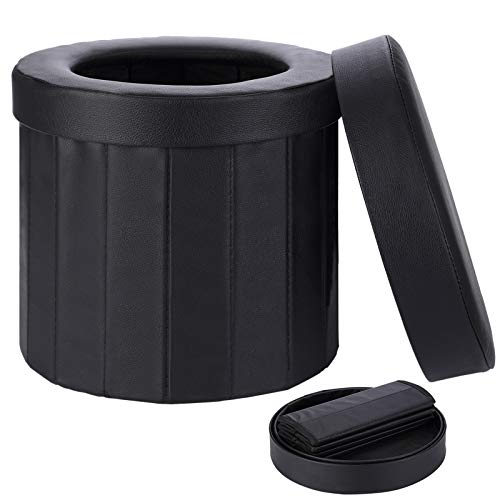
The TRIPTIPS foldable portable toilet is the budget pick in this roundup, and it is the right choice when weight and packed size matter more than a flush. It is a folding frame toilet that packs down to two inches thick, which means it slides into a car trunk, a roof box, or a storage tote without taking the space a cassette toilet needs. It sets up in seconds and folds down just as fast.
The frame is height-adjustable and comes in an extra-large size with a 13-inch seat height, which gives a more comfortable sitting position than a low folding stool. The toilet works with standard 6 to 8 gallon waste bags, so there is no tank to empty and no chemical to dose: line the frame with a bag, use it, seal the bag, and carry it out. That routine suits short trips, roadside stops, and camps where a dump station is not nearby, as long as local rules allow sealed bags in regular trash.
The folding design is the whole point. A cassette toilet is a fixed box that needs a fixed space in the vehicle, while this toilet folds flat and can be stored under a seat or behind a storage bin. For overlanders, solo campers, and families who need a backup toilet for the kids, that packed size is worth more than a flush. The frame is sturdy enough for adults and children, and the elongated seat shape gives more sitting room than a small round folding seat.
The trade-off is clear: there is no flush, no fresh-water tank, and no level indicator. The bowl does not rinse itself, so the user relies on the bag for hygiene and on a sealed bag for odor control. Campers who want a home-like experience should choose one of the cassette picks above. Campers who want the lightest, smallest toilet that still gives a real seat will find this one hard to beat, and its low packed weight makes it the only pick here that fits comfortably in a hiking pack or a motorcycle pannier.
This is a budget pick that earns its place on portability alone. It suits solo hikers, overlanders, festival campers, and families who want a spare toilet for emergencies. It is less suited to a week-long basecamp where a flush toilet would be used many times a day, and to campers who want a sealed tank rather than a bag-based routine.
Specs
- Type: Foldable portable toilet with waste bags
- Folded thickness: 2 inches
- Seat height: 13 inches, extra-large size
- Height: Height-adjustable frame
- Waste bags: Compatible with 6 to 8 gallon bags
- Setup: Sets up and folds down in seconds
- Included: Waterproof handy bag
- Use: Camping, car trips, hiking, boating, and road trips
- Group: Budget
Side-by-Side Comparison
The five picks cover the full range of camping toilets, and the right one depends on the trip rather than on a single best model. The Camco 41541 is the reliable middle ground: a 5.3-gallon cassette toilet with a bellows flush and a detachable tank, suited to car camping and family trips. The SereneLife toilet adds a carry bag and a level indicator to the same 5.3-gallon cassette shape, which makes it the most pack-ready of the flush models. The Thetford Porta Potti 365 steps up to a 5.5-gallon waste tank, a 4-gallon fresh-water tank, and a piston flush with a 16.3-inch seat, which makes it the most home-like pick here. The Alpcour toilet matches the 5.3-gallon cassette shape but adds a full-circle washing sprayer and an anti-leak drain valve, which makes it the easiest to keep clean. The TRIPTIPS folding toilet is the outlier: no flush and no tank, but a frame that folds to two inches thick and works with standard waste bags, which makes it the lightest and smallest option by a wide margin.
Tank size is the first filter. The cassette models all sit close together, between 5.3 and 5.5 gallons of waste capacity, so the choice between them turns on the flush, the seat, and the cleaning features rather than on capacity. The folding toilet has no tank at all, so its capacity is the number of bags packed for the trip, which is a different kind of planning.
Flush style is the second filter. The Camco 41541 uses a bellows flush, which is the simplest and most reliable style here. The Thetford Porta Potti 365 and the Alpcour toilet use piston pump flushes, which deliver a stronger rinse. The SereneLife toilet uses a pump flush rated for more than fifty uses per fresh-water fill. The TRIPTIPS toilet has no flush, which is a real trade-off in exchange for its folded size.
Cleaning is the third filter. The Alpcour sprayer leads here, followed by the piston flush models, which rinse the bowl more thoroughly than a bellows flush. The SereneLife and Camco models clean well with a brush and a rinse, and the TRIPTIPS toilet avoids bowl cleaning entirely by using a fresh bag for each stretch of use.
Weight and packed size are the final filter. The cassette models weigh between about eleven and fourteen pounds empty, and they all need a fixed space in the vehicle. The TRIPTIPS toilet weighs far less and folds to two inches thick, which is why it is the only pick here for hikers and motorcycle campers. Campers who drive to a site and stay for days should choose on flush and seat comfort; campers who carry everything on foot should choose on weight and folded size.
Frequently Asked Questions
How do I empty a portable camping toilet?
Close the slide valve, separate the waste tank from the seat section, and carry the tank to a dump station or a chemical disposal point. Open the vent, rotate the pour-out spout over the disposal inlet, and pour slowly. Rinse the tank with clean water, close the cap, and reattach it to the seat section. Never empty chemical toilet waste into a storm drain, a watercourse, or onto open ground.
How long does a five-gallon waste tank last?
A tank of around five gallons serves two people for about two to three days of regular use. Solo campers can stretch that further, while a family of four will need to empty more often. A level indicator helps with timing, and emptying a half-full tank is easier than carrying a full one, so plan emptying stops into the route rather than waiting for the tank to fill completely.
Do I need chemicals in a portable camping toilet?
Cassette toilets work best with toilet chemicals made for the waste tank, which break down waste and control odor, and some models also use a chemical in the fresh-water tank. Follow the chemical maker’s dosing guide for the tank size, and never mix different chemical types in the same tank. Folding bag toilets do not need chemicals, since the waste goes into a sealed bag.
Can I use a portable camping toilet inside a tent?
A portable toilet can be used inside a large tent vestibule or a dedicated privacy shelter, as long as there is room to open the lid fully and to pull the waste tank out for emptying. Keep the toilet on level ground, close the slide valve between uses, and keep the area ventilated. A small privacy shelter gives more room and more comfort than a tent vestibule, and it keeps the toilet out of the sleeping area.
Conclusion
The best portable camping toilets make a campsite feel like a basecamp rather than a rough stop. A cassette toilet with a waste tank of around five gallons, a manual flush, and a level indicator covers most camping, and the Camco 41541 is the straightforward pick in that shape. Campers who want a pack-ready kit should look at the SereneLife toilet with its carry bag, while campers who want the strongest flush and the tallest seat should look at the Thetford Porta Potti 365. The Alpcour toilet is the pick for campers who put bowl cleaning first, thanks to its full-circle washing sprayer and anti-leak drain valve. Campers who count every pound and every inch should take the TRIPTIPS folding toilet, which packs to two inches thick and works with standard waste bags.
Match the toilet to the trip: a flush cassette model for car camping and family stays, a premium piston-flush model for long basecamps, and a folding frame for light travel and backup use. Practice the emptying routine at home with clean water, pack the right chemicals and bags, and confirm a legal disposal point on the route before leaving. With those steps handled, the toilet stops being a worry and becomes one more piece of camp kit that simply works.
Product and ASIN Reference
| Product | ASIN |
|---|---|
| Camco Portable Toilet 41541 | B004SFKJIQ |
| SereneLife Portable Toilet | B07218B4DQ |
| Thetford Porta Potti 365 | B07CHVQ3RM |
| Alpcour Portable Toilet | B07RP2TVNH |
| TRIPTIPS Foldable Portable Toilet | B07DZS5XRY |