Key takeaways
- Compare the best camping stoves for backpacking and car camping, from ultralight canister burners to two-burner propane stoves, and pick the right one.
A good camping stove decides whether dinner at camp feels like a pleasure or a chore. The best camping stoves boil water fast, hold a steady simmer, pack down small enough to carry without complaint, and keep working when the wind picks up or the temperature drops. The wrong one leaves you waiting beside a sputtering flame while daylight fades and everyone gets hungry.
The short answer is that there is no single stove that fits every trip. A solo backpacker counting every gram needs something very different from a family cooking breakfast for six at a drive-up campsite. Canister stoves win on weight and simplicity, integrated systems win on speed and wind resistance, and two-burner propane stoves win on cooking space and versatility. This guide covers all three styles, explains how to match a stove to your trip, and compares five proven models across the budget, mid-range, and premium groups so you can choose with confidence.
As an Amazon Associate, we earn from qualifying purchases.
Table of Contents
- How to Choose a Camping Stove
- Fuel Types Explained
- Burner Count and Cooking Space
- Output, Boil Time, and Simmer Control
- Weight and Pack Size
- Ignition and Wind Performance
- MSR PocketRocket 2
- SOTO WindMaster with 4Flex
- Jetboil Flash Camping Stove Cooking System
- Coleman Classic Propane Stove, 2-Burner
- Coleman Fold N Go 2-Burner Propane Stove
- Camping Stoves at a Glance
- Common Mistakes to Avoid
- Frequently Asked Questions
- Conclusion
- Product and ASIN Reference
How to Choose a Camping Stove
Start with the trip, not the stove. A stove that is perfect for a weekend at a lakeside campground can be a poor choice for a five-day trek through the mountains, and the lightest backpacking burner on the market will frustrate a cook who wants to fry bacon and simmer sauce at the same time. Work through the questions below before comparing models, and the right category usually reveals itself.
First, how are you getting to camp? If you are carrying everything on your back, weight and packed size matter more than anything else. A canister stove that weighs less than three ounces and folds down to the size of a small pocket knife earns its place easily. If you are driving to a campsite and unloading from a car, weight barely matters, and a sturdy two-burner stove with a wide cooking surface is the better tool. Car campers can afford the bulk of a propane stove and a separate fuel cylinder because the car does the carrying.
Second, how many people are you cooking for? One or two people can share a single burner and a single pot without much friction. Three or more people, or anyone planning real meals rather than just boiling water for dehydrated food, will appreciate a second burner. Two burners let you boil water on one side while cooking on the other, which cuts the total time to get a meal on the table and keeps food warm while the next course cooks.
Third, what are you actually cooking? Boiling water for coffee, oatmeal, and rehydrated meals asks very little of a stove. The flame only needs to be strong and steady for a few minutes. Frying, sauteing, and simmering ask much more. A stove with fine flame control and a wide burner head spreads heat evenly and keeps food from scorching in the middle while the edges stay cool. Narrow, focused burners boil fast but cook unevenly, so they suit water boiling far better than pan frying.
Fourth, what conditions will you face? Wind is the enemy of every camp stove. An exposed flame loses heat fast, burns more fuel, and takes far longer to boil water. If you camp in open, windy places, look for a stove with a sheltered burner head, a built-in windscreen, or a design that sits the pot close to the flame. Cold weather matters too. Standard canister fuel loses pressure as the canister cools and empties, so a stove with a pressure regulator holds its output steady late in a canister’s life and on chilly mornings.
Finally, how much fuss are you willing to tolerate? Some stoves light with a push button and simmer with a twist of a valve. Others need a separate lighter, a careful hand on the valve, and a windscreen you set up yourself. Neither approach is wrong, but the simpler stove gets used more often and causes fewer headaches at the end of a long day on the trail.
Fuel Types Explained
Most camping stoves in this guide run on one of two fuel families, and the choice shapes everything from weight to cold-weather performance.
Canister fuel is a sealed, self-pressurizing mix of isobutane and propane in a threaded metal canister. You screw the stove directly onto the canister, open the valve, and light it. There is no pumping, no priming, and no liquid fuel to spill. Canisters are sold in several sizes, and the same threaded fitting works across most brands, which makes it easy to buy fuel in trail towns and outdoor shops. The trade-off is cold weather. As the canister empties and the temperature drops, pressure falls and the flame weakens. A regulated stove compensates for this, while an unregulated stove simply burns lower and slower. Empty canisters must be packed out, and in some regions they must be punctured and recycled rather than thrown away.
Propane from a standard 16.4-ounce cylinder is the fuel of the classic two-burner camp stove. The cylinders are widely available at hardware stores, grocery stores, and campgrounds, and they hold enough fuel for several meals. Propane performs well in cool weather and delivers strong, steady output for big pots and long cooking sessions. The cost is bulk. A steel cylinder plus a two-burner stove is a car-camping setup, not a backpacking one, and the cylinder must be stored upright and kept away from heat.
A few stoves accept both butane cartridges and propane cylinders with an adapter. Dual-fuel designs are handy for emergency kits and for trips where fuel availability is uncertain, but they add parts to keep track of, and the adapter must match the stove exactly.
Whichever fuel you choose, always cook outside or in a well-ventilated shelter. Burning fuel produces carbon monoxide, and a stove should never be used inside a closed tent, a vehicle, or a garage. Keep fuel canisters and cylinders away from the flame, out of direct sun, and upright during use and storage.
Burner Count and Cooking Space
A single burner is the right call for solo travelers and couples who mostly boil water. It keeps the stove light, simple, and cheap, and it packs into a cook pot or a jacket pocket. The limitation is obvious: one pot at a time. If your meal needs two pots, you cook in sequence, and the first dish cools while the second cooks.
Two burners change the rhythm of camp cooking entirely. You can boil pasta water while a sauce simmers, or fry eggs while coffee brews. The cooking surface is wider, the grates are sturdier, and the stove can hold a 12-inch pan beside a 10-inch pan at the same time. That capacity is what makes a two-burner stove the default for family camping, group trips, and anyone who enjoys cooking outdoors rather than merely reheating.
Integrated stove systems are a third shape. The burner and the cooking cup are designed as one unit, with a heat exchanger ring on the bottom of the cup that captures heat the open flame would waste. The result is very fast boiling and strong wind resistance in a package that nests together for packing. The trade-off is flexibility. The system works best with its own cup, and it is a water boiler first and a general cooker second, though a separate pot support accessory opens up more options.
Output, Boil Time, and Simmer Control
Output is usually stated in BTU per hour, and higher numbers mean more heat. Two-burner propane stoves commonly offer around 20,000 BTU across both burners, which is ample for large pots and group meals. Backpacking canister stoves range lower, and their headline number matters less than how much of that heat actually reaches the pot. A sheltered burner that holds its flame in wind often outperforms a stronger burner that loses heat to every gust.
Boil time is the most quoted figure for backpacking stoves, and it is useful as a comparison as long as you remember it is measured under controlled conditions. Altitude, wind, water temperature, and pot shape all change the result. A stove that boils half a liter in under two and a half minutes in a lab will take longer on a windy ridge with cold water. Treat boil times as a ranking tool, not a promise.
Simmer control separates the stoves that only boil from the stoves that truly cook. A valve that adjusts smoothly from a rolling boil down to a gentle simmer lets you cook rice without burning it, melt cheese without scorching it, and keep a sauce warm without constant attention. When you read a listing, look for mentions of precise flame adjustment and simmer capability rather than raw output alone.
Weight and Pack Size
Backpacking stoves live or die by weight. The lightest canister burners weigh about two and a half ounces and fold down to a bundle roughly two inches on a side, small enough to nest inside a cook pot with a small fuel canister. At that weight, the stove effectively disappears into the pack, and the fuel canister becomes the heavier part of the cooking kit.
Integrated systems weigh more, usually around thirteen ounces for the complete system including the cup, lid, and stabilizer. That is still light for what it does, and because the parts nest together, the packed volume stays small. The weight buys speed and wind resistance, which matters on trips where a fast hot drink at the end of a cold day is worth carrying a few extra ounces.
Two-burner propane stoves weigh around eleven to twelve pounds and fold into a slim case about the size of a briefcase. That sounds heavy until you remember they travel in a car, where weight is nearly irrelevant. What matters for car camping is the folded size, the sturdiness of the latches, and whether the stove sits level on a picnic table.
Ignition and Wind Performance
Push-button ignition is a small feature that makes a real difference. A built-in igniter means you never have to dig out a lighter with cold hands, and it keeps working in damp conditions where matches struggle. Stoves without an igniter are lighter and simpler, with one less part that can fail, but they demand a lighter or matches every time you cook. Most experienced campers carry a lighter as a backup either way.
Wind performance is harder to judge from a listing, so look for the design clues. A concave burner head with a raised rim shelters the flame. A pot that sits close to the flame loses less heat. A pressure regulator keeps output steady as the canister cools. A windscreen helps, but it must be used with care around canister stoves, because enclosing a fuel canister can trap heat where it does not belong. The safest wind protection for a canister stove is a low screen that blocks the breeze without wrapping the canister, plus a sheltered cooking spot behind a rock, a log, or the lee side of the tent vestibule.
MSR PocketRocket 2

The MSR PocketRocket 2 is the classic ultralight canister stove, and it has earned its reputation by doing one thing extremely well: disappearing into a pack and then boiling water fast when it is needed. It is the stove to choose when every gram matters and the menu is simple.
The stove weighs 2.6 ounces on its own and 4.2 ounces inside its included hard-shell carry case. It folds down to a bundle about two inches by two inches by three inches, and it opens to a stable platform about 4.8 inches across. That size lets it nest inside a cook pot, slip into a hip-belt pocket, or ride in the top lid of a pack without claiming space from anything else.
On the trail, the PocketRocket 2 screws onto a standard threaded isobutane-propane canister and lights with a match or lighter, since it has no built-in igniter. The valve adjusts smoothly from a simmer to a rolling boil, and the burner brings a liter of water to a boil in about three and a half minutes under the maker’s test conditions. Three folding pot supports grip pots and mugs securely, and a wind clip on the burner helps the flame hold in a light breeze.
The stove’s simplicity is its strength and its limit. With no igniter and no regulator, it depends on a lighter and on a canister with healthy pressure. In cold weather or with a nearly empty canister, the flame weakens, so the stove suits three-season trips and moderate conditions best. For fast-and-light hiking, weekend backpacking, and travel where a tiny stove earns its keep, it is hard to beat.
Budget group. Best for solo backpackers and ounce counters who mainly boil water and want the smallest capable stove available.
Specs
- Fuel: isobutane-propane canister, not included
- Weight: 2.6 ounces, 4.2 ounces with included hard-shell case
- Packed size: about 2 x 2 x 3 inches
- Open size: about 4.8 x 4.8 x 3.6 inches
- Boil time: about 3.5 minutes for one liter
- Ignition: manual, lighter or matches required
- Pot supports: three folding serrated supports
- Warranty: 3-year limited manufacturer warranty
SOTO WindMaster with 4Flex
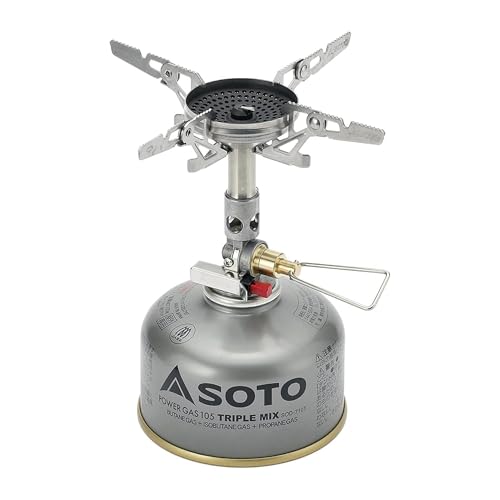
The SOTO WindMaster is the stove to pick when the weather is part of the plan. It is built around wind resistance and steady output, and it keeps boiling when simpler stoves fade in gusts and cold mornings.
The heart of the WindMaster is a concave burner head with a raised rim. The pot sits close to the flame inside that sheltered bowl, so gusts have less flame to grab and less heat to steal. A micro regulator holds the output steady as the canister cools and empties, which is exactly when unregulated stoves start to struggle. The stove is rated at 11,000 BTU, or 3,260 watts, and it burns for about an hour and a half on an 8-ounce canister.
The version covered here comes with the 4Flex pot support, a four-armed support that holds larger cookware steady. The stove itself weighs 67 grams, and the weight with the 4Flex support fitted is 87 grams, or about three ounces. A stealth igniter sits inside the burner post, shielded from knocks inside a packed cook kit, so the stove lights with a push even after a rough day on the trail. The maker states a boil time of under two and a half minutes for two cups of water in strong wind, which is the figure that matters most to a backpacker cooking in exposed country.
The WindMaster runs on butane, isobutane, and propane mixes in standard threaded canisters, and the maker is explicit that straight propane is not to be used. A narrower TriFlex support for smaller pots is sold separately, which is worth knowing if your kit is built around a small mug or a narrow pot. The stove also carries a stated limit of a two-liter pot and one and a half liters of liquid, so it is a personal and duo cooking tool rather than a group kitchen.
For hikers who camp on ridges, in open country, or late in the season, the WindMaster is the most weather-capable canister stove in this guide. It costs more than the simplest ultralight burners and weighs a little more than the lightest of them, but it pays that back every time the wind rises and dinner still arrives on schedule.
Mid-range group. Best for backpackers who camp in wind and cold and want regulated output with a built-in igniter.
Specs
- Fuel: butane, isobutane, and propane mixes in threaded canisters, not included
- Output: 11,000 BTU, 3,260 watts
- Weight: 67 grams stove only, 87 grams with 4Flex support
- Boil time: under 2.5 minutes for two cups of water in strong wind
- Burn time: about 1.5 hours on an 8-ounce canister
- Ignition: built-in stealth igniter inside the burner post
- Pot support: 4Flex included, TriFlex sold separately
- Fuel warning: do not use with straight propane
Jetboil Flash Camping Stove Cooking System

The Jetboil Flash is an integrated stove system built for one job above all others: boiling water as fast as possible, in any weather, with the least fuss. If your trail meals are coffee, oatmeal, soup, and rehydrated dinners, the Flash is the most convenient tool in this guide.
The system pairs a burner with a one-liter insulated cooking cup that carries a FluxRing heat exchanger on its base. The ring captures heat that an open flame would lose to the air, and the cup’s insulating cozy keeps the water hot after the flame is out. The whole system weighs 13.1 ounces and nests together for packing: the burner, the fuel canister stabilizer, and a small canister all fit inside the cup, with the lid on top.
Lighting is a single push of the built-in igniter, and the maker claims a 100-second boil for half a liter of water. A thermochromatic heat indicator on the side of the cup changes color as the water heats, so you can tell at a glance when it is ready without lifting the lid. The cup’s drinking lid and measuring marks make it easy to pour without spilling, and the bottom cover doubles as a small bowl or measuring cup.
The Flash is a water boiler first. It simmers less gracefully than a wide canister burner, and it works best with its own cup, though a separate pot support accessory lets it take other pots. For backpackers who want the fastest possible hot drink and the simplest possible cooking routine, that trade is an easy one. It is also a strong choice for two people sharing drinks and simple meals, since a liter of boiling water covers two mugs of coffee or two rehydrated meals with one burn.
Premium group. Best for backpackers and fast packers who want the quickest boils and a self-contained system.
Specs
- System type: integrated burner and cooking cup
- Cup capacity: 1 liter, FluxRing heat exchanger base
- System weight: 13.1 ounces
- Boil claim: 100 seconds for half a liter of water
- Ignition: push-button auto igniter
- Heat indicator: thermochromatic color-change band on cup
- Included: burner, 1-liter cup with cozy and lid, fuel canister stabilizer, bottom cover
- Fuel: propane and isobutane canister, not included
Coleman Classic Propane Stove, 2-Burner
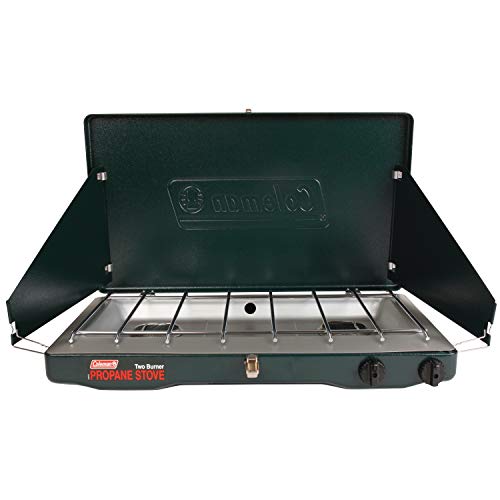
The Coleman Classic is the stove that has fed generations of car campers, and it remains the default two-burner propane stove for a reason. It is sturdy, simple, and roomy, and it turns a picnic table into a real kitchen.
Two independently adjustable burners deliver 20,000 BTU of total cooking power, with each burner adjustable from a low simmer to full heat. The cooking surface fits a 12-inch pan and a 10-inch pan at the same time, so a full breakfast or a two-pot dinner cooks side by side instead of in sequence. A removable chrome-plated grate lifts out for cleaning, and the aluminized steel cooktop resists rust through seasons of outdoor use.
Coleman fits the Classic with its PerfectFlow pressure regulator, which is designed to hold performance steady even when conditions turn rough. Adjustable WindBlock panels fold up around the burners to shield the flame, and they fold down into the lid for transport. The lid latches shut, and a handle makes the folded stove easy to carry from the car to the table. Closed, the stove measures about 13.7 inches by 21.9 inches by 4.1 inches.
The stove runs on a standard 16.4-ounce propane cylinder, sold separately. With both burners on high, one cylinder lasts up to about an hour, and far longer at the moderate settings most cooking actually uses. There is no push-button igniter on this model, so a lighter or matches are part of the kit. The stove weighs just under twelve pounds, which is a non-issue at a drive-up site and the reason it stays home on a backpacking trip.
For family camping, group trips, tailgating, and anyone who wants to cook real meals outdoors, the Classic is the workhorse of this guide. It is the least expensive way to get two full-size burners and a wide cooking surface, and its long production history means parts and know-how are easy to find.
Budget group. Best for car campers and families who want a roomy two-burner stove at a modest cost.
Specs
- Burners: 2 independently adjustable burners
- Total output: 20,000 BTU
- Cooking space: fits a 12-inch pan and a 10-inch pan at the same time
- Regulator: PerfectFlow pressure regulator
- Wind protection: adjustable WindBlock panels
- Cooktop: aluminized steel, rust-resistant, removable chrome-plated grate
- Fuel: standard 16.4-ounce propane cylinder, not included
- Run time: up to about 1 hour with both burners on high
- Closed size: about 13.7 x 21.9 x 4.1 inches
- Weight: just under 12 pounds
Coleman Fold N Go 2-Burner Propane Stove

The Coleman Fold N Go takes the two-burner propane formula and adds two conveniences that matter at a crowded campsite: instant ignition and a folding design that packs away neatly when the meal is done.
Like the Classic, the Fold N Go offers two independently adjustable burners with 20,000 BTU of total cooking power, so it handles large pots, group meals, and two dishes at once. The difference is in the details. InstaStart push-button ignition lights each burner without a lighter, which is a genuine help when hands are cold or the wind is up. The stove folds for storage and transport, with a handle that makes it easy to carry, and the folding design keeps its footprint small in a packed car or a storage tote.
The Fold N Go suits campers who like the Classic’s cooking capacity but want a quicker setup and a tidier pack-down. It is equally at home at a drive-up campsite, a tailgate, or a backyard cookout, and its two burners make it a practical choice for families who cook full meals outdoors. As with every propane stove, it runs on a standard propane cylinder, needs ventilation and open air, and should never be used inside a tent or an enclosed space.
Mid-range group. Best for car campers who want two-burner cooking with push-button ignition and a folding, easy-to-store body.
Specs
- Burners: 2 independently adjustable burners
- Total output: 20,000 BTU
- Ignition: InstaStart push-button ignition
- Design: folding body with carry handle for compact storage
- Fuel: propane cylinder, not included
- Use: outdoor use only, with ventilation
Camping Stoves at a Glance
The five stoves in this guide fall into three clear styles. The ultralight canister burners, the PocketRocket 2 and the WindMaster, are the backpacking tools. They weigh almost nothing, pack into a pot, and run on threaded fuel canisters. Between the two, the PocketRocket 2 is the lighter and simpler choice, while the WindMaster is the weather-capable choice with a regulator and a built-in igniter.
The Jetboil Flash sits in its own lane as an integrated system. It weighs more than a bare burner but boils water faster than anything else here, and its nesting design keeps the packed size small. It is the best pick when speed and convenience outrank cooking versatility.
The two Coleman stoves are the car-camping tools. Both offer two burners and 20,000 BTU of total output, and both cook for a group. The Classic is the simpler, proven workhorse, while the Fold N Go adds push-button ignition and a folding body for easier storage. Either one turns a campsite into a kitchen, and the choice between them comes down to whether instant ignition and the folding design are worth the step up.
A practical way to decide is to count the people and the miles. One or two people and miles on foot point to a canister burner or an integrated system. Three or more people and a car point to a two-burner propane stove. If you do both kinds of trips, many campers end up owning one of each: a tiny canister stove for the trail and a two-burner stove for the car.
Common Mistakes to Avoid
The most common mistake is buying a stove for the trip you imagine rather than the trips you actually take. A big two-burner stove gathers dust if you mostly hike solo, and a tiny burner frustrates a family of five at a campground. Match the stove to your real pattern, not an aspirational one.
The second mistake is forgetting fuel. Canister stoves and propane stoves alike are useless without the right fuel, and fuel is not always sold where you expect it. Check your canister or cylinder before you leave, carry a spare on longer trips, and know where you can buy more along the route.
The third mistake is cooking in the wind without a plan. Even a sheltered burner loses efficiency in a strong breeze. Pick a cooking spot out of the wind, behind a rock or a vehicle, and give the stove a windscreen or a WindBlock panel where the design allows it. Never fully enclose a fuel canister with a windscreen, and never cook inside a closed tent.
The fourth mistake is ignoring simmer control. A stove that only knows full blast will burn rice, scorch sauces, and turn a relaxed camp meal into a rescue operation. If you cook real food, test the low end of the valve at home before you depend on it in the field.
The fifth mistake is skipping the practice run. Every stove has its own quirks: how the valve responds, how the igniter behaves, how the pot sits on the supports. A trial run at home, with the pots and fuel you will actually carry, reveals all of it before you are hungry, tired, and miles from the nearest shop.
Frequently Asked Questions
What is the best camping stove for backpacking?
For most backpackers, a light canister stove is the best choice, and the decision comes down to conditions. The MSR PocketRocket 2 is the lightest and simplest option for fair-weather trips, while the SOTO WindMaster is the better pick for wind, cold, and exposed campsites thanks to its regulator and sheltered burner head. If speed matters most and your meals are mainly boiled water, the Jetboil Flash integrated system boils fastest and packs as a single nested unit.
Can I use a camping stove inside a tent?
No. Camping stoves should only be used outdoors or in a well-ventilated open shelter. Burning fuel produces carbon monoxide, which is colorless and odorless and can build up to dangerous levels in an enclosed space. Cook outside the tent, keep the stove away from tent walls and sleeping gear, and store fuel canisters and cylinders outside the sleeping area.
How much fuel will I need for a weekend trip?
It depends on the stove, the group size, and the menu. A small threaded canister typically covers a weekend of boiling water for one or two people, while a group cooking full meals will go through fuel faster. A standard 16.4-ounce propane cylinder on a two-burner stove lasts up to about an hour with both burners on high and considerably longer at moderate settings. Carry a spare canister or cylinder on longer trips, and check fuel levels before you leave home.
Do I need a windscreen for a canister stove?
A windscreen helps a great deal in open country, but it must be used with care. A low screen that blocks the breeze without wrapping the fuel canister is the safe approach, and a sheltered cooking spot matters just as much. Never fully enclose a canister stove and its fuel canister inside a windscreen, because trapped heat around the canister is a safety risk. Stoves with sheltered burner heads and regulators, like the WindMaster, handle wind better without extra gear.
Conclusion
The best camping stove is the one that fits your trip, your group, and your cooking style. Backpackers who count grams will love the MSR PocketRocket 2 for its featherweight simplicity, and those who camp in wind and cold will get more from the regulated, sheltered SOTO WindMaster. Travelers who want the fastest hot water with the least fuss should look at the Jetboil Flash, which boils quickly and packs as one tidy unit. Car campers cooking for a family or a group will be happiest with a two-burner propane stove, and the Coleman Classic delivers that capacity at a modest cost, while the Coleman Fold N Go adds push-button ignition and a folding body for easier storage.
Start with how you travel, how many people you feed, and what you cook, then choose the style that matches. Buy the fuel before you leave, practice with the stove at home, and pick a sheltered spot to cook. Do that, and whichever of these five stoves you choose will serve you well for many trips to come.
Product and ASIN Reference
| Product | ASIN |
|---|---|
| MSR PocketRocket 2 | B01N5O7551 |
| SOTO WindMaster with 4Flex | B07R7BZCB3 |
| Jetboil Flash Camping Stove Cooking System | B0753NBMJ5 |
| Coleman Classic Propane Stove, 2-Burner | B00005OU9D |
| Coleman Fold N Go 2-Burner Propane Stove | B000F7T2MU |